Financial Management: DOD Needs to Improve System Oversight

Financial Management: DOD Needs to Improve System Oversight

What GAO Found

For over 30 years, the Department of Defense (DOD) has initiated a variety of efforts and undergone several changes in organizational responsibility to help modernize its business and financial systems. However, these efforts and changes have not been fully successful to date. DOD is the only major federal agency to not achieve an unmodified (clean) audit opinion—its business and financial systems are a key impediment to this effort.

Effective oversight of systems is essential to moving DOD in the right direction. Key elements of such oversight include establishing oversight processes, using and communicating quality information, sustaining leadership commitment, and managing risk.

  • Oversight processes. DOD has established a process for overseeing its business and financial management systems. First, systems are not to proceed into development unless the approving official determines that statutory requirements have been met. These requirements are that the system (1) has been reengineered and streamlined, and unique software requirements and interfaces minimized, (2) complies with the defense business enterprise architecture, (3) has valid, achievable requirements, (4) has an acquisition strategy designed to eliminate or reduce the need to modify commercial off-the-shelf systems, and (5) complies with the Department’s auditability requirements. Second, once approved, systems proceed through an annual certification process in which DOD checks to make sure that systems are continuing to meet the requirements. However, the key guidance documents that govern DOD, military department, and defense agency decisions about initial approvals and annual certifications are limited. Specifically, the guidance does not fully address how systems are to document compliance or how decision-makers are to substantiate that systems are complying with requirements. For example, DOD-level guidance does not describe how approval authorities are to determine compliance with the auditability requirement. This places DOD at risk of making decisions based on a “check the box” exercise.

Extent to Which DOD, Military Department, and Defense Agency Guidance Addresses Initial Approval and Annual Certification Requirements for Covered Business Systems

Initial approval and Annual certification requirement

DOD

Army

Department of the Navy

Air Force

Defense Agencies

Business process reengineering

Business enterprise architecture

Requirement plan

Acquisition strategy

Auditability requirement

Legend:

● = Fully addressed: Guidance explains how systems are to address and decision-makers are to substantiate the initial approval and annual certification requirements.

◑ = Partially addressed: Guidance discusses at least one of the initial approval and annual certification requirements, but does not fully describe how systems are to address and decision-makers are to substantiate the requirements.

○ = Not addressed: Guidance does not discuss the requirements.

Source: GAO Analysis of Department of Defense (DOD) documentation. | GAO-23-104539

In addition, DOD does not apply key requirements to systems in sustainment, even though the statute does not provide for such an exclusion. By excluding application of these requirements, DOD may be missing important opportunities for improving these systems.

  • Quality information. As part of its oversight, DOD collects data about business and financial system compliance with statutory requirements. For example, of the 136 systems that indicated the auditability requirement was applicable or required, 84 indicated they were compliant with the requirement, 44 indicated they planned to comply, three indicated they were not compliant, and five indicated they had not completed an assessment.

Summary of DOD’s Data on Business System Compliance with Statutory Requirements

Compliance response

Business process reengineering

Business enterprise architecture

Requirement plan

Acquisition Strategy

Auditability

Compliance required or applicablea

189

192

66

67

136

No answer

1

1

1

1

1

Not required (Legacy system)b

18

15

21

20

Not required (System in sustainment)c

120

120

Not applicable

71

Total

208

208

208

208

208

Legend:

– = no responses under the specified category.

Source: GAO Analysis of Department of Defense (DOD) documentation. | GAO-23-104539

aSystems indicated that compliance with the requirement was required or applicable.

bDOD defines legacy systems as systems that it plans to phase out over the next 36 months. It does not require legacy systems to comply with certain requirements.

cDOD does not require systems that have proceeded past the development phase (i.e., systems in sustainment) to comply with selected requirements.

However, the reliability of these data is limited. For example, of the 208 systems that DOD identified as relevant to the financial audit, information on 71 systems indicated that the auditability requirement was not applicable to them. However, a separate database indicated that at least 58 of these 71 were relevant to the audit. In addition, as of January 2022, DOD reported that its Independent Public Auditors had identified 1,411 unresolved IT-related notices of findings and recommendations associated with 3,478 underlying IT-related issues. These results raises further questions about data reliability, which may also impact the extent of compliance with statutory requirements.

  • Leadership. DOD has experienced frequent changes to the organizations and entities responsible for overseeing its business and financial systems. For example, in February 2018 a new Chief Management Officer position was established with broad responsibilities for business operations; three years later the position was abolished. GAO has previously reported that demonstrating sustained, consistent leadership is imperative for successful business transformations.
  • Managing risk. Officials from across DOD provided their perspectives on risks and challenges facing the department as it seeks to modernize its financial system environment. These include legacy systems, system interfaces, and human capital. DOD has taken a number of steps to address risks and challenges identified by DOD officials. GAO will continue monitoring DOD’s efforts in this area.

In addition, DOD is not taking a strategic approach to managing the human capital needed for its financial management systems. It does not, among other things, analyze the gaps in capabilities between existing staff and future workforce needs, or formulate strategies for filling expected gaps. As a result, as discussed in the report, challenges have emerged.

Why GAO Did This Study

DOD spends billions of dollars each year on its business and financial systems. However, DOD’s business systems modernization and financial management efforts have been on GAO’s high risk list since 1995. These high risk areas remain obstacles to DOD’s efforts to achieve an unmodified audit opinion.

GAO was asked to review DOD’s financial management systems. This report (1) describes DOD’s efforts to improve its business and financial systems; (2) assesses the extent to which DOD is effectively overseeing its business and financial systems; and (3) assesses the extent to which DOD is taking a strategic approach to managing human capital for its financial management systems.

To describe DOD’s efforts to improve its business and financial systems, GAO reviewed related laws, GAO reports, and DOD and military department documentation associated with DOD’s business and financial systems.

To assess DOD’s oversight of these systems, GAO reviewed reports, guidance, and relevant statutes to identify key elements of business and financial management systems oversight. GAO evaluated DOD policy and DOD, military department, and defense agency guidance and plans against statutory requirements for oversight. It also evaluated DOD’s data on its systems’ compliance with statutory requirements associated with improving the department’s ability to obtain an unmodified audit opinion.

GAO also evaluated DOD and military department guidance and plans against key practices for workforce management. In addition, it interviewed relevant officials from DOD and the military departments
DOD Financial Management: Greater Attention and Accountability Needed over Government-Furnished Property

DOD Financial Management: Greater Attention and Accountability Needed over Government-Furnished Property

What GAO Located

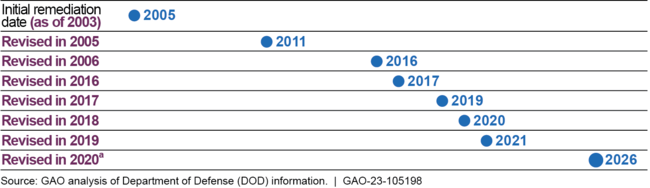
For several years, the Department of Protection (DOD) has struggled to properly account for authorities residence in the possession of contractors, known as federal government-furnished home (GFP). DOD has regularly revised its prepared dates to deal with a GFP-similar content weak point considering that auditors initial claimed it in 2001.

Department of Defense’s Revisions to Remediation Dates for Addressing the Govt-Furnished Residence (GFP) Materials Weak spot

Department of Defense's Revisions to Remediation Dates for Addressing the Government-Furnished Property (GFP) Material Weakness

DOD administration has issued multiple memorandums to remediate the very long-standing GFP-connected material weakness, including a Might 2019 memorandum that directed DOD parts to set up a baseline of GFP belongings. On the other hand, GAO uncovered that DOD did not accomplish its stated objective for the May well 2019 memorandum as a outcome of challenges with (1) an inefficient and incomplete preliminary memorandum distribution course of action, (2) confusion between division officials more than memorandum terminology, (3) components’ logistical struggles to determine and provide requested info, and (4) a absence of successful management review of the components’ development. Moreover, GAO determined problems with the Property Functional Council (Council), which DOD set up in part to oversee initiatives to tackle the substance weak spot. For case in point, the Council did not routinely focus on GFP or the Could 2019 memorandum, and did not regularly meet or incorporate all important participants when it did. Without having documented processes and methods for GFP-connected memorandum advice and the Council’s functions, DOD raises the risk that it will keep on to experience problems with its initiatives to remediate the GFP-related materials weak point.

Whilst DOD has taken measures to tackle the GFP-similar materials weak point, GAO found that division-huge attempts have not been in depth and adequately comprehensive. Creating a comprehensive section-broad strategy, individual from DOD’s overarching fiscal management technique, would guide the division in pinpointing root triggers of deficiencies with common remedies across the departments, and plainly defining specific treatments for reaching responsibilities and assembly concentrate on dates. Without having such a tactic, DOD is at an enhanced hazard that its endeavours to remediate the GFP content weak point will continue on to be inadequate and that it will proceed to skip or force again target remediation dates.

Why GAO Did This Examine

DOD’s lack of accountability around govt property in the possession of contractors has been documented by auditors for a long time. This prolonged-standing problem impacts the accounting and reporting of GFP and is 1 of the motives DOD is unable to generate auditable economic statements. DOD believed the value of its GFP at in excess of $220 billion nevertheless, that sum is very likely drastically understated.

This report, produced in connection with fulfilling GAO’s mandate to audit the U.S. government’s consolidated money statements, examines the (1) difficulties DOD has encountered in division-large attempts to tackle weaknesses associated to its accounting for GFP and (2) extent to which DOD has formulated a office-broad system to handle the GFP-relevant content weak point.

GAO reviewed related audit reports, memorandums issued by DOD administration, DOD system paperwork, and Council assembly documents interviewed officers and analyzed armed service section reports.

DOD Financial Management: Additional Actions Would Improve Reporting of Joint Strike Fighter Assets

DOD Financial Management: Additional Actions Would Improve Reporting of Joint Strike Fighter Assets
Department of Defense The Under Secretary of Defense for Acquisition and Sustainment together with the F-35 Program Executive Officer, and in coordination with the Under Secretary of Defense (Comptroller), should develop and document a comprehensive strategy to address the JSF material weakness. The strategy should include (1) complete, detailed procedures; (2) time frames based on an analysis of the time needed to accomplish the procedures; and (3) resources required to design and implement the procedures. (Recommendation 1)

Open

When we confirm what actions the agency has taken in response to this recommendation, we will provide updated information.

Department of Defense The Under Secretary of Defense for Acquisition and Sustainment together with the F-35 Program Executive Officer should develop and document a plan for verifying the completeness of JSF assets recorded in its APSR, including conducting an analysis and documenting the results on the feasibility of performing a wall-to-wall inventory to capture all JSF assets. (Recommendation 2)

Open

When we confirm what actions the agency has taken in response to this recommendation, we will provide updated information.

Department of Defense The Under Secretary of Defense for Acquisition and Sustainment together with the F-35 Program Executive Officer should develop procedures for performing physical inventories of JSF assets held at DOD and international partner facilities. To the extent that the procedures include the F-35 JPO relying on these facilities’ staff to perform the physical inventory counts, the office should develop and document a plan that describes how the F-35 JPO plans to review the results of these inventory procedures in order to verify the existence and completeness of the recorded amounts of JSF assets at these locations. (Recommendation 3)

Open

When we confirm what actions the agency has taken in response to this recommendation, we will provide updated information.

Department of Defense The Under Secretary of Defense for Acquisition and Sustainment together with the F-35 Program Executive Officer should develop procedures for performing periodic physical inventories once the initial inventory count has been completed, including how DOD will assess the resources and time needed to conduct the inventories and any sampling methodology intended to be used. (Recommendation 4)

Open

When we confirm what actions the agency has taken in response to this recommendation, we will provide updated information.

Department of Defense The Under Secretary of Defense for Acquisition and Sustainment together with the F-35 Program Executive Officer should develop procedures that outline the steps to periodically capture and verify the accuracy and completeness of JSF asset data from contractors and other DOD sources to be recorded in DPAS until a direct interface with the prime contractors’ systems has been established. (Recommendation 5)

Open

When we confirm what actions the agency has taken in response to this recommendation, we will provide updated information.

Department of Defense The Under Secretary of Defense for Acquisition and Sustainment together with the F-35 Program Executive Officer should finalize the business rules within DPAS to identify and populate default characters for missing data elements in JSF asset property records. (Recommendation 6)

Open

When we confirm what actions the agency has taken in response to this recommendation, we will provide updated information.

Department of Defense The Under Secretary of Defense for Acquisition and Sustainment together with the F-35 Program Executive Officer, and in consultation with the Under Secretary of Defense (Comptroller), should finalize and implement procedures to calculate deemed cost for all JSF assets that lack documentation of historical cost data. The procedures should include the preferred deemed cost valuation methodologies and steps to prepare and retain supporting documentation for all property records created using deemed cost. (Recommendation 7)

Open

When we confirm what actions the agency has taken in response to this recommendation, we will provide updated information.

Department of Defense The Under Secretary of Defense for Acquisition and Sustainment together with the F-35 Program Executive Officer should develop procedures to capture and record new JSF asset transactions and retain supporting documentation to support the recorded transactions after beginning balances are recorded using deemed cost. (Recommendation 8)

Open

When we confirm what actions the agency has taken in response to this recommendation, we will provide updated information.

Department of Defense The Under Secretary of Defense for Acquisition and Sustainment together with the F-35 Program Executive Officer should identify a complete list of JSF software applications that meet DOD’s reporting criteria. (Recommendation 9)

Open

When we confirm what actions the agency has taken in response to this recommendation, we will provide updated information.

Department of Defense The Under Secretary of Defense for Acquisition and Sustainment together with the F-35 Program Executive Officer should develop policies and procedures to record and report new JSF internal-use software development costs. (Recommendation 10)

Open

When we confirm what actions the agency has taken in response to this recommendation, we will provide updated information.

Department of Defense The Under Secretary of Defense for Acquisition and Sustainment together with the F-35 Program Executive Officer should analyze the significance of purchase-related subsequent transportation costs on financial reporting of JSF asset balances. As needed, the office should either document the decision and rationale for not capturing these costs or develop policies and procedures for capturing and recording JSF asset purchase-related subsequent transportation costs for financial reporting. (Recommendation 11)

Open

When we confirm what actions the agency has taken in response to this recommendation, we will provide updated information.

Department of Defense The Under Secretary of Defense for Acquisition and Sustainment, in collaboration with the Under Secretary of Defense (Comptroller), should determine and document whether information on joint programs needed for reporting purposes is sufficiently maintained and whether a central data source and standard definition would be appropriate to help ensure consistent, complete, and accurate tracking, recording, and reporting of joint program information. (Recommendation 12)

Open

When we confirm what actions the agency has taken in response to this recommendation, we will provide updated information.

DOD Financial Management: Air Force Needs to Improve Its System Migration Efforts

DOD Financial Management: Air Force Needs to Improve Its System Migration Efforts

What GAO Identified

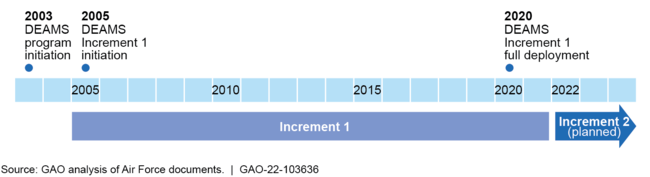
The Air Force depends on its economical administration devices to support deal with division functions and help core accounting functions, these kinds of as retaining monetary data and earning payments. Its environment is intricate and is made up of several techniques that are not completely integrated, avoiding Air Power management from obtaining well timed, precise, and dependable details on the benefits of its business enterprise functions. To address these challenges, the Air Power has been migrating from its legacy, or growing older, financial management systems to far more modern-day target systems. 1 this sort of key target is the Protection Enterprise Accounting and Administration Procedure (DEAMS), which is to be the Air Force’s core accounting and finance process. DEAMS has been deployed incrementally to Air Pressure consumers because 2005, and the Air Drive ideas to develop its use in the future (see determine).

Air Force’s Defense Company Accounting and Administration System (DEAMS) Timeline

Air Force's Defense Enterprise Accounting and Management System (DEAMS) Timeline

The Air Pressure has not followed main procedures, these kinds of as developing a migration plan to tutorial its changeover from the present legacy system to DEAMS. Instead, the Air Drive resolved to pursue a twin processing plan in which the legacy and concentrate on devices would both equally continue to work for at minimum the upcoming 10 yrs. The ongoing use of the legacy method indicates that resolution of its deficiencies would be delayed for lots of decades. Further, related interior manage weaknesses would also persist.

Auditors have discovered quite a few issues linked to the Air Force’s broader monetary management systems, like DEAMS. For fiscal 12 months 2020, auditors described deficiencies like nonintegrated Air Force monetary programs, an insufficient economic reporting course of action, and a lack of controls in the design of details systems. Whilst the Air Pressure has some endeavours underneath way to handle economical administration system–related deficiencies, it does not have a extensive system encompassing the entirety of its economical management techniques modernization initiatives. Without the need of this kind of a extensive fiscal management method approach, it will be more tricky for the Air Drive to report precise and responsible economical details. In addition, the Air Power will keep on to face challenges producing and entirely implementing Air Force–wide corrective motion designs to handle the procedure-linked challenges that auditors recognized. These difficulties have led to the Air Pressure not getting able to offer sufficient, correct audit proof to guidance the described amounts in its economical statements.

Why GAO Did This Analyze

The Air Force is at the moment modernizing and migrating its economical administration systems as portion of a broader hard work to enhance economic management operations and get ready auditable fiscal statements. Profitable technique migration is key to the Air Force addressing weaknesses that monetary assertion auditors have determined.

The Govt Administration Reform Act of 1994 incorporates a provision for GAO to audit the U.S. government’s consolidated economical statements. This report examines the extent to which the Air Drive is (1) subsequent major methods for its money management method migration and (2) preparing to deal with the economical management system–related difficulties that auditors identified.

GAO reviewed steerage on method migration primary methods noticed DEAMS application functions reviewed documentation associated to the Air Force’s migration efforts and approach, fiscal assertion audit final results, and attempts to resolve technique deficiencies and interviewed cognizant officers.