CHARLOTTE, N.C. & CALGARY, Alberta–(BUSINESS WIRE)–InfraSight Software Corporation (InfraSight) and GRID Dynamics, Inc. (GRID) have agreed to integrate InfraSight’s Inframeter™ technology with GRID’s industry-leading Financial Planning & Analysis (FP&A) and Enterprise Performance Management (EPM) solutions.
Inframeter™, an IT Financial Observability Platform:
Works across Hybrid IT and Multi-Cloud investments;
Measures disparate compute, graphics, networking, and storage resources;
Calculates Infrascore™, a metric that represents the collective cost of doing IT work;
Analyzes historical and current data to enhance IT forecasting, budgeting, and resource allocation;
Enables developers to extend its functionality through an open API.
“This partnership brings together complementary platforms to provide greater transparency and more effective IT budgeting and execution for enterprise-scale organizations,” says InfraSight Co-Founder and CEO, Tim Martin. “GRID’s value-add is exceptional, and with GRID, Inframeter is now available in new markets, including Canada.”
EPM Simplification and Operating Leverage
GRID’s portfolio of FP&A and EPM solutions enable finance professionals to simplify corporate planning and budgeting through browser- and Microsoft Excel-based interfaces while leveraging AI and advanced analytics. GRID’s approach focuses on establishing functional Key Performance Indicators (KPIs) and integrating datasets to build a comprehensive single-source-of-truth for financial and operating data.
For customers, the integration of Inframeter™ and GRID’s technology solutions:
Facilitates in-depth visibility and analysis of IT infrastructure consumption costs for CTOs and CIOs, while simplifying cost management for CFOs;
Helps decision-makers better rationalize expenses across disparate IT investments;
Integrates FinOps budgeting and planning with other traditional financial management practices available with broad-scope EPM solutions.
“By layering in detailed on-premise and cloud consumption statistics with financial data, this solution gives customers new insights they have been desperately seeking,” says Rick Clazie, Managing Director of GRID Dynamics.
“For many enterprises, infrastructure cost management is a highly reactive process with adjustments made only after costs have been incurred, often with huge overages,” Clazie says. “Now we can help customers proactively understand how and where utilization affects expense.”
GRID has Certified Inframeter™ Professionals on staff and is deploying the integrated solution for clients. Contact inframeter@grid-dynamics.com or info@infrasightsoftware.com for more details.
InfraSight Software Corporation
Headquartered in Charlotte, NC, InfraSight is the developer of Inframeter™, an IT Financial Observability Platform. Inframeter™ facilitates visibility into IT workload costs and provides enterprise leadership with information they can trust to make financial decisions with confidence. The Inframeter™ platform includes an intuitive executive dashboard and an open API for developers to extend its functionality and produce actionable business outcomes.
Based in Calgary, Alberta, Canada, GRID Dynamics was founded in 2005 and creates tailored Financial Planning & Analysis (FP&A) and Enterprise Performance Management (EPM) solutions for all sizes of organizations. GRID helps organizations gain critical insights into their organizational performance, by designing and mapping KPIs to business objectives, streamlining and facilitating access to critical operating data, and facilitating planning scenarios.
CFOs today play a critical role in their organization as strategic advisors in addition to overseeing the numbers — these leaders need to be data-driven and embrace strategies and technology that allow for more visibility across the organization and produce faster data for better decision making.
To keep up with these new expectations to provide relevant data and insights in a timely manner, CFOs need to keep on top of relevant trends and prioritize digital transformation projects.
1. Accelerate Cloud Adoption Across F&A
Moving to the cloud allows organizations to adopt a digital-first mindset. 90{21df340e03e388cc75c411746d1a214f72c176b221768b7ada42b4d751988996} of organizations already embrace cloud adoption and expect to exceed their usage, leaving organizations who have not embraced this foundational strategy at a serious disadvantage.¹
Looking ahead, CFOs need to accelerate cloud adoption and implement holistic solutions. Cloud-based providers’ expertise in handling large volumes of data means they can better ensure accessibility and data security than on-premises providers. By deploying cloud-based solutions, F&A teams will improve the speed, trust and predictive nature of their insights.
2. Enable Better Decision-Making with Real-Time Data
Accessing accurate data quickly allows CFOs to help organizations stay ahead of the competition. However, without automation in place, data is often isolated in different point solutions across an organization, making it cumbersome to collate. By leveraging a holistic Record to Report platform with dashboard views built in, organizations can gain real-time visibility to the data related to the close and reconciliation processes. Focusing on data accessibility removes obstacles and allows organizations to be more efficient in interpreting data and zeroing in on what may need extra attention.
According to Gartner, by 2023, augmented data management will also reduce the reliance on finance analysts for repetitive and routine data management tasks, freeing up to 20{21df340e03e388cc75c411746d1a214f72c176b221768b7ada42b4d751988996} of their time for collaboration, training and high-value analytics tasks.² Accountants have analytical mindsets, and leveraging automation allows them to refocus their time to higher level initiatives and strategic decision making. Automation frees up human capacity to focus on critical tasks like exceptions — that are often identified through automation.
3. Increase inAdoption of Advanced Technologies
One trend to watch for is the rise of artificial intelligence (AI) adoption, which can help guide organizations by providing improved agility and better data-backed decisions. Plenty of businesses have accelerated their adoption of AI and will continue to increase usage across the organization. According to a study by PwC, half of the companies surveyed accelerated their plans to adopt AI due to the crisis created by the pandemic, and 86{21df340e03e388cc75c411746d1a214f72c176b221768b7ada42b4d751988996} of companies surveyed indicate AI is becoming a form of their main technology usage this year.³
By expanding automation strategies with technologies such as machine learning and AI, Robotic Process Automation (RPA) can be used for more complex activities, such as budgeting and forecasting. This will free up relevant staff to focus on the most impactful decision-support aspects of their jobs.
According to Deloitte, 95{21df340e03e388cc75c411746d1a214f72c176b221768b7ada42b4d751988996} of businesses that have implemented RPA indicated it has improved their productivity.⁴ Furthermore, 93{21df340e03e388cc75c411746d1a214f72c176b221768b7ada42b4d751988996} of businesses that have implemented RPA feel it’s helped their team improve compliance, and 77{21df340e03e388cc75c411746d1a214f72c176b221768b7ada42b4d751988996} believe it’s given better management information.
4. Hire, Retain and Develop Digital Skills in Finance
Digital skills are needed to support an always-on, technology-driven, real-time business. Because skill needs are changing so quickly, finance leaders need an “always on” skills-sensing ability to locate new skills and evaluate skills-development priorities. This enables finance to course-correct quickly and apply skills closer to the time of need.
While some companies are simply looking for candidates who can demonstrate how analysis is important to the finance function, CFOs are increasingly looking for candidates who demonstrate analytical and problem-solving skills.
In an EY survey of 769 finance leaders, 57{21df340e03e388cc75c411746d1a214f72c176b221768b7ada42b4d751988996} of respondents indicated building prescriptive and predictive analysis capability is crucial for their company’s longevity.⁵ Plus, their success as a CFO depends on hiring talent who have emotional intelligence and interpersonal skills to maximize the potential of adopted technologies.⁶
5. Support the Enterprise with Digitization Initiatives
Collaborating closely with CIOs is essential for CFOs to shape and evolve their F&A teams into one that helps the overall organization by being more adaptable to business change. By working collaboratively to identify and implement essential technology, the organization is more effective compared to taking a siloed approach.
Supporting digital transformation and the ability to scale quickly is critical for CFOs as they look towards the future. Prioritizing the transportability of data without going over budget is key — driving this change should be one where the finance function data is no longer siloed.
CadencyDirect, the only native Built on Now® application for the ServiceNow® Platform that is designed specifically to address unique needs for finance, complements and extends financial operations management tasks so that CFOs and their teams can digitize workflows throughout the close process, reducing complexity and risk and providing a greater experience for the entire organization. Built on Trintech’s industry-leading technology, CadencyDirect provides a collaborative and connected system by leveraging robust financial controls and deep automation capabilities.
By embracing technology that offers the best solutions for platforms to speak and share data to one another, CFOs can ensure the long-term success of an organization. CFOs are considered not only as a finance leader, but as the data steward for their organization. When data is leveraged in an effective manner, these leaders will have key insights into their organization to ensure the most competitive and strategic business decisions can be made.
Alibaba’s longtime finance chief Maggie Wu is stepping down as the Chinese ecommerce giant shakes up its organisation to reverse slowing growth and halt the fall of its share price to a five-year low.
The ecommerce group founded by Jack Ma more than two decades ago has been under pressure since Ma criticised Chinese regulators in a Shanghai speech last year that led to the suspension of sister company Ant Group’s blockbuster initial public offering.
Alibaba’s US-listed shares have tumbled 64 per cent since the IPO was derailed, and the group was fined a record $2.8bn for antitrust abuses this year. Analysts said it had poorly navigated Beijing’s campaign to rein in tech companies.
“This year, Alibaba has raised its share buybacks while competitors like Tencent have spent big to fulfil the government’s common prosperity aims,” said Robin Zhu of Bernstein, referring to Beijing’s policy to encourage wealth redistribution.
“Investors have been discussing accountability in management so [Wu’s departure] is not a total surprise,” added Zhu, noting she had led the company for many years.
Deputy finance chief Toby Xu, who joined Alibaba from accounting firm PwC three years ago, will take over the role from Wu in April.
Alibaba last month slashed its growth prospects in response to China’s slowing economic momentum and mounting competition from rivals.
The ecommerce company, the largest Chinese group listed in the US, has come under additional pressure after ride-hailing leader Didi Chuxing announced on Friday it would delist from the New York Stock Exchange just five months after its IPO.
Didi’s delisting plan has stoked concerns about the future of other Chinese companies listed overseas. China’s securities regulator said on Sunday it was not pushing companies to withdraw from US exchanges, adding that it was working with Washington to resolve a stand-off over access to audit papers that could result in all Chinese groups being kicked off Wall Street within three years.
Alibaba chief Daniel Zhang on Monday outlined further structural changes that will consolidate the company’s international business under the leadership of 36-year-old executive Jiang Fan, while co-founder Trudy Dai takes over its domestic ecommerce business.
Jiang ably helmed Taobao’s push into mobile and was seen as a contender to take the reins of the entire group until a personal scandal turned into a public relations crisis for Alibaba last year.
Wu, who managed Alibaba’s books through three public listings, was known for taking subtle jabs at less frugal competitors in earnings calls and for her steady hand in the company.
“Maggie is forever calm and unflappable, regardless of ups and downs in the global capital markets and macro environment,” said Zhang.
“She is humble and resilient, and has been my irreplaceable and closest partner over the years,” he added. Wu will remain at Alibaba as a partner and director.
Wu called her resignation the “culmination of extensive preparation over many years” and a step to promote a new generation of leaders at the company.
“The markets will always have ups and downs, but Alibaba has ambitious long-term goals,” she said.
#techAsia newsletter
Your crucial guide to the billions being made and lost in the world of Asia Tech. A curated menu of exclusive news, crisp analysis, smart data and the latest tech buzz from the FT and Nikkei
As stock market investors have learned over the past week, it’s tricky to time the next move in the Dow Jones Industrial Average after a big selloff. Buyers stepped in Monday after the 900-point Nov. 26 dive, but there were signs of weakness. Stocks tanked Tuesday, soared back Wednesday before whipsawing into the close, and then had a huge day on Thursday before ending the week’s trading with another loss for the Dow.
“Always tricky,” says Keith Lerner, co-chief investment officer and chief market strategist at Truist.
Looking to market history can help.
Some are betting on the Santa Claus rally for a big December, even as clarity on the omicron variant threat remains lacking and cases spread, including in the U.S. And even after a week in which Fed Chair Jerome Powell surprised the market — with timing that was “curious,” according to Mohamed El-Erian — saying the Fed’s taper may be accelerated and inflation should no longer be described as “transitory.”
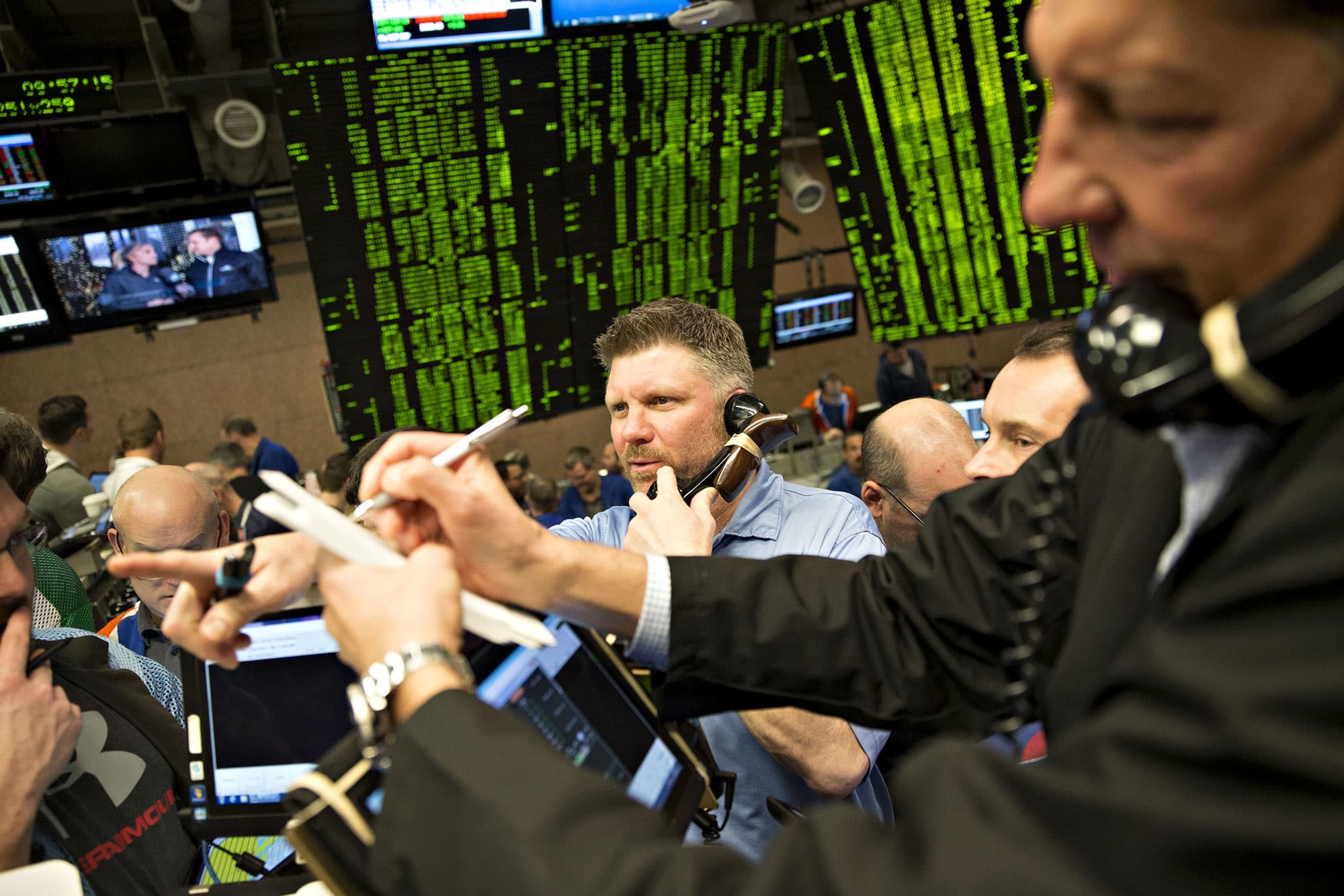
Traders work in the S&P 500 options pit at Cboe Global Markets Inc. in Chicago, Illinois.
Daniel Acker | Bloomberg | Getty Images
Lerner is looking to market history, and he sees an environment in which the patient investors will be ahead, if not in December, a year from now.
“We want at least a 12-month trend, because even if your entry point is not exactly right, you have greater chances of success in that timeframe,” he said.
The “Black Friday” Nov. 26 spike in the VIX volatility index of 54{21df340e03e388cc75c411746d1a214f72c176b221768b7ada42b4d751988996} was among the five biggest single-day volatility moves in the past three decades. Since 1990, there have been 19 trading sessions during which the VIX spiked by 40{21df340e03e388cc75c411746d1a214f72c176b221768b7ada42b4d751988996} or more. In 18 of those 19 instances, or 95{21df340e03e388cc75c411746d1a214f72c176b221768b7ada42b4d751988996} of the time, the S&P 500 Index was higher one-year later, and the gains were large — an average of 20{21df340e03e388cc75c411746d1a214f72c176b221768b7ada42b4d751988996}.
With the U.S. market still up more than 20{21df340e03e388cc75c411746d1a214f72c176b221768b7ada42b4d751988996} this year even after the recent volatility, another 20{21df340e03e388cc75c411746d1a214f72c176b221768b7ada42b4d751988996} might be aspirational. Lerner noted that before the recent market whipsaw, stocks had gained 9{21df340e03e388cc75c411746d1a214f72c176b221768b7ada42b4d751988996} since early October, and that is a negative as far as having confidence the market will move up substantially in the short-term. That implies the immediate future is “vulnerable” to more moves down.
But the more important data point is the longer-term trend in the VIX history: there isn’t any instance across the 19 biggest VIX spikes of the past three decades after which stocks weren’t positive a majority of the time one month, three months, six months, and one year later. One month later, stocks were only up an average of 1{21df340e03e388cc75c411746d1a214f72c176b221768b7ada42b4d751988996}, but were positive 70{21df340e03e388cc75c411746d1a214f72c176b221768b7ada42b4d751988996} of the time, and the numbers get better with time.
The caveat: Covid is a type of risk that the markets have not seen often over the past three decades, and two of the biggest VIX spikes came as Covid first hit the U.S. in February 2020. After both, the one-month period for stocks was brutal. That implies a market that remains on edge for now, and that should not come as a surprise — especially after the past week of trading. But the only of the 19 instances in which stocks were still down a year later was at the onset of the financial crisis. That data point gives Lerner more confidence in remaining bullish.
Volatility will remain the headline before the dominant trend returns, but that trend, he says, will be an economy that continues to expand and support further stock gains.
“In the last decade, we’ve had these V-shaped recoveries. They have been more normal,” he said. “Go back to the pandemic low, when you had a sharp move down and you get a kick back rally and a battle between greed and fear ensues. But in general, over the last 5 to 10 years, we’ve seen more of these come-down and go-back-up markets, as if nothing happened,” he added.
The last time was the end of September when the financial issues at Chinese property giant Evergrande sent the global equity markets into a tailspin.
Fear of missing out in a Covid market
The base case, Lerner says, is more of a tug-of-war until more of the news filters out and the market is able to get a better gauge on this new variant. This doesn’t change his view that investors are more likely to be rewarded by sitting tight rather than sitting out the market. In a “fear of missing out” era, that’s a lesson many investors learned from Spring 2020, the fastest bull market in history based on S&P 500 price gains.
“For people who missed out that time, it is a reminder about becoming too negative too fast,” Lerner said. “Even if you had had all the news on the pandemic, you would have been better staying in the market. By the time we have the all clear the market has moved,” he said.
The stock market was at a record shortly before Nov. 26, and when markets come off new highs, history says investors should be prepared for more downside over the next one to three months. A pandemic may heighten that volatility since the science is a type of uncertainty the market isn’t accustomed to analyzing. But the market does now have the 2020 Covid playbook to learn from.
“In February 2020, it was all new,” Lerner said. “We didn’t know how businesses would adapt, and now there is playbook. We saw they become more digital. There will be winners and losers, no matter what, but companies and consumers have adapted and will again.”
The Federal Reserve is on record as saying one of the lessons of the Covid era is that the economy has gotten better at adapting to pandemic during each successive wave. When Fed Chair Powell outlined a more hawkish position during Senate testimony this week, some market pundits pointed to the inflationary risks from an economy that is too hot as being the larger concern than a new Covid variant.
Like many market experts, Lerner says on the margins inflation may become even worse because of an exacerbation of the existing supply chain issues, which were starting to show signs of easing and now with a new variant unknown could go back up again on new factory shutdowns and delays in transportation.
“It is a risk to the market,” he said, and another reason volatility may remain elevated in the near-term.
Fed Chair Powell said this week that the omicron variant “complicates” the inflation picture.
But another difference between now and Spring 2020: the economy is not in a recession, which it quickly entered during lockdowns and stay-at-home orders during the initial Covid wave. “Now we know, even with this variant, it may slow activity down, but I still think recession risk is low. That’s a key difference from February and March 2020 when a recession happened so quickly,” Lerner said.
“Especially in the U.S. market, composition does matter,” Lerner said.
Reflation trades may ultimately benefit if omicron doesn’t turn out to be as bad as feared and the economic expansion remains on track, but “right now, the strongest sector is tech and that’s the most important sector for those investing at the index level,” he said. “If the big mega-cap tech stocks hold up, you may see the headline index hold up better and more bifurcation below the surface. The knee jerk is investors will rotate to companies that can still create a lot of cash flow and have bigger balance sheets, so if there is a slowdown, they have enough to get through. They’ve become more defensive in some ways,” he added.
This view also makes Lerner in favor of continuing a tilt to U.S. equities versus peer markets around the globe, even as international and emerging markets trade at significant discounts to U.S. stocks. He noted that international equity prices are making fresh lows relative to the U.S., and in the case of the EAFE index versus the S&P 500, a relative price that is at the lowest level in history.
The sector composition of the S&P 500 and outsize role of mega-cap is a major reason for that versus the European market and the EAFE universe, in which financial and industrials are the top two sectors. Lerner stressed that this doesn’t mean gains won’t eventually come to those who enter early into discounted overseas equities trades. In fact, he has told clients that part of sticking with a U.S. equities tilt and technology for now likely means missing the onset of an investor rotation that is inevitably going to favor overseas markets as earnings power improves, but it’s a price he is willing to pay.
“Valuations are cheap overseas but that hasn’t been a catalyst,” he said. “We will miss the turn, but we are willing to wait for stability and earning trends, and that has served us well in being overweight U.S. … If there is a sustainable move, there should be sustainable upside,” he added. “You don’t need to be a hero trying to buy those markets.”
Equity market strategists remain cautious on any sustainable bounce in the U.S., too, based on this past week’s action. Monday’s big really featured an advance/decline breakdown of 1,834 winning stocks versus 1,502 losing ones — “not a resounding up day.” Lerner said. But Thursday’s big bounce was more encouraging. Advances: 2,525. Declines: 868. “You want to see an advance-decline that is three-to-one,” Lerner said, and the market delivered that on Thursday — though that confidence didn’t last.
The Russell 2,000, a broader look at the U.S. market and domestic economy than the large-cap S&P, broke it’s four-day losing streak on Thursday, but by Friday’s close was 12{21df340e03e388cc75c411746d1a214f72c176b221768b7ada42b4d751988996} of its 5-week high. Lerner’s says the action in the small-cap Russell 2000 is an example of the “nice kickback but more mixed below the surface” market action investors will need to keep an eye on, and not let themselves be fooled by any “all clear” signal amid the stock nibbling and, most importantly, continued uncertainty over the course of the omicron variant.
The market had its best day since March 2021 on Thursday, but strategists remain wary. Tom Lee’s Fundstrat Global Advisors, which called for “aggressive buying” early in the week, said after both the Monday and Thursday rallies that the market wasn’t sending an all-clear signal.
According to Bank of America and FactSet Research Systems, headed into Friday’s trading action only 32 S&P 500 stocks were off their highs less than the S&P 500 Index.
“Thursday’s rally, similar to Wednesday’s bounce, failed to show sufficient strength to think a low is in,” Fundstrat Global Advisors wrote to clients on Thursday night. “This rally could still weaken further into next week. … Given the extreme drop off in breadth in recent weeks, a monumental effort is necessary along with broad-based participation to have confidence.”
On Friday, the S&P 500 barely avoided its sixth-consecutive trading session with a move of 1{21df340e03e388cc75c411746d1a214f72c176b221768b7ada42b4d751988996} or more, declining by 0.8{21df340e03e388cc75c411746d1a214f72c176b221768b7ada42b4d751988996}.
Lerner pointed out in a note to clients last Thursday that the percentage of retail investors with a bullish view has dropped to just 27{21df340e03e388cc75c411746d1a214f72c176b221768b7ada42b4d751988996} versus 48{21df340e03e388cc75c411746d1a214f72c176b221768b7ada42b4d751988996} a few weeks ago, according to the latest survey from the American Association of Individual Investors (AAII), while the percentage of bearish investors jumped to the highest level in more than a year. He sees investor patience as being as important as confidence. Corporations and consumers have adapted to Covid, pent-up demand remains, and the economy remains on solid footing, all which leads him to that bottom-line takeaway that the primary market trend is higher, but it will likely continue to be a rocky near-term road.
While the S&P 500 is below its peak from a month ago; the ARK Innovation ETF that made fund manager Cathie Wood a star in recent years and during the pandemic: now down 40{21df340e03e388cc75c411746d1a214f72c176b221768b7ada42b4d751988996} from its February high and its largest pullback since the onset of the pandemic. The iShares Tech-Software ETF, which includes DocuSign, was below its 200-day moving average for the first time since May on Friday, and more than 14{21df340e03e388cc75c411746d1a214f72c176b221768b7ada42b4d751988996} below its intraday all-time high from November.
The one factor investors should not let set their investment course is fear. Fear in the market right now is being driven by a factor that is real, and to get to the other side of that fear can takes weeks, if not months. But fear can also rotate from a market headwind to market tailwind, and that is what the history of big spikes in the VIX index shows. “The same fear becomes the catalyst,” Lerner said.
After the “Black Friday” selloff, Lee said the lack of an inversion in the VIX, when the nearer-term risk is being priced higher than the outer risk, was a positive sign. But by this past Friday, the VIX curve had inverted, which is a sign of portfolio stress. While that “can occur near the climax of a selloff, as fear peaks,” the VIX will have to un-invert again for more confidence.
“We have to say with humility what we know and don’t know,” Lerner said, but he added that if the catalyst for the S&P being down is renewed Covid fears, and we find out these concerns are overblow and won’t disrupt the economic trajectory and won’t effect corporate profits, the headlines that had people braced for negative news become a positive catalyst for the market because expectations were reset lower.
“There are times like 2007 when investors weren’t fearful enough,” he said. “But our baseline view is that we’re not going into a recession, this doesn’t change the economic expansion materially.”
Friday’s monthly jobs report was below expectations in number of jobs added by the U.S. economy in November, but it was a mixed report, with the unemployment rate falling and labor participation rising, both encouraging signs for the economic outlook.
A “garden-variety” correction in stocks, was how S&P 500 technician Ed Yardeni described it early last week.
By Friday’s close, the Nasdaq was down more than 6{21df340e03e388cc75c411746d1a214f72c176b221768b7ada42b4d751988996} from its 52-week high; the off Dow over 5{21df340e03e388cc75c411746d1a214f72c176b221768b7ada42b4d751988996}; and the S&P less than 5{21df340e03e388cc75c411746d1a214f72c176b221768b7ada42b4d751988996} from its annual high.
“5{21df340e03e388cc75c411746d1a214f72c176b221768b7ada42b4d751988996} to 10{21df340e03e388cc75c411746d1a214f72c176b221768b7ada42b4d751988996} corrections are the admission price to the market,” Lerner often says. “Investors are better served by focusing on the longer term trend.”
FOX Business’ Cheryl Casone breaks down the November jobs report as 210,000 new jobs were added to the U.S. economy, falling short of the 550,000 estimate.
U.S. job growth significantly undershot expectations in November, suggesting that difficulty in attracting new workers is weighing on the labor market’s recovery from the pandemic, even as COVID-19 cases dissipated nationwide.
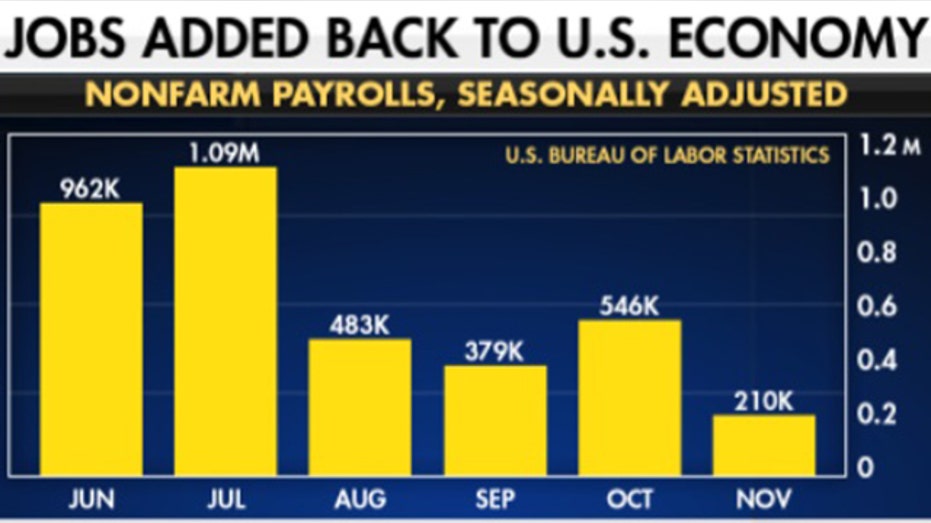
The Labor Department said in its monthly payroll report released Friday that payrolls in November rose by just 210,000, well below the 550,000 jobs forecast by Refinitiv economists. It marked the worst month for job creation so far this year. The unemployment rate (which is calculated based on a separate survey) dropped more than expected to 4.2{21df340e03e388cc75c411746d1a214f72c176b221768b7ada42b4d751988996} from 4.6{21df340e03e388cc75c411746d1a214f72c176b221768b7ada42b4d751988996} — the lowest level since the pandemic began.
The labor market had been gaining momentum after a delta-induced slowdown over the summer, but the latest figure represents a significant drop from October’s upwardly revised number of 546,000 and September’s upwardly revised 379,000. There are still about 3.9 million fewer jobs than there were last February, before the crisis began.
FED TO TAPER BOND PURCHASES BY $15B A MONTH AS IT EXITS PANDEMIC-ERA POLICY
“Today’s employment report is doubly disappointing, because the reference week occurred just as it looked like Covid was on the retreat,” said Justin Wolfers, a University of Michigan economist. “This was a moment for people to return to malls and to return to work. The COVID-related news has only gotten worse since then.”
(U.S. Bureau of Labor Statistics)
The report wasn’t all bad news, however: The labor force participation rate rose to 61.8{21df340e03e388cc75c411746d1a214f72c176b221768b7ada42b4d751988996}, wages rose 4.8{21df340e03e388cc75c411746d1a214f72c176b221768b7ada42b4d751988996} from a year ago and the survey of households offered a brighter outlook, pointing to an employment gain of 1.13 million for the month. (The jobs report consists of two surveys – one based on employers and the other on households).
RSM chief economist Joe Brusuelas described the report as a “tale of two surveys.”
“Rarely has the estimate produced by the good folks at the Bureau of Labor Statistics resulted in such divergent results as that illustrated by the twin establishment and household surveys that are the foundation of the monthly tally,” Brusuelas said.
Prospective employers and job seekers interact during a job fair Wednesday, Sept. 22, 2021, in the West Hollywood section of Los Angeles. (AP Photo/Marcio Jose Sanchez, File)
The job growth stumble comes before the emergence of the newly identified omicron variant of COVID-19, which could jeopardize the global economy’s recovery. There is still a lack of clarity over how dangerous the new variant is, including whether it is more transmissible or capable of causing more severe illness. Early evidence suggests an increased risk of reinfection.
Public health officials have urged caution against panic.
But the economic impacts of the new strain – which has been found in at least 38 countries including the U.S. – have already been felt, with the U.S. and at least 10 European nations suspending air travel from southern Africa. The 27-nation European Union also recommended an “emergency brake” on travel from southern Africa, citing the “very concerning” new variant.
Surveys for the November jobs report were conducted about three weeks ago, before the new variant was detected.
Leisure and hospitality, one of the hardest-hit sectors that has become a bellwether of sorts for the economy’s recovery, saw a gain of just 23,000 new jobs last month. By comparison, it added 170,000 new jobs in October. The sector, which includes bars, restaurants and hotels, has recovered about 7 million of the jobs it lost during the pandemic, but remains about 1.3 million below its February 2020 level.
Federal Reserve Board Chair Jerome Powell testifies before Senate Banking, Housing, and Urban Affairs hearing to examine the Semiannual Monetary Policy Report to Congress, Thursday, July 15, 2021, on Capitol Hill in Washington. (AP / AP Newsroom)
A mixed bag of industries accounted for growth last month. Substantial gains took place in professional and business services (90,000), transportation and warehousing (50,000), and construction (31,000). But retail employment fell by 20,000 last month on a seasonally adjusted basis, despite the upcoming holiday season.
Markets remained relatively calm, despite the disappointing report.
Federal Reserve policymakers have been closely watching the labor market for signs that employment is reaching pre-crisis levels after the pandemic triggered one of the steepest – but shortest – recessions in nearly a century.
Although the jobs figure came in well below economists’ expectations, the U.S. central bank may plow ahead with tentative plans to begin more aggressively unwinding the economic support put in place in March 2020 in order to curtail surging inflation.
“If you think this report will push back the accelerated taper mentioned by Fed Chairman Jerome Powell this week, you would be mistaken,” said Jamie Cox, managing partner for Harris Financial Group.
GET FOX BUSINESS ON THE GO BY CLICKING HERE
The central bank has been purchasing $120 billion in bonds each month throughout most of the pandemic in order to keep credit cheap and stabilize the financial markets. In November, Fed officials announced plans to scale back the program by $15 billion a month, a timeline that would end the program by late June.
Chairman Jerome Powell suggested this week that Fed officials may accelerate their plan to reduce their monthly purchases of bonds and mortgage-backed securities later this month.
“At this point, the economy is very strong, and inflationary pressures are high,” Powell said on Tuesday. “It is therefore appropriate in my view to consider wrapping up the taper of our asset purchases, which we actually announced at our November meeting, perhaps a few months sooner.”
Ritholtz Wealth Management has teamed up with WisdomTree to launch the RWM WisdomTree Crypto Index that will provide exposure to Bitcoin (36{21df340e03e388cc75c411746d1a214f72c176b221768b7ada42b4d751988996}), Ethereum (20{21df340e03e388cc75c411746d1a214f72c176b221768b7ada42b4d751988996}) and 11 other cryptoassets (at 4{21df340e03e388cc75c411746d1a214f72c176b221768b7ada42b4d751988996} each). Those 11 additional cryptoassets include layer-1 networks, layer-2 protocols, oracle networks, crypto indexing services, decentralized finance (DeFi) and the metaverse.
While the index is currently only available to Ritholtz clients using separately managed accounts on Gemini, Onramp is bringing this to a wider swath of advisors via its cryptocurrency platform, writes Michael Batnick, director of research at Ritholtz.
“In our view, this direct indexing implementation of the RWM WisdomTree Crypto Index via Onramp Invest and Gemini is the best assembled structure and diversified cryptoasset exposure currently available to U.S. investors and particularly the RIA community,” said Jeremy Schwartz, global chief investment officer at WisdomTree, in a statement.
“Cryptoassets show great promise for financial advisors to add value, to be compensated for it, and to do so in a way that can be in line with their fiduciary responsibilities,” said Eric Ervin, chief investment officer and co-founder at Onramp Invest. “Our goal at Onramp from day one was to make this possible.”
The cryptocurrency and investing communities have waited years to have a Bitcoin ETF approved by the Securities and Exchange Commission, and, so far, no ETF that directly invests in Bitcoin has been approved. The Winklevoss twins were the first to file for a Bitcoin ETF in 2014.
SEC Chair Gary Gensler gave a speech on crypto ETFs in August, indicating that the commission would prefer funds that invest in Bitcoin futures. And Gensler just recently doubled down on his concerns about spot Bitcoin ETFs.
ProShares made history in October with the launch of the first bitcoin futures ETF, under ticker BITO. A few other bitcoin futures ETFs have listed since then.
Thrivent Gets Into the ETF Game
Thrivent, the Midwest-based not-for-profit financial services organization founded by Lutherans, has filed an initial registration statement with the SEC for an exchange traded fund.
According to the filing, the firm plans to launch the Thrivent Small-Mid Cap ESG ETF (TSME), which will be actively managed and invest in the companies with market capitalizations at or below the market cap of the largest company in either or both of the Russell 2500 Index or the S&P MidCap Index.
“The new ETF is part of the organization’s long-term strategic growth objectives focused on helping more clients achieve financial clarity,” a spokeswoman said in a statement.
It will use the “proxy portfolio” methodology, under which Thrivent will provide daily disclosures of a proxy portfolio, which reflects the economic exposures and risk characteristics of the portfolio, without revealing the actual holdings. This reduces front-running and intellectual property theft.
Looks like Thrivent is getting into the ETF game: They’ve filed to launch their first ETF, Thrivent Small-Mid Cap ESG ETF, which will be actively managed (new, not a conversion; not-fully-transparent holdings disclosure). https://t.co/k7wQabQvTx
The ETF will be a completely new fund, not a conversion of one of Thrivent’s existing mutual funds. Several traditionally active managers have announced plans to convert mutual funds into ETFs.
Apollo Continues Its Move Into Retail Wealth Management
Private equity firm Apollo continues to build out its global wealth management solutions business with the acquisition of Griffin Capital, a privately held alternative investment asset manager in Los Angeles. The move adds 60 retail-facing distribution professionals and hundreds of distribution agreements, as Apollo continues to bring its products and services to the retail wealth management market.
Apollo recently set a target at its investor day of raising $50 billion-plus of organic capital for its global wealth business over the next five years.
In May, the company introduced the new business unit and outlined plans to develop new products that individuals can invest in through financial advisors.
Griffin is particularly strong in its distribution capabilities to the independent channel, Apollo said, a nice complement to its focus on private banks, wirehouses, RIAs and family offices.
“The democratization of finance brings tremendous opportunity for individual investors to access alternatives,” Apollo CEO Marc Rowan said in a statement. “With the acquisition of Griffin, we will significantly advance our U.S. wealth market growth plans that we presented at our recent Investor Day. As one of the first firms to bring alternative strategies to the individual investor and advisor market in the U.S., Griffin has built trusted relationships over 20-plus years, and in combination with Apollo can offer the market a broader set of solutions.”
First NFT-Focused ETF Goes to Market
Defiance has launched the first exchange traded fund focused on NFTs. The Defiance Digital Revolution ETF (NFTZ) does not directly hold non-fungible tokens, but seeks to provide thematic exposure to the NFT, blockchain and cryptocurrency markets.
The fund has a management fee of 65 basis points, and invests in NFT- and blockchain-related companies, such as Silvergate Capital Corp., Cloudfare, Bitfarms and Coinbase, among others.