
Q&A: How to Manage Climate-Change Risk in Fixed-Income Portfolios | Financial Advisors

Climate-change risk is present in nearly every industry – so ubiquitous, in fact, that investors cannot diversify away from it. That means that investors must learn how to manage the risk in both their equity and fixed-income portfolios.

We spoke with Ognjen Sosa, chief investment officer at Breckinridge Capital Advisors, an asset management firm specializing in investment-grade fixed income and environmental, sustainable and governance, or ESG, integration. The asset manager focused its 2021 issuer engagement program on climate-change risk, speaking with nearly 60 subject matter experts in addition to the routine interactions its analysts have during security research and selection for their fixed-income portfolios. Sosa shares how financial advisors and investors should think about climate-change risk in fixed-income portfolios.

How is climate-change risk a risk multiplier for corporate, municipal and securitized bonds? 

Climate risk is sometimes suggestive of higher event risk or a more challenging long-term credit environment.

For example, in the municipal bond market, communities in one coastal state face higher-than-average, climate-driven disaster risks relative to U.S. peers. Right now, most issuers are insulated from disaster risk: The population is growing, most communities have strong reserves, and states’ catastrophe funds and subsidized federal flood insurance insulate many homeowners from material credit risk in the wake of a hurricane or extreme flooding.

But the insurance environment may become less generous. Some communities may become less likely to rebuild certain areas of their tax bases after large storms. Issuers with lower reserves and less ability to finance infrastructure hardening will be more at risk as climate change accelerates.

Corporations face physical climate risks. For instance, the real estate sector has heavy investments in coastal office properties that may be at risk from rising sea levels. Corporations that do not consider climate change may miss out on growth opportunities as the world transitions to a low- or no-carbon future. Utilities that miss out on renewable energy investments may have longer-term growth challenges as fossil fuel power plants decline in utilization.

Energy companies may face rising risks and opportunities related to climate transition as their business model shifts in response to investors and regulators. Large U.S. bank lenders to the energy sector may also face risk and opportunities through better pricing carbon risk and financing green energy.

Securitized bonds also face risks associated with climate change. For mortgage-backed securities, properties backed by underlying mortgage pools are subject to risks from droughts, wildfires or flooding.

How does climate-change risk impact fixed income specifically?

Climate-change risk – in addition to inflation risk, credit risk, default risk and liquidity risk – is another long-term risk for fixed-income investors that should be considered and ideally be priced and managed.

Specifically, climate-change risk can impact creditworthiness and the ability of a borrower to repay fixed obligations as they come due over time. Climate-transition risk can render certain assets stranded or business segments obsolete, which could also impact cash flows, creditworthiness and the ability of an issuer to pay back fixed-income instruments.

How should financial advisors incorporate climate change in their clients’ fixed income portfolios?

Advisors may want to explore with clients their concerns about climate change and their investments.

The advisors can make appropriate recommendations of strategies that reflect a client’s risk tolerance, investing horizons and financial goals while integrating the client’s views on climate risk. For example, strategies that are centered on fossil-fuel-free or values-based themes may align with the investor’s goals.

Finally, monitor and report to clients on the performance of their climate-risk-related allocations. Look for specific data within the selected portfolios that are responsive to the client’s climate-change concerns, as revealed during the initial fact-finding discussions.

Disclosure around climate risk continues to be a challenge for investors and advisors. How can financial advisors address this challenge?

Look for asset managers experienced in climate-related investing. Managers who can explain how their investment process integrates ESG risk analysis and climate-risk considerations typically can point to a repeatable approach to security selection. This also helps to avoid investment approaches that are potentially inauthentic – so-called “greenwashing.”

Select managers who report performance in accordance with climate-related objectives. This can facilitate personalization as the advisor subsequently monitors and discloses performance.

Finally, look for asset managers that demonstrate commitment to sustainability in their own operations. Ask, “Do you produce an annual corporate sustainability report? Do you report according to protocols provided by the United Nations or the Task Force on Climate-Related Financial Disclosures, for example?” These can be additional indicators of commitment.

Stock futures build on gains after rally

Stock futures opened higher on Monday after a rally earlier in the session, with volatility stemming from concerns about the Omicron variant at least momentarily abating. 

Contracts on the Dow extended gains. Earlier, the index ended higher by nearly 650 points, or 1.9{21df340e03e388cc75c411746d1a214f72c176b221768b7ada42b4d751988996}, as cyclical names that had underperformed in the recent session rebounded strongly. The jump marked the Dow’s best day since March. 

More upbeat commentary suggesting the Omicron variant may not produce as severe of infections as previously feared helped boost markets. Dr. Anthony Fauci, director of the National Institute of Allergy and Infectious Diseases (NIAID), told CNN on Sunday that “thus far it does not look like there’s a great degree of severity” to the Omicron variant relative to prior mutations of the virus. 

The CBOE Volatility Index (^VIX) decreased to just over 28 on Monday as investors digested the remarks, bringing the so-called “fear gauge” down from its peak of more than 35 on Friday, or its highest level since January. 

“The level of volatility is somewhat logical here because a lot of this started prior to the Omicron variant really emerging. We knew that [Fed Chair Jerome] Powell was changing course in terms of his policy actions, he was speaking more hawkishly. Markets were already in the process of re-pricing a bit,” Jim Caron, Morgan Stanley Investment Management fixed income portfolio manager, told Yahoo Finance Live on Monday. 

“I know after Thanksgiving [news about Omicron] came out and that created a pretty big volatile event, but I think the initial conditions where valuations were pretty full, we knew the Fed was starting to change course and starting to tighten financial conditions a bit, and that’s going to mean that asset prices are going to have to reprice,” he added. “You start to get somewhat of a perfect storm when you add a health risk.”

Even amid the broad market rally on Monday, technology stocks were still the laggards, rising less than 1{21df340e03e388cc75c411746d1a214f72c176b221768b7ada42b4d751988996} compared to the S&P 500 and Dow’s at least 1.2{21df340e03e388cc75c411746d1a214f72c176b221768b7ada42b4d751988996} gains during the session. 

Alongside concerns of the Omicron variant, investors have also been ascertaining when and how robustly the Federal Reserve will move to accelerate its asset-purchase tapering program and raise interest rates from their current near-zero levels as inflationary pressures continue to mount. On Friday, the Labor Department is set to release its November Consumer Price Index (CPI), which is expected to show the fastest year-over-year rise in core consumer prices since 1991, at a 4.6{21df340e03e388cc75c411746d1a214f72c176b221768b7ada42b4d751988996} annual gain. 

“Tech and growth stocks are the longest-duration assets, which means they’re going to be the most negatively impacted in valuation by any bump up in inflation which would take interest rates up,” Paul Meeks, portfolio manager for Independent Wealth Solutions Management, told Yahoo Finance Live. “But on the other hand, what the Fed is doing and is even talking about doing, which is going from accommodative to more restrictive monetary policy, is a known.”

“It is well-broadcasted,” he added. “So despite that and even despite Omicron … which I actually think is starting to look more transitory and a lot less of a threat than we had with COVID back in the spring of 2020, I’m starting to feel again … more sanguine about the tech sector.” 

6:06 p.m. ET Monday: Stock futures open higher after rally 

Here were the main moves in markets in late trading on Monday: 

  • S&P 500 futures (ES=F): +4.75 points (+0.1{21df340e03e388cc75c411746d1a214f72c176b221768b7ada42b4d751988996}), to 4,594.75

  • Dow futures (YM=F): +41 points (+0.12{21df340e03e388cc75c411746d1a214f72c176b221768b7ada42b4d751988996}), to 35,253.00

  • Nasdaq futures (NQ=F): +9.5 points (+0.06{21df340e03e388cc75c411746d1a214f72c176b221768b7ada42b4d751988996}) to 15,852.25

Traders work on the floor of the New York Stock Exchange (NYSE) in New York City, U.S., December 3, 2021.  REUTERS/Brendan McDermid

Traders work on the floor of the New York Stock Exchange (NYSE) in New York City, U.S., December 3, 2021. REUTERS/Brendan McDermid

Emily McCormick is a reporter for Yahoo Finance. Follow her on Twitter

Metaverse will disrupt human life — here are 7 companies that may win big

The metaverse will be disruptive to society once it gains its true form over the next decade Jefferies analyst Simon Powell argues. But several companies could be poised to benefit greatly from the new digital ecosystem. 

“A single metaverse could be more than a decade away, but as it evolves it has the potential to disrupt almost everything in human life that has not yet already been disrupted,” said Powell in a lengthy research note on Monday titled “The Digitization of Everything.” 

“The pandemic accelerated the adoption of various technologies. Many people were forced to spend even more of their lives online from socializing to working, from education to entertainment. This shift to an online world will continue.”

The metaverse arguably burst into the public lexicon for the first time this year as Facebook founder Mark Zuckerberg has hyped the digital world’s potential (and changed its holding company name to Meta in a show of support). Microsoft (Yahoo Finance’s Company of the Year) has also talked increasingly about the metaverse and how it will play in it moving forward. 

In its simplest form, the metaverse is an online world that includes augmented reality, virtual reality, and 3D avatars. As this world takes form, how things are done stand to change dramatically. Explains Powell, “The digitization of everything will create a new world that we can all move in and out of. The metaverse can be viewed as a new platform for the digital age. We see it as a wrapper that will roll up other digital platforms. It will not replace the internet, but instead build on top of it and, when combined with other technologies and interfaces, will allow us to essentially step into, and perhaps live in it.”

INDIA - 2021/11/30: In this photo illustration, a Metaverse logo seen displayed on a smartphone with a facebook logo in background. (Photo Illustration by Avishek Das/SOPA Images/LightRocket via Getty Images)

INDIA – 2021/11/30: In this photo illustration, a Metaverse logo seen displayed on a smartphone with a facebook logo in background. (Photo Illustration by Avishek Das/SOPA Images/LightRocket via Getty Images)

This virtual environment is not only expected to change how people interact with the physical world, but also how we work with other. 

“We are building towards a metaverse. I am really excited about the vision,” said Dropbox founder and CEO Drew Houston recently on Yahoo Finance Live. “Where Dropbox fits in if you are working in that kind of environment or in the metaverse, you need stuff. So for your digital content, Dropbox could help and that is what we are building towards. It is very early. It is a long journey, but it is exciting.”

Jefferies’ Powell acknowledges it’s still early for investors to pick definitive metaverse winners. But investors could begin mapping out a plan of attack. 

“Focus initially on the hardware needed to lift the internet to become the metaverse. Then look at the software that will design and host it, and ultimately the businesses that create use cases on it,” adds Powell. 

The analyst outlines several potential winners from the metaverse, mostly relegated to the social media and gaming sectors. 

“Facebook (Meta) /SNAP are both working on hardware to access the metaverse while having social platforms with significant reach. Roblox (RBLX) is the closest to being an early stage metaverse. TakeTwo (TTWO) is currently running three games that arguably could be early stage metaverses. Electronic Arts (EA) has several IPs that would be ripe to be turned into walled garden metaverses: Skate, Sims, SimCity, and even its sports franchises. Activision Blizzard (ATVI) has one of the innovators in early metaverse with World of Warcraft in its library. Moreover, Call of Duty could use many of the tools in building a metaverse to better monetize and engage users (cross platform, cross universe, single currency economy). Music will likely play a role along the way from here to there … Warner Music (WMG) already sees this as it has invested in several start ups that are building tools/platforms in the metaverse,” notes Powell.

Brian Sozzi is an editor-at-large and anchor at Yahoo Finance. Follow Sozzi on Twitter @BrianSozzi and on LinkedIn.

Read the latest financial and business news from Yahoo Finance

Follow Yahoo Finance on Twitter, Instagram, YouTube, Facebook, Flipboard, and LinkedIn

ASIC says financial market cyber resiliency remained steady but fell short of target

Firms in Australia’s financial market have continued to be resilient against cyber threats, with improvement rates in cyber resiliency remaining steady, the Australian Securities and Investment Commission (ASIC) reported on Monday.

This finding was published in the corporate regulator’s latest report [PDF], which compiled trends from self-assessment surveys completed by financial markets firms. The report, titled Cyber resilience of firms in Australia’s financial markets: 2020–21, is an update to a similar cyber resilience report published by ASIC two years ago.

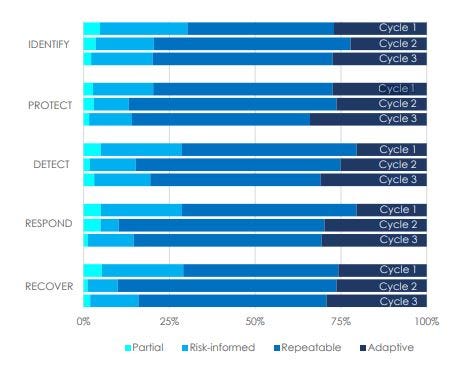
In both 2020 and 2021, ASIC asked participants to reassess their cyber resilience against the National Institute of Standards in Technology (NIST) Cybersecurity Framework. The NIST Framework allows firms to assess cyber resilience against five functions: Identify, protect, detect, respond, and recover, using a maturity scale of where they are now and where they intend to be in 12-18 months.

In the new report, ASIC identified that cyber resiliency among firms operating within Australia’s financial market increased by 1.4{21df340e03e388cc75c411746d1a214f72c176b221768b7ada42b4d751988996} overall, but this fell short of the 14.9{21df340e03e388cc75c411746d1a214f72c176b221768b7ada42b4d751988996} improvement targeted for the period. It was also lower than the 15{21df340e03e388cc75c411746d1a214f72c176b221768b7ada42b4d751988996} improvement that was achieved between 2017 and 2019.

ASIC attributed the shortfall to a combination of reasons including overly ambitious targets, a rise in the cyber threat environment, and disruptions caused by the COVID-19 pandemic, which resulted in organisations directing resources towards enabling secure remote working and ensuring products and services could be delivered to customers as supply chains were burdened with growing cyber activists.

asic-cybersecurity-financial-firms-2021.jpg

Improvement in cyber resilience preparedness between cycles (by function).


Image: ASIC

Overall, 2021 saw improvements in the management of digital assets, business environment, staff awareness and training, and protective security controls.

“Firms operating in Australia’s markets continue to be resilient against a rapidly changing cyber threat environment. The COVID-19 pandemic has increased opportunities for threat actors to target remote workers, and access remote infrastructure and supply chains critical to the delivery of products and services. However, the response from firms has been robust,” ASIC commissioner Cathie Armour said.

The report said 90{21df340e03e388cc75c411746d1a214f72c176b221768b7ada42b4d751988996} of firms strengthened user and privileged access management, 88{21df340e03e388cc75c411746d1a214f72c176b221768b7ada42b4d751988996} of firms ensured users were trained and aware of cyber risks, and 86{21df340e03e388cc75c411746d1a214f72c176b221768b7ada42b4d751988996} had mature cyber incident response plans in place.

Other key findings from the report included the gap between large firms and small to medium-sized enterprises (SMEs) continued to close, with an overall improvement of 3.5{21df340e03e388cc75c411746d1a214f72c176b221768b7ada42b4d751988996}. In contrast, larger firms reported a slight drop in confidence of 2.2{21df340e03e388cc75c411746d1a214f72c176b221768b7ada42b4d751988996}, ASIC said.

“This comes off a strong base and can be attributed to large firms reassessing their response and recovery capabilities in light of: Increased complexity of their business operating models [and] a significant increase in threats to critical products and services reliant on third parties and supply chains,” the corporate regulator said.

ASIC also highlighted the greatest gaps between larger firms and SMEs continued to be in supply chain risk management where 40{21df340e03e388cc75c411746d1a214f72c176b221768b7ada42b4d751988996} of SMEs indicated weak supply chain risk management practices, but a majority of firms identified that this would be an ongoing priority over the next period.

Investment in cyber resiliency by credit rating agencies increased during the period, ASIC said, triggered by the 2017 Equifax incident, while investment banks continued to set high targets for all NIST Framework categories.

The release of the reports follows ASIC recently putting forward a recommendation for market operators and participants to simulate outages and recovery strategies to improve resiliency. It was off the back of an investigation into the Australian Securities Exchange (ASX) software issues that arose when the refresh of its trade equity platform went live in November last year, causing the exchange to pause trade.

MORE FROM ASIC

InfraSight and Grid Dynamics Bring New Observability to IT Financial Management

CHARLOTTE, N.C. & CALGARY, Alberta–(BUSINESS WIRE)–InfraSight Software Corporation (InfraSight) and GRID Dynamics, Inc. (GRID) have agreed to integrate InfraSight’s Inframeter™ technology with GRID’s industry-leading Financial Planning & Analysis (FP&A) and Enterprise Performance Management (EPM) solutions.

Inframeter™, an IT Financial Observability Platform:

  • Works across Hybrid IT and Multi-Cloud investments;
  • Measures disparate compute, graphics, networking, and storage resources;
  • Calculates Infrascore™, a metric that represents the collective cost of doing IT work;
  • Analyzes historical and current data to enhance IT forecasting, budgeting, and resource allocation;
  • Enables developers to extend its functionality through an open API.

“This partnership brings together complementary platforms to provide greater transparency and more effective IT budgeting and execution for enterprise-scale organizations,” says InfraSight Co-Founder and CEO, Tim Martin. “GRID’s value-add is exceptional, and with GRID, Inframeter is now available in new markets, including Canada.”

EPM Simplification and Operating Leverage

GRID’s portfolio of FP&A and EPM solutions enable finance professionals to simplify corporate planning and budgeting through browser- and Microsoft Excel-based interfaces while leveraging AI and advanced analytics. GRID’s approach focuses on establishing functional Key Performance Indicators (KPIs) and integrating datasets to build a comprehensive single-source-of-truth for financial and operating data.

For customers, the integration of Inframeter™ and GRID’s technology solutions:

  • Facilitates in-depth visibility and analysis of IT infrastructure consumption costs for CTOs and CIOs, while simplifying cost management for CFOs;
  • Helps decision-makers better rationalize expenses across disparate IT investments;
  • Integrates FinOps budgeting and planning with other traditional financial management practices available with broad-scope EPM solutions.

“By layering in detailed on-premise and cloud consumption statistics with financial data, this solution gives customers new insights they have been desperately seeking,” says Rick Clazie, Managing Director of GRID Dynamics.

“For many enterprises, infrastructure cost management is a highly reactive process with adjustments made only after costs have been incurred, often with huge overages,” Clazie says. “Now we can help customers proactively understand how and where utilization affects expense.”

GRID has Certified Inframeter™ Professionals on staff and is deploying the integrated solution for clients. Contact inframeter@grid-dynamics.com or info@infrasightsoftware.com for more details.

InfraSight Software Corporation

Headquartered in Charlotte, NC, InfraSight is the developer of Inframeter™, an IT Financial Observability Platform. Inframeter™ facilitates visibility into IT workload costs and provides enterprise leadership with information they can trust to make financial decisions with confidence. The Inframeter™ platform includes an intuitive executive dashboard and an open API for developers to extend its functionality and produce actionable business outcomes.

Visit: www.infrasightsoftware.com

GRID Dynamics, Inc.

Based in Calgary, Alberta, Canada, GRID Dynamics was founded in 2005 and creates tailored Financial Planning & Analysis (FP&A) and Enterprise Performance Management (EPM) solutions for all sizes of organizations. GRID helps organizations gain critical insights into their organizational performance, by designing and mapping KPIs to business objectives, streamlining and facilitating access to critical operating data, and facilitating planning scenarios.

Visit: www.grid-dynamics.com

5 trends CFOs should know about in 2022

CFOs today play a critical role in their organization as strategic advisors in addition to overseeing the numbers — these leaders need to be data-driven and embrace strategies and technology that allow for more visibility across the organization and produce faster data for better decision making.

To keep up with these new expectations to provide relevant data and insights in a timely manner, CFOs need to keep on top of relevant trends and prioritize digital transformation projects.

1. Accelerate Cloud Adoption Across F&A

Moving to the cloud allows organizations to adopt a digital-first mindset. 90{21df340e03e388cc75c411746d1a214f72c176b221768b7ada42b4d751988996} of organizations already embrace cloud adoption and expect to exceed their usage, leaving organizations who have not embraced this foundational strategy at a serious disadvantage.¹

Looking ahead, CFOs need to accelerate cloud adoption and implement holistic solutions. Cloud-based providers’ expertise in handling large volumes of data means they can better ensure accessibility and data security than on-premises providers. By deploying cloud-based solutions, F&A teams will improve the speed, trust and predictive nature of their insights.

2. Enable Better Decision-Making with Real-Time Data

Accessing accurate data quickly allows CFOs to help organizations stay ahead of the competition. However, without automation in place, data is often isolated in different point solutions across an organization, making it cumbersome to collate. By leveraging a holistic Record to Report platform with dashboard views built in, organizations can gain real-time visibility to the data related to the close and reconciliation processes. Focusing on data accessibility removes obstacles and allows organizations to be more efficient in interpreting data and zeroing in on what may need extra attention.

According to Gartner, by 2023, augmented data management will also reduce the reliance on finance analysts for repetitive and routine data management tasks, freeing up to 20{21df340e03e388cc75c411746d1a214f72c176b221768b7ada42b4d751988996} of their time for collaboration, training and high-value analytics tasks.² Accountants have analytical mindsets, and leveraging automation allows them to refocus their time to higher level initiatives and strategic decision making. Automation frees up human capacity to focus on critical tasks like exceptions — that are often identified through automation.

3. Increase in Adoption of Advanced Technologies

One trend to watch for is the rise of artificial intelligence (AI) adoption, which can help guide organizations by providing improved agility and better data-backed decisions. Plenty of businesses have accelerated their adoption of AI and will continue to increase usage across the organization. According to a study by PwC, half of the companies surveyed accelerated their plans to adopt AI due to the crisis created by the pandemic, and 86{21df340e03e388cc75c411746d1a214f72c176b221768b7ada42b4d751988996} of companies surveyed indicate AI is becoming a form of their main technology usage this year.³

By expanding automation strategies with technologies such as machine learning and AI, Robotic Process Automation (RPA) can be used for more complex activities, such as budgeting and forecasting. This will free up relevant staff to focus on the most impactful decision-support aspects of their jobs.

According to Deloitte, 95{21df340e03e388cc75c411746d1a214f72c176b221768b7ada42b4d751988996} of businesses that have implemented RPA indicated it has improved their productivity.⁴ Furthermore, 93{21df340e03e388cc75c411746d1a214f72c176b221768b7ada42b4d751988996} of businesses that have implemented RPA feel it’s helped their team improve compliance, and 77{21df340e03e388cc75c411746d1a214f72c176b221768b7ada42b4d751988996} believe it’s given better management information.

4. Hire, Retain and Develop Digital Skills in Finance

Digital skills are needed to support an always-on, technology-driven, real-time business. Because skill needs are changing so quickly, finance leaders need an “always on” skills-sensing ability to locate new skills and evaluate skills-development priorities. This enables finance to course-correct quickly and apply skills closer to the time of need.

While some companies are simply looking for candidates who can demonstrate how analysis is important to the finance function, CFOs are increasingly looking for candidates who demonstrate analytical and problem-solving skills.

In an EY survey of 769 finance leaders, 57{21df340e03e388cc75c411746d1a214f72c176b221768b7ada42b4d751988996} of respondents indicated building prescriptive and predictive analysis capability is crucial for their company’s longevity.⁵ Plus, their success as a CFO depends on hiring talent who have emotional intelligence and interpersonal skills to maximize the potential of adopted technologies.⁶

5. Support the Enterprise with Digitization Initiatives

Collaborating closely with CIOs is essential for CFOs to shape and evolve their F&A teams into one that helps the overall organization by being more adaptable to business change. By working collaboratively to identify and implement essential technology, the organization is more effective compared to taking a siloed approach.

Supporting digital transformation and the ability to scale quickly is critical for CFOs as they look towards the future. Prioritizing the transportability of data without going over budget is key — driving this change should be one where the finance function data is no longer siloed.

CadencyDirect, the only native Built on Now® application for the ServiceNow® Platform that is designed specifically to address unique needs for finance, complements and extends financial operations management tasks so that CFOs and their teams can digitize workflows throughout the close process, reducing complexity and risk and providing a greater experience for the entire organization. Built on Trintech’s industry-leading technology, CadencyDirect provides a collaborative and connected system by leveraging robust financial controls and deep automation capabilities. 

By embracing technology that offers the best solutions for platforms to speak and share data to one another, CFOs can ensure the long-term success of an organization. CFOs are considered not only as a finance leader, but as the data steward for their organization. When data is leveraged in an effective manner, these leaders will have key insights into their organization to ensure the most competitive and strategic business decisions can be made.


Resources

¹ Flexera. Cloud Computing Trends: 2021 State of the Cloud Report. March 15, 2021. https://www.flexera.com/blog/cloud/cloud-computing-trends-2021-state-of-the-cloud-report/

²Gartner. 4 Data & Analytics Trends CFOs Can’t Afford to Ignore. September 30, 2021. https://www.gartner.com/en/articles/4-data-analytics-trends-cfos-can-t-afford-to-ignore#:~:text=Augmented{21df340e03e388cc75c411746d1a214f72c176b221768b7ada42b4d751988996}20analytics{21df340e03e388cc75c411746d1a214f72c176b221768b7ada42b4d751988996}20techniques{21df340e03e388cc75c411746d1a214f72c176b221768b7ada42b4d751988996}20will{21df340e03e388cc75c411746d1a214f72c176b221768b7ada42b4d751988996}20automatically{21df340e03e388cc75c411746d1a214f72c176b221768b7ada42b4d751988996}20generate{21df340e03e388cc75c411746d1a214f72c176b221768b7ada42b4d751988996}2075{21df340e03e388cc75c411746d1a214f72c176b221768b7ada42b4d751988996}25{21df340e03e388cc75c411746d1a214f72c176b221768b7ada42b4d751988996}20of{21df340e03e388cc75c411746d1a214f72c176b221768b7ada42b4d751988996}20those{21df340e03e388cc75c411746d1a214f72c176b221768b7ada42b4d751988996}20stories.&text=By{21df340e03e388cc75c411746d1a214f72c176b221768b7ada42b4d751988996}202023{21df340e03e388cc75c411746d1a214f72c176b221768b7ada42b4d751988996}2C{21df340e03e388cc75c411746d1a214f72c176b221768b7ada42b4d751988996}20augmented{21df340e03e388cc75c411746d1a214f72c176b221768b7ada42b4d751988996}20data{21df340e03e388cc75c411746d1a214f72c176b221768b7ada42b4d751988996}20management,and{21df340e03e388cc75c411746d1a214f72c176b221768b7ada42b4d751988996}20high{21df340e03e388cc75c411746d1a214f72c176b221768b7ada42b4d751988996}2Dvalue{21df340e03e388cc75c411746d1a214f72c176b221768b7ada42b4d751988996}20analytics{21df340e03e388cc75c411746d1a214f72c176b221768b7ada42b4d751988996}20tasks

³ PwC. AI Predictions 2021. https://www.pwc.com/us/en/tech-effect/ai-analytics/ai-predictions.html

⁴ Deloitte. Robotic roll-outs reap results: 95{21df340e03e388cc75c411746d1a214f72c176b221768b7ada42b4d751988996} of organisations using RPA say the technology has improved productivity. October 10, 2018. https://www2.deloitte.com/uk/en/pages/press-releases/articles/robotic-roll-outs-reap-results.html

⁵ EY. Is the future of finance new technology or new people? https://assets.ey.com/content/dam/ey-sites/ey-com/en_ca/topics/finance/ey-is-the-future-of-finance-new-technology-or-new-people.pdf

⁶ EY. DNA of the CFO: Is the future of finance new technology or new people? April 11, 2019. https://www.ey.com/en_us/consulting/is-the-future-of-finance-new-technology-or-new-people