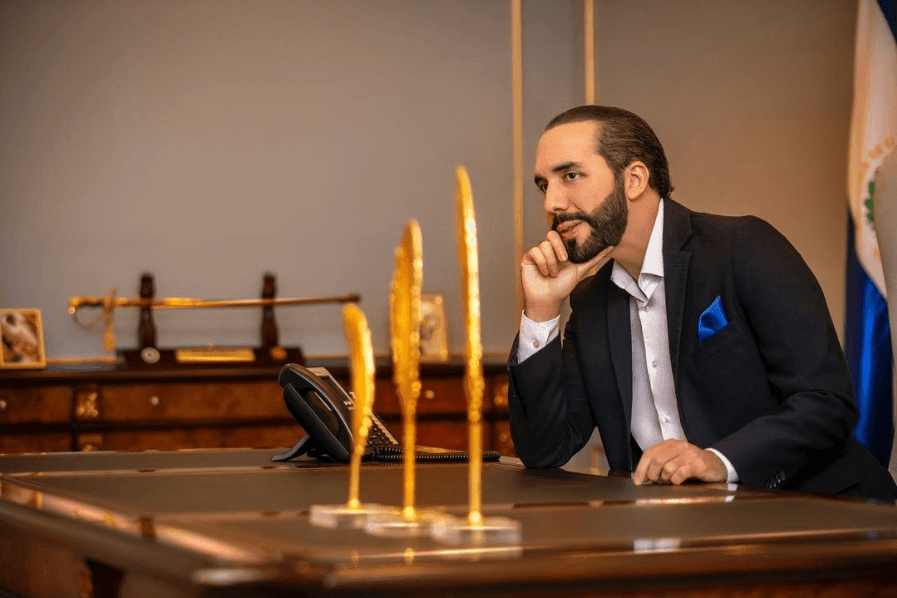
Nayib Bukele. Source: A screenshot, Instagram/nayibbukele
Mainstream analysts have criticized El Salvador’s budget plans for 2022 and its bitcoin (BTC) bond ambitions – and a media outlet has pointed out that international ratings agencies are now lining up to take aim at the nation’s President Nayib Bukele and his adoption plans.
According to El Diario de Hoy’s ElSalvador.com website, the London-based financial services company EMFI Group has echoed earlier warnings from the likes of Moody’s that the country will need USD 1.75bn in financing to meet its budgeting goals as set out in late September. However, the firm does not expect the country will reach an agreement with the International Monetary Fund (IMF).
The group claims that a strong economic recovery may well be on the cards, but El Salvador’s fiscal deficit and debt levels will remain high nonetheless.
Similar sentiments were the order of the day more recently from the America-based, Santander-owned brokerage Amherst Pierpont, which the media outlet noted has “pointed out inconsistencies in Bukele’s economic policies and his decisions on Bitcoin bonds.”
The broker was quoted as stating:
“The formal announcement of a BTC-related USD bond issuage informally confirms a break with the IMF, along with an uncertain alternative financing/growth model.”
Amherst Pierpont added that initial market reaction has been “skeptical of increased borrowing, the lack of conditionality for a coherent economic framework and latent skepticism on the matter of whether bitcoin represents a positive alternative for growth.”
Rommel Rodríguez, a researcher from El Salvador’s National Development Foundation (Funde)’s Macroeconomics and Development unit, concurred. Rodríguez was quoted as opining that the 2022 budget plan, as outlined by the government finance chief Alejandro Zelaya, seemed somewhat “optimistic.”
Rodríguez questioned whether “projected revenues” could “coincide with the expected growth rate” – although he conceded that the “projections” had been “made with a lower growth rate” in mind.
Bukele appears to be hoping that an alternative economy will arise organically at the BTC bond-powered “Bitcoin City” settlement to be built at the foot of one of the Latin American nation’s volcanoes. He has promised potential entrepreneurial residents fast-tracked residency permits, as well as virtually no taxes – barring a single VAT charge on sales.
But there could be more trouble ahead for the BTC-keen Bukele. The same media outlet also reported that the state-run Chivo wallet’s sales volumes currently “do not even account for 1{21df340e03e388cc75c411746d1a214f72c176b221768b7ada42b4d751988996} of the trade done by SMEs [small or medium-sized enterprises].”
It quoted the Society of Merchants and Industrialists of El Salvador’s Advisor Ramón Rivera, as stating that companies “continue to make transactions in dollars, despite the fact that the government has insisted they use the Chivo mobile application, with which bitcoin can be used as legal tender.”
The same group’s President, Luis Chevez, was quoted as stating:
“In our sector, [bitcoin adoption] has not materialized. People have not been going out of their way to use bitcoin. People work with the US dollar and we do not [see] the impact that bitcoin could have on the economy.”
Last month, the IMF warned El Salvador about the need to address risks related to using bitcoin as legal tender, as well as its “new payments ecosystem” and bitcoin trading. ____ Learn more: – El Salvador’s Bitcoin City, BTC Bonds Plans Met With Mixed Reaction – El Salvador Buys Bitcoin Dip Again
– Corporations & Countries Watch and Learn From El Salvador’s Bitcoin Experiment – El Salvador Bitcoin ‘Scalpers’ Force App Turnaround as Chivo Criticism Continues
Rohit Chopra, director of the Consumer Financial Protection Bureau.
Alex Edelman/Bloomberg via Getty Images
The Consumer Financial Protection Bureau is cracking down on banks charging fees for customers who overdraw their checking accounts, the bureau announced Wednesday.
The financial watchdog is planning a “range of regulatory interventions” targeting firms that rely heavily on overdraft fees as a revenue source, Rohit Chopra, director of the CFPB, said in a press call.
Overdrafts occur when customers don’t have enough funds in their accounts to cover a transaction. Banks may allow the transaction to proceed, but charge a fee to cover the cost.
Charging for overdrafts and non-sufficient funds is a big money maker for banks, and has continued during the Covid-19 pandemic, Chopra said. Banks earned more than $15 billion from such charges in 2019, a figure that has risen steadily, according to the bureau.
More from Personal Finance: Must-know changes for the upcoming tax season More than half of employers to require Covid vaccines as omicron fears grow Why Social Security retirement claims haven’t surged amid Covid-19
The fees, typically around $34 for each overdraft, largely impact families who can least afford them, Chopra said.
“Banks, especially big banks, continue to rely on overdraft and [non-sufficient funds] fees as a major source of revenue,” Chopra said. “Rather than competing on transparent upfront pricing, large financial institutions are still hooked on exploitative junk fees that can quickly drain a family’s bank account.”
The CFPB, a federal agency created by the Dodd-Frank financial reform law in the aftermath of the Great Recession, will increase its oversight of banks “heavily dependent” on overdraft fees, according to the Wednesday announcement.
Officials didn’t quantify what constitutes heavy reliance on overdraft fees. The agency will tell firms how they measure against peers, Chopra said.
The market won’t solve this on its own.
Rohit Chopra
director of the Consumer Financial Protection Bureau
The agency’s oversight will come via additional supervisory and enforcement scrutiny, according to the bureau.
The agency will take action against large banks with overdraft practices that violate the law, and officials will prioritize examinations of banks heavily reliant on overdrafts, Chopra said.
Officials declined to outline whether it will take additional steps to curb the practice.
Banks continued to charge overdraft fees during the Covid-19 pandemic, and shareholders enjoy a predictable, steady revenue stream from them, Chopra said.
Three banks — JPMorgan Chase, Wells Fargo and Bank of America — accounted for about $5 billion of total overdraft fees collected in 2019, representing 44{21df340e03e388cc75c411746d1a214f72c176b221768b7ada42b4d751988996} of the fees collected by banks with over $1 billion in assets, according to the CFPB.
Of course, not all banks charge customers for overdrafts. For example, Ally Bank, an online bank, got rid of overdraft fees earlier this year. And other firms, including PNC Bank and Bank of America, have made it tougher for customers to overdraw their accounts.
Capital One said Wednesday that it is eliminating all overdraft fees for retail banking customers starting in 2022. It’s the largest U.S. bank yet to end the industry practice. The bank expects to lose $150 million in annual revenue as a result.
Chopra said he’s not expecting other banks to follow in the near term.
“The market won’t solve this on its own,” Chopra said. “We have a clear market failure here,” he added.
A small share of households account for the bulk of overdraft revenue. About 9{21df340e03e388cc75c411746d1a214f72c176b221768b7ada42b4d751988996} of consumer accounts pay 10 or more overdrafts per year, accounting for close to 80{21df340e03e388cc75c411746d1a214f72c176b221768b7ada42b4d751988996} of all overdraft revenue, according to the CFPB.
The bureau will also “harness technology” to make it easier for customers to change banks, a difficult task due to the need to update information like automatic debits with many sources, Chopra said. He advocated for an “open banking infrastructure” in the future to make this easier, but didn’t detail how or when this might come to fruition.
(Correction: The market share of overdraft revenue for three large banks was misstated by the CFPB in an earlier version of this story. The agency has since amended the figures.)
HOUSTON, Nov. 29, 2021 /PRNewswire/ — Experienced wealth advisor Henry Bragg, CPA, CFP®, is pleased to announce the first anniversary of Henry Bragg & Co., an independent Registered Investment Advisor (RIA). Serving as the Principal, Bragg celebrates the successful launch of his firm, which offers a full complement of comprehensive portfolio and wealth management services. Foremost among the firm’s responsibilities as an investment advisor is the obligation to act in the best interests of its clients.
Building on more than 20 years of experience, including five years at professional services firm Ernst & Young, and as partner with two different investment management firms, Bragg leverages his broad experience in investments, tax, and estate planning. Henry Bragg & Co. is centered around personalized services with a hands-on, individual approach for clients. Bragg understands and communicates the “big picture” while relating it to the client’s personal needs, goals, and family values. Bragg utilizes specialized wealth mapping techniques to visually illustrate a client’s overall financial picture. Bragg believes finding perspective in the complexities of each client’s individual circumstances is key.
“While I established my career at larger firms,” Bragg said, “I saw the opportunity for a more individualized approach. The ability to serve our clients based on their specific needs and financial subtleties makes all the difference in their overall success. As a result, tailored plans are core to our work.”
In keeping with the firm’s vision and to serve clients’ needs, Henry Bragg & Co. offers a variety of services including portfolio management, retirement planning, managing trusts and estates, tax and insurance planning, charitable giving, next-generation investment education, wealth transfer design, and succession planning.
“A good wealth advisor can help clients see the forest, the trees, and where the roads need to be built.” said Bragg. “People may not think of engaging a wealth advisor until something new or significant is happening in their lives. However, having an advisor help you plan for the future is important no matter what stage of life you’re in. We all need help at some point. Life doesn’t slow down; it only moves on. Not being prepared can lead to unexpected challenges and missed opportunities.”
With a passion for helping people and building relationships, Bragg strives to be more than a financial advisor. Clients see him as a trusted partner dedicated to helping them bring their finances in good order.
Henry Bragg & Co. is a member of the Wealth Advisor Alliance and is closely supported by Forum Financial Management, recently named a Top 300 financial advisor by the Financial Times. For more information on Henry Bragg & Co. and its wealth management services, please visit www.henrybraggco.com.
About Henry Bragg & Co.
Headquartered in Houston, TX, Henry Bragg & Co. is a wealth management firm that specializes in designing tailored investment and planning strategies for its clients. Led by Principal Henry Bragg, CPA, CFP®, the firm prides itself on its detail-oriented approach to the “big picture,” believing perspective is found in the complexities of each client’s unique circumstances. The firm follows an integrated method to portfolio management, financial planning, and risk management, working closely with clients to help them streamline their situation and capitalize on the opportunities of substantial wealth. Passionate about helping people, Henry Bragg strives to be more than a financial advisor. Clients see him as a trusted partner dedicated to helping them bring their finances in good order.
Tehran, Iran, Nov. 29, 2021 (GLOBE NEWSWIRE) — During the 8 years of my experience in financial markets like Stock, Forex and cryptocurrency, according to the observations, statistics and existing data, I get that most people (about 90{21df340e03e388cc75c411746d1a214f72c176b221768b7ada42b4d751988996}) have been caused so many damages to their initial funds by entering these markets. They have not even earned money but also lost it.
I investigate 440 people, who have been in the markets more than 2 years. They indicated that they get no money and have not a little increase in their funds. But what is the reason of such a failure?
1- Lack of knowledge (not knowing yourself or markets)
Unfortunately, most people trading in the different markets have no idea about their mental and physical situations or even don’t know what works in these days. Unlike the public assumptions, interest and attempt is not enough to be successful in the markets. These are just the basics, there are much more things to know that I just name some the most important ones:
Being patient: There is no way to get rich in one night. Markets act like a swamp for those who are not patient. It gets hours, months and years to reach the point that you start making continuous profits.
Having enough time: Trading is not a part-time job. You need to spend several hours a day, especially in the beginning, for studying, learning and monitoring the charts in order to identify investing opportunities. If you don’t have much time, it’s better to avoid the markets.
Being disciplined: Act like a robot. Don’t get emotional and freaky. If you behave like a robot which has organized mind(programs), no feelings, you’ll be surely successful. Otherwise, you’ll fail with no doubt.
Knowing markets in depth: Markets differs in rules and the types of activities. Each market has its own way and identity and it’s necessary to know it in depth ahead. This helps you to get whether your intended market fits your situation and personality or not. For instance, ask yourself if your ideal market is the one in which you can have daily and short-term trades or middle/long-term trades. You can also think of what kind of analysis is needed to be used in this market. Do you know it by heart? Does the working hours of that market match the hours of your country? And etc. These questions cause you to make the best decisions.
2-Letting feelings take control of you
As the researches show, most people give in to their emotions and excitements. Because they don’t want to stay behind, they start trading without any knowledge or experience. This causes them hard failures and losses.
Why think of studying and compensating while you can do it sooner and avoid losses?
3-Wrong information
I told you about the risks of getting into the markets without any knowledge. But you know what is the worse? Being part of the market while you’ve got wrong information. Sometimes people have trained ahead but the things they’ve learned is not correct or enough due to lack of accurate information sources. Many people who work in the field of financial market training, are not qualified and their wrong teachings lead people to a wrong way.
According to my research on 440 traders, this 2nd group suffers more losses than the ones who know nothings about the markets. The first group do what the specialized tell them but the second group act by their incorrect information.
4-Lack of a clear trading plan
More than 90{21df340e03e388cc75c411746d1a214f72c176b221768b7ada42b4d751988996} of the financial markets’ participants don’t have a clear trading plan and it leads them to failures. Having no clear trading plan and strategies will end to irrational behaviors.
These people are doomed to failure due to lack of rules, orders, disciplines and strategies.
I always urge my students to have a written trading plan and check it carefully before entering into any trade. It’s a big help to write down the strategy you have in mind.
5-Lack of attention to trading risks
The most important difference between successful and unsuccessful people is that the successful usually weight the risks of the trade they want to enter, so they avoid emotional and irrational behaviors and also the risky trades with high levels.
On the contrary, the amateurs just think of the profits and as a result, the risk of the trades increases. These people even the best analyzer of them will eventually lose their profits in several small loss-making trades with high risk.
6-Eccentric expectations
Trading is hard and stressful and needs high consideration. Having eccentric expectations will add to this stress and make you distracted. When the markets do not meet your expectations, your attentions will fly away and there is no end to the loop of mistakes.
The path of success is slow and continuous and there is no shortcut. When you get this, your mind will settle down, expectations will fade away and instead focus and work efficiency increase.
7-Addiction to trading
Many traders are involving in a problem called overtrade. They get used to trading again and again with no stop. As a result, they lost their logic and mind orders. Finally, because of low mind efficiency and lack of discipline, they lost so much money.
Their main problem is not being able to filter the trades. They see a chance and rush into it without considering the risks. Most of the times, these traders don’t get successful in spite of their efforts and the number of the trades they do.
These are just some of the reasons why people are not successful in financial markets but also the most important ones that are almost common among all those who have experienced many failures in the markets.
According to what said, I can say on contrary to popular belief in the simplicity of working in financial markets, working in these markets requires precise knowledge, sufficient time, patience and extensive training.
I believe that the philosophy of creating financial markets for real and small people is to make them lose. Their losses will bring profits to the big traders. This is also the main reason for your easy way to the financial markets and your access to a variety of credits and levers.
That’s why I recommend you to study this essay before stepping in the markets and investigate the nature of each. In the first months, use demos to practice until you get enough experienced and find yourself a real and written trade plan and strategy.
After that you’re ready to start trading. Try it with the 10{21df340e03e388cc75c411746d1a214f72c176b221768b7ada42b4d751988996} of your money, the one which will not cause big pain if lost. Examine your trading plan in real market for about 6 months. It is possible to experience many failures during this time but no matter. This is the expenses of getting experienced. For these six months, the purpose is not getting successful and earning money but is not to fail.
I promise if you hold on these 6 months and trade (while controlling your emotions and considering all possible risks) in order to keep the money (even if you earn not a dollar), you will definitely be one of the best traders in future. And after 5 years, you’ll be in a position that many dream of.
CONTACT: Media Company: Mahan Teymouri International Holding & Kaafx, Media Name: Vahid Kardanian, Media Phone: +982143000203, Media Email: Mahanteymouri@gmail.com, Media URL: https://mahanteymouri.com/
Amaravati: Unbridled revenue expenditure and constricted capital expenditure have pushed Andhra Pradesh’s finances into disarray, causing a revenue deficit of a staggering Rs 26,441 crore (1,486.28 per cent over the estimate) in the year 2019-20, the Comptroller and Auditor General of India has observed.
The CAG strongly rebuked the state government over the gross financial mismanagement, particularly in failing to contain the mounting revenue deficit, and violation of the FRBM Act.
The CAG found fault with the government over the grossly decreased capital expenditure in the year 2019-20 and said it pointed to the need for a review of the fiscal strategy and creation of the fiscal space for increased capital expenditure, which in turn, would help in promoting and accelerating equitable growth.
The liabilities of the state have been increasing year-on-year and, over 80 per cent of the borrowings during 2019-20 were utilised only to balance the Revenue Account, affecting asset creation.
The CAG, in its State Finances Audit Report for the year ending March 2020, observed that the government AP needed to estimate its resources “more realistically” and manage its expenditure “judiciously”.
The CAG report was tabled in the state Legislature on Friday.
The report noted that the state failed to contain revenue deficit during 2015-20, despite receipt of post-devolution Revenue Deficit Grants (to the tune of Rs 22,112 crore) from the Centre as per the 14th Finance Commission recommendations.
Revenue deficit of Rs 26,441 crore in 2019-20 was substantially higher than the Budget estimates (Rs 1,779 crore) due to the introduction of new schemes like Amma Vodi (Rs 6,349.47 crore) and nine-hour free power supply to the agriculture sector (Rs 4,919.84 crore) during 2019-20 and a decrease in state’s own revenue of Rs 1,511 crore over the previous year, it said.
Comparatively, the state incurred a capital expenditure of only Rs 12,242 crore, including Rs 1,830.93 crore funded by the Centre, that constituted mere 7.89 per cent of the total expenditure during 2019-20 and fell way short of the Budget estimate of Rs 32,293 crore. It accounted for only 1.26 per cent of the Gross State Domestic Product and decreased by Rs 7,734 crore (38.72 per cent) from the previous year.
The report said there were instances of misclassification of revenue transactions under capital section and non-accounting of other liabilities that would have pushed up the deficits to a further extent.
The outstanding debt of the state showed an increasing trend during the five-year period 2015-20. The debt that was Rs 1,73,854 crore during 2015-16, mounted to Rs 3,01,802 crore in 2019-20, marking an increase of 73.60 per cent, the CAG observed.
The off-budget borrowing liability of Rs 26,096.98 crore has not been disclosed appropriately as part of the state budget documents.
“This has the impact of diluting public financial management and oversight role of the Legislature and placing major sources of funding of government’s crucial infrastructure projects beyond the control of the Legislature,” the CAG remarked.
“Sound budgetary management requires advance planning and accurate estimation of revenues and expenditure. There were instances of incurring excess expenditure or large savings against the provisions made during the year, which point to flaws in expenditure monitoring and control, the CAG noted.
It warned that “persistent excess expenditure” over grants approved by the state Legislature was a violation of the “will of the Legislature” and needed to be viewed seriously.
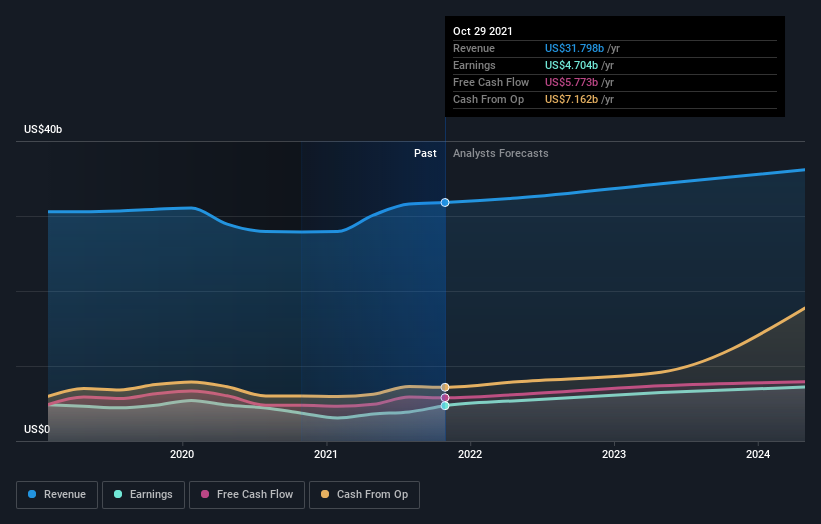
Last week, you might have seen that Medtronic plc (NYSE:MDT) released its second-quarter result to the market. The early response was not positive, with shares down 2.7{21df340e03e388cc75c411746d1a214f72c176b221768b7ada42b4d751988996} to US$114 in the past week. It was a credible result overall, with revenues of US$7.8b and statutory earnings per share of US$0.97 both in line with analyst estimates, showing that Medtronic is executing in line with expectations. This is an important time for investors, as they can track a company’s performance in its report, look at what experts are forecasting for next year, and see if there has been any change to expectations for the business. Readers will be glad to know we’ve aggregated the latest statutory forecasts to see whether the analysts have changed their mind on Medtronic after the latest results.
NYSE:MDT Earnings and Revenue Growth November 26th 2021
Taking into account the latest results, Medtronic’s 25 analysts currently expect revenues in 2022 to be US$32.4b, approximately in line with the last 12 months. Per-share earnings are expected to grow 12{21df340e03e388cc75c411746d1a214f72c176b221768b7ada42b4d751988996} to US$3.90. Yet prior to the latest earnings, the analysts had been anticipated revenues of US$33.0b and earnings per share (EPS) of US$3.96 in 2022. So it’s pretty clear that, although the analysts have updated their estimates, there’s been no major change in expectations for the business following the latest results.
There were no changes to revenue or earnings estimates or the price target of US$141, suggesting that the company has met expectations in its recent result. The consensus price target is just an average of individual analyst targets, so – it could be handy to see how wide the range of underlying estimates is. There are some variant perceptions on Medtronic, with the most bullish analyst valuing it at US$155 and the most bearish at US$127 per share. The narrow spread of estimates could suggest that the business’ future is relatively easy to value, or thatthe analysts have a strong view on its prospects.
Looking at the bigger picture now, one of the ways we can make sense of these forecasts is to see how they measure up against both past performance and industry growth estimates. It’s clear from the latest estimates that Medtronic’s rate of growth is expected to accelerate meaningfully, with the forecast 3.8{21df340e03e388cc75c411746d1a214f72c176b221768b7ada42b4d751988996} annualised revenue growth to the end of 2022 noticeably faster than its historical growth of 0.3{21df340e03e388cc75c411746d1a214f72c176b221768b7ada42b4d751988996} p.a. over the past five years. Compare this with other companies in the same industry, which are forecast to see revenue growth of 8.9{21df340e03e388cc75c411746d1a214f72c176b221768b7ada42b4d751988996} annually. So it’s clear that despite the acceleration in growth, Medtronic is expected to grow meaningfully slower than the industry average.
The Bottom Line
The most important thing to take away is that there’s been no major change in sentiment, with the analysts reconfirming that the business is performing in line with their previous earnings per share estimates. On the plus side, there were no major changes to revenue estimates; although forecasts imply revenues will perform worse than the wider industry. The consensus price target held steady at US$141, with the latest estimates not enough to have an impact on their price targets.
With that in mind, we wouldn’t be too quick to come to a conclusion on Medtronic. Long-term earnings power is much more important than next year’s profits. We have forecasts for Medtronic going out to 2024, and you can see them free on our platform here.
It is also worth noting that we have found 1 warning sign for Medtronic that you need to take into consideration.
This article by Simply Wall St is general in nature. We provide commentary based on historical data and analyst forecasts only using an unbiased methodology and our articles are not intended to be financial advice. It does not constitute a recommendation to buy or sell any stock, and does not take account of your objectives, or your financial situation. We aim to bring you long-term focused analysis driven by fundamental data. Note that our analysis may not factor in the latest price-sensitive company announcements or qualitative material. Simply Wall St has no position in any stocks mentioned.
Have feedback on this article? Concerned about the content?Get in touch with us directly. Alternatively, email editorial-team (at) simplywallst.com.
The views and opinions expressed herein are the views and opinions of the author and do not necessarily reflect those of Nasdaq, Inc.





 View original content to download multimedia:




 NYSE:MDT Earnings and Revenue Growth November 26th 2021