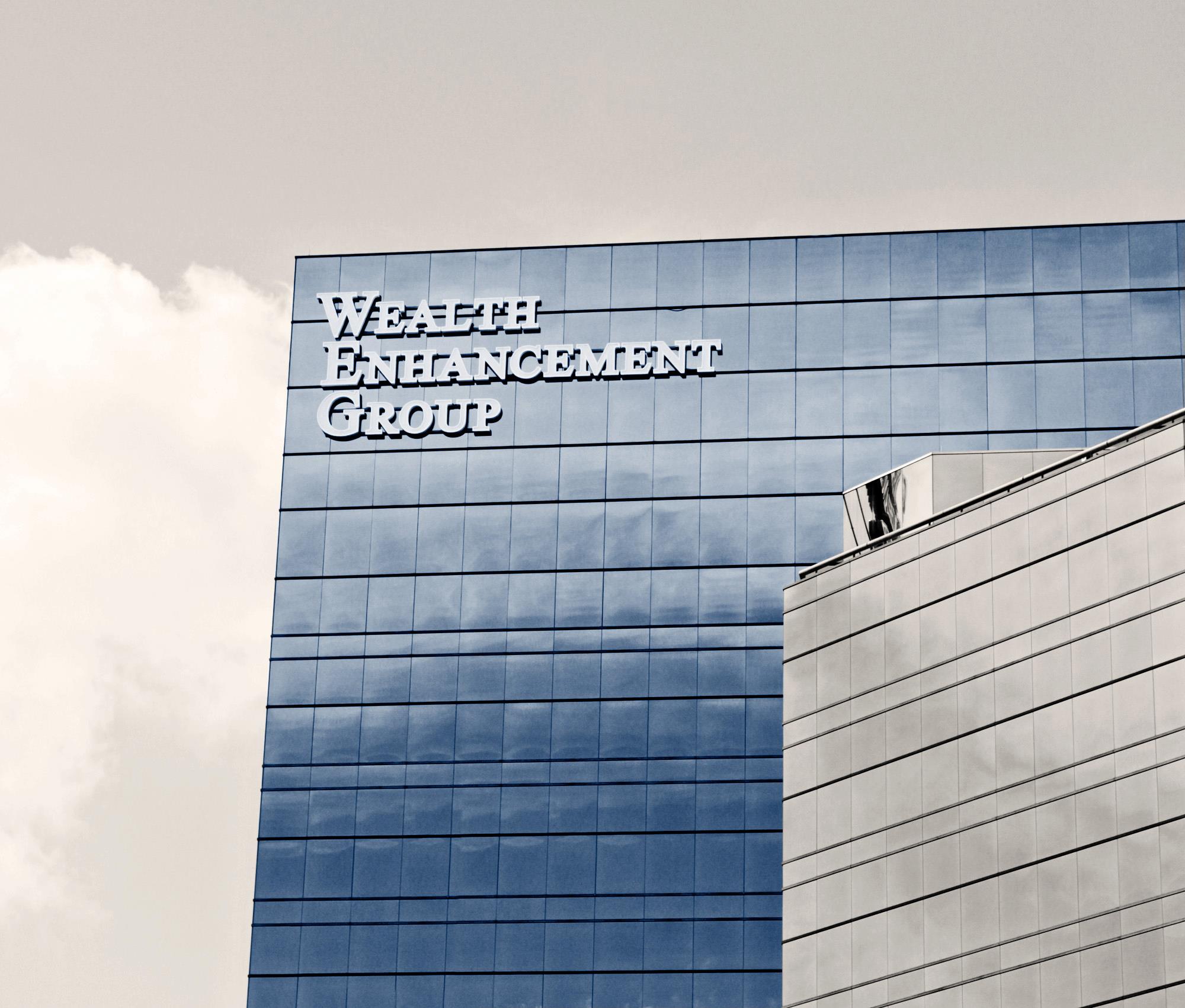

Wealth Enhancement Group Acquires Vivid Financial Management

Wealth Enhancement Group is acquiring Vivid Financial Management, a hybrid RIA based in central California with $674 million in client assets under management, the firm announced. The acquisition will push WEG’s AUM above $55 billion.

WEG CEO Jeff Dekko said the group was excited to work with the six-advisor practice “shoulder-to-shoulder” in the coming years, adding Vivid built a strong track record of planning-centered client service that brandished their reputation as a high-quality firm. In an interview with WealthManagement.com, Dekko also said the deal was indicative of WEG’s broader approach to acquisitions, and that the firm was not looking to buy firms everywhere solely for the sake of scale.

“National scale clearly matters, but we also believe local scale matters, because it creates a number of opportunities to create more team activity at a local level, and allows us to deliver business development and resources within that,” he said.

Vivid was founded in 2015, and includes three locations in Orcutt, Lompoc and Arroyo Grande, Calif. The firm was founded by Julie Darrah, Brad Boulton, Todd Woodland and Tim Miller, and its clientele includes executives, families and clients that range from physicians to dentists, educators and farmers. It offers an array of financial planning services, including tax, estate and insurance planning, as well as asset management services and retirement planning support.

With the addition of the three Vivid offices, the Minneapolis, Minn.-based WEG will now have seven outposts in California. According to Dekko, WEG began boosting its California presence in early June and July with acquisitions in the Los Angeles area (though the acquired firms had satellite offices in San Francisco). In considering how to broaden their Golden State reach, Dekko said they’d intended to mirror their approach in areas like the Northeast, where they set up shop in metro centers and branched out into the region like spokes on a wheel. Vivid became central to their California expansion, Dekko said.

“These folks came to us and they were just so good that we were ready to start that ‘spoke’ process,” he said.

WEG’s dealmaking has been prolific this year, with 16 in 2021 alone. In late September, the company announced its largest ever addition, acquiring QCI Asset Management, a 46-year-old independent RIA based in western New York, with $5.2 billion in total client assets (it was also WEG’s first acquisition in the region). The previous largest deal had been finalized earlier that same month, when WEG added the Charlotte, N.C.-based RIA Carroll Financial Associates, which had assets totaling about $4.7 billion. In August, the firm announced it was getting an investment from private equity firm Onex Corp., which became equal capital partners in WEG with TA Associates.

Dekko said WEG would likely announce more West Coast-based acquisitions soon, and also would continue its concentration on the Southeast. Helping direct the firm for the long-term was their belief that the number of transactions occurring among firms with an asset range of $500 million to $3 billion was likely to continue, but he expected at some point in the race for consolidation, aggregators would begin to consolidate themselves.

“I think that same thing is yet to come for us,” he said. “I think you’ll start to see it in 2022, and maybe 2023, you’ll start to see a little bit of that, maybe.”

Financial terms on the deal weren’t disclosed, but the deal will close on Dec. 31, with Darrah, Boulton and Miller all coming onboard as senior vice presidents and financial advisors at WEG.

ITC announces first-ever Institutional Investors and Financial Analysts Day on 14 December; analysts expect major announcements

ITC Limited stocks were in news on Thursday after the company informed the exchanges about an analyst and investor day, scheduled on 14 December. The news has already created a lot of buzz, analysts opined.   

The event ‘ITC Institutional Investors and Financial Analysts Day 2021’ is scheduled for 14th December. The six-hour event is also its first-ever and will be held between 10:30 am and 5 pm, the company said in its filing to exchanges. 

See Zee Business Live TV Streaming Below:

Technical Analyst Sacchitanand Uttekar said that the news was a positive trigger for the stock today and the company is expected to announce something major, calling this event “unprecedented” for the ITC.  

Uttekar, who is DVP-Head-Technicals & Derivatives at Tradebulls Securities said that he expected ITC to announce a demerger of its businesses. If this happens it will augur well for the company and its different businesses. This will not only help in the value unlocking of its businesses but also propel the stock prices, significantly, he added. 

The company has business interests in sectors including Fast Moving Consumer Goods (FMCG), IT, packaging, hotels and agri-business.  

ITC also remains a preferred by for this analyst and he recommended this stock for target of Rs 275. The stock today ended Rs 234.80, up by almost 4.4 per cent or over Rs 9 from the Wednesday closing price. He had recommended this stock at levels around Rs 229.  

Also Read: Stocks to Buy: With 20{21df340e03e388cc75c411746d1a214f72c176b221768b7ada42b4d751988996} upside, ITC is ‘preferred buy’ for this technical analyst; know why?

The views were also endorsed by another analyst, Sandeep Jain. The Tradeswift Director called this a positive development for the company and investors. 

He said that he expected some announcements around the demerger of ITC’s businesses. The demerger will trigger value unlocking of its various businesses, he opined. 

Even the top management has indicated its concerns around valuation, Jain said adding that some positive news was likely in the offing. 

See Tweet: 

It could be around bonus as well, he further said. Though the picture will get clear only after the analyst meet, he said.       

(Disclaimer: The views/suggestions/advises expressed here in this article is solely by investment experts. Zee Business suggests its readers to consult with their investment advisers before making any financial decision.)  

Stock futures edge up as investors await inflation data

Stock futures opened higher Thursday evening as investors awaited a key inflation report ahead of the Federal Reserve’s final policy-setting meeting of the year next week. 

Contracts on the S&P 500 gained. Earlier, the blue-chip index closed out the regular session in the red after three consecutive days of gains, with concerns over Omicron beginning to ease as new developments suggested the variant may not cause as severe of infections as previously feared. The Nasdaq dropped 1.7{21df340e03e388cc75c411746d1a214f72c176b221768b7ada42b4d751988996} during the regular trading day, but was still on track for a weekly return of nearly 2.9{21df340e03e388cc75c411746d1a214f72c176b221768b7ada42b4d751988996} after posting solid gains earlier this week. 

Investors on Friday are set to receive the Labor Department’s latest Consumer Price Index (CPI), which is expected to show another multi-decade high rate of inflation for November. Consensus economists are looking for the CPI to climb by 6.8{21df340e03e388cc75c411746d1a214f72c176b221768b7ada42b4d751988996} in November over last year, or the fastest annual rate since the 1980s. And even excluding more volatile food and energy prices, the core CPI likely rose by 4.9{21df340e03e388cc75c411746d1a214f72c176b221768b7ada42b4d751988996} over last year, or the fastest rate in about three decades.  

“We think that inflation is still going to be pretty broad when we see tomorrow’s report,” Luke Tilley, Wilmington Trust chief economist, told Yahoo Finance Live on Thursday. “But what we’re looking for is a deceleration as we go forward over the course of 2022.”

“That doesn’t mean prices are going to go down, it’s just a question of, are they going to go up as much in 2022 as in 2021 without the kind of fiscal stimulus we’ve had this year? And we don’t think that that’s going to happen, because it won’t be as much of a push on the demand side,” he added. “And then on the supply side, we’re looking for the labor market to improve, more people returning to work, and of course the delivery and the ports to improve.”  

Other recent data have further underscored the present tightness on the supply side of the economy. Weekly U.S. jobless claims plunged more than expected to reach the lowest level since 1969 last week, coming in even below pre-pandemic levels. And U.S. job openings came in at more than 11 million for only the second time on record in October.  

“Wage increases are probably on the agenda for next year. That’s part of the broadening of inflationary pressures that we’ve already started to see come through in some of that CPI data,” Seema Shah, Principal Global Investors chief strategist, told Yahoo Finance Live on Thursday. “But I have to say that we’re not so worried because we’re starting to see other parts of the inflation picture actually starting to fade. So at the end of next year, 12 months from now, we’re not expecting the kind of 6-7{21df340e03e388cc75c411746d1a214f72c176b221768b7ada42b4d751988996} CPI numbers that we may see tomorrow. We’re thinking more the 3{21df340e03e388cc75c411746d1a214f72c176b221768b7ada42b4d751988996} level for 12 months time.” 

Given the backdrop of elevated inflation, Federal Reserve officials have adopted more hawkish rhetoric about the monetary policy path forward. Some pundits suggested more rotation could occur in U.S. equity markets beneath the surface as investors price in expectations for tighter Fed policy to rein in inflation. The Federal Open Market Committee is slated to hold its final two-day monetary policy-setting meeting of the year next week. 

“If we go back to the bulk of the second half of 2020 and for much of this year, the pendulum of risk-on, risk-off in the market was really simply occurring just below the surface of the index, of the S&P 500 —meaning that when there was a risk-on rally, it was value and it was cyclicals,” Craig Fehr, principal and leader of investment strategy for Edward Jones, told Yahoo Finance Live on Thursday. “And when it was risk-off and the risk appetite was declining, it was tech that was the safe haven.”

“What we’re seeing is a transition now, particularly as the Fed is signaling a withdrawal of some of this excess liquidity and stimulus that’s been in place for quite some time,” he added. “The market isn’t going to run directly into high-valuation, perhaps tech names broadly like it has over the past year-and-a-half. I think we’re going to see more discernment.” 

6:25 p.m. ET Thursday: Stock futures open higher 

Here were the main moves in markets in late trading on Thursday:

  • S&P 500 futures (ES=F): +6.5 points (+0.14{21df340e03e388cc75c411746d1a214f72c176b221768b7ada42b4d751988996}), to 4,673.50

  • Dow futures (YM=F): +34 points (+0.1{21df340e03e388cc75c411746d1a214f72c176b221768b7ada42b4d751988996}), to 35,787.00

  • Nasdaq futures (NQ=F): +25.25 points (+0.16{21df340e03e388cc75c411746d1a214f72c176b221768b7ada42b4d751988996}) to 16,174.00

NEW YORK, NEW YORK - DECEMBER 08: Traders work on the floor of the New York Stock Exchange (NYSE) on December 08, 2021 in New York City. Following news from the pharmaceutical company Pfizer on the effectiveness of its vaccine against the Omicron COVID-19 variant, the Dow Jones Industrial Average rallied nearly 100 points in morning trading on Wednesday. (Photo by Spencer Platt/Getty Images)

NEW YORK, NEW YORK – DECEMBER 08: Traders work on the floor of the New York Stock Exchange (NYSE) on December 08, 2021 in New York City. Following news from the pharmaceutical company Pfizer on the effectiveness of its vaccine against the Omicron COVID-19 variant, the Dow Jones Industrial Average rallied nearly 100 points in morning trading on Wednesday. (Photo by Spencer Platt/Getty Images)

Emily McCormick is a reporter for Yahoo Finance. Follow her on Twitter

SEC chair Gensler seeks tougher SPAC disclosure, liability rules

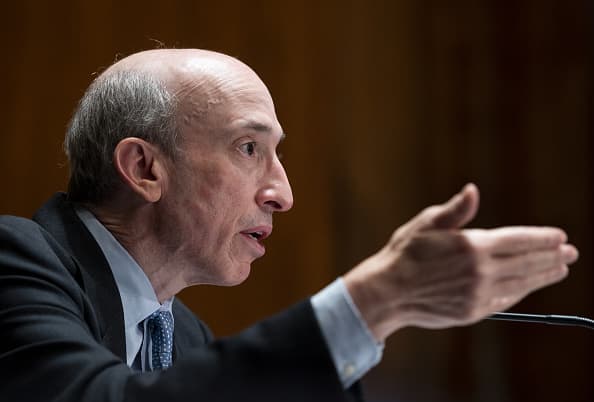
Gary Gensler, chairman of the U.S. Securities and Exchange Commission (SEC), speaks during a Senate Banking, Housing and Urban Affairs Committee hearing in Washington, D.C., U.S., on Tuesday, Sept. 14, 2021.

Bill Clark | Bloomberg | Getty Images

Securities and Exchange Commission Chairman Gary Gensler on Thursday floated several potential SPAC rules he hopes the regulator will consider as it works to oversee one of Wall Street’s up-and-coming ways to take companies public.

Among the ideas Gensler pitched were new rules around marketing practices, tougher disclosure requirements and liability obligations for SPAC “gatekeepers,” which could include sponsors, financial advisors and other bookkeepers.

Specifically, the SEC chief said he’d like to see new rules that compel SPACs to provide investors with more information about fees, expected equity dilution and conflicts, as well as better ways to access that information before an investment is made.

SPACs, or special-purpose acquisition companies, have been around for decades without much fanfare.

Also known as a blank-check company, a SPAC is a shell company that raises money and trades on public markets while looking to merge with a private company. Their eventual marriage will bring the private firm into the public marketplace, meaning that investors in the public SPAC will have an opportunity to own a piece of the still-private target.

The public push for new SPAC rules comes days after news broke that the SEC and other federal regulators are investigating a SPAC merger involving former President Trump’s fledgling media company.

The SPAC, called Digital World Acquisition Corp., disclosed in a filing earlier this week that regulators began asking for information about certain stock trades “that preceded the public announcement of the October 20, 2021 Merger Agreement” with Trump’s firm.

Gensler said Thursday that he is concerned by a disconnect between the amount of information that companies are required to provide through a traditional initial public offering versus the disclosures required from SPACs.

“Currently, I believe the investing public may not be getting like protections between traditional IPOs and SPACs,” the SEC chair said in remarks at the virtual Healthy Markets Association Conference. “Due to the various moving parts and SPACs’ two-step structure, I believe these vehicles may have additional conflicts inherent to their structure.”

Appointed by President Joe Biden earlier this year, Gensler said added rules clamping down on marketing prior to proper disclosure may also be needed to help anchor the value of the SPAC’s shares closer to the business’s actual worth.

Glitzy corporate presentation decks, hyped press releases and celebrity endorsements can balloon a SPAC’s equity well beyond a reasonable value long before proper disclosures are filed, Gensler said.

CNBC Politics

Read more of CNBC’s politics coverage:

In the past two years, SPACs have blossomed into a popular alternative to traditional initial public offerings and a way to invest in start-ups.

The allure of possibly finding the next Amazon or Apple, prior to a young company’s entrance to public markets, has drawn billions from Wall Street in 2021. SPACs have raised as much money as traditional IPOs this year thanks to the support of big banks and investment firms.

But Gensler and others worry that insufficient SPAC disclosures leave investors open to steep losses in the future.

While Gensler did not offer more specific details on the rules he wants to see from SEC staff, his speech reinforces Wall Street’s belief that his tenure will result in a hands-on approach and that the chairman will serve as a stricter “cop on the beat” toward Wall Street.

He said he wants the SEC to ensure SPAC directors, officers, sponsors and financial advisors aren’t misleading investors with inflated financial projections only to stiff them with a backlog of bills — or a mediocre business — after the merger is complete.

“In traditional IPOs, issuers usually work with investment banks,” he said. “Thus, a lot of people think the term ‘underwriters’ solely refers to investment banks.”

“There may be some who attempt to use SPACs as a way to arbitrage liability regimes,” Gensler continued. “Many gatekeepers carry out functionally the same role as they would in a traditional IPO but may not be performing the due diligence that we’ve come to expect.”

While some take-public SPACs have seen success on Wall Street — electric-vehicle maker Lucid Group or personal-finance company SoFi, for example — others have seen mixed trading among investors.

Some of the well-known public companies resulting from SPAC mergers include space-tourism firm Virgin Galactic and online real-estate company Opendoor. Both have seen their equity slide more than 30{21df340e03e388cc75c411746d1a214f72c176b221768b7ada42b4d751988996} this year.

The proprietary CNBC SPAC Post Deal Index, which is comprised of the largest SPACs that have already completed a SPAC merger within the last two years, is down more than 33{21df340e03e388cc75c411746d1a214f72c176b221768b7ada42b4d751988996} in 2021.

The market fever hasn’t broken

A feeling of unreality still pervades financial markets. Investors who take fiduciary duties seriously still exist — but they’re seemingly outnumbered by people who see investing as a fun get-rich-quick game.

Why it matters: The post-pandemic return to some kind of pre-pandemic “normal” has yet to arrive, and as a result there’s a lot of worry about the disruption and volatility that could accompany such a transition. The markets, so far, have done an excellent job of climbing that wall of worry.

The big picture: The defining characteristic of the pandemic era has been feverishness. The initial weeks of uncertainty and isolation felt like a fever dream, with time dilating and reality warping. After that, the whole country entered a particularly febrile state, as the Black Lives Matter movement and the 2020 presidential election ratcheted up the nation’s emotional temperature to unsustainable levels.

  • Markets have not been immune. In some ways, they’re the last bastion of delirium, in a country where vaccines and a boring president have allowed much of the country to feel some semblance of normality.
  • Money has become something to play with for fun and profit. There are even now hundreds of play currencies, some of which are worth hundreds of billions of dollars, for people who find government-issued money too constrained.
  • The decadence is increasingly offensive to anybody living paycheck to paycheck, or even just people brought up to respect the value of a dollar.

Be smart: The strength of the economic rebound from the March 2020 recession came as a surprise to almost everyone — and helped to create windfall gains in everything from NFTs to mega-cap stocks.

  • Get-rich-quick fever has reached unprecedented levels over the past 18 months, encompassing everything from GameStop and Dogecoin to SPACs and even Spider-Man tickets. One company became a unicorn by persuading individual investors to buy securitized art.

Financial shenanigans are everywhere you look; Bloomberg’s Matt Levine, for instance, has a masterful dissection of the $1 billion private investment in Donald Trump’s barely-existent new social-media company — a classic greater-fool trade which doesn’t need to be based on any underlying value at all.

What they’re saying: Pollster Bruce Mehlman cites “extreme expectations” as the number one risk facing the U.S. in 2022. “Lack of realism and perspective is itself a major risk,” he tells Axios. “It undermines the rationality-based cooperation essential for the nation and its institutions to succeed as designed.”

The bottom line: The occasional crypto crash doesn’t mean the fever has broken. It just means the game is still exciting.

Business News for Dec. 9, 2021

WASHINGTON — Lawmakers of both parties came out swinging in a hearing on Wednesday with Adam Mosseri, the head of Instagram, expressing deep skepticism and anger toward the company for not doing enough to protect young users.

In a hearing held by a Senate subcommittee on consumer protection, lawmakers grilled Mr. Mosseri on internal research leaked by a whistle-blower that showed Instagram had a toxic effect on some teenagers. They pressed him to commit to share data with researchers on algorithmic ranking systems and to support legislation for stronger privacy and security protections for children online.

Even Instagram’s announcements this week on new safety tools for children were too little and too late, they said.

“Facebook’s own researchers have been warning management, including yourself, Mr. Mosseri, for years,” said Senator Richard Blumenthal, Democrat of Connecticut and chairman of the subcommittee. “Parents are asking, what is Congress doing to protect our kids and the resounding bipartisan message from this committee is that legislation is coming. We can’t rely on self-policing.”

The hearing is part of a growing effort in Washington to rein in the power of Silicon Valley’s biggest companies. Antitrust regulators are seeking to break up Google and Meta, the parent company of Facebook and Instagram, and lawmakers have introduced dozens of data privacy, speech and competition bills.

Calls for legislative changes have intensified in recent weeks, after a whistle-blower at Facebook leaked internal research that said Instagram led one out of three teenagers to feel worse about their body image and for as many as 16 percent of some teenagers in Britain to have thoughts of suicide. The documents obtained by the whistle-blower, Frances Haugen, often contradicted public statements made by Meta officials, who have long underplayed or rebutted criticism that Instagram harms the mental and emotional well-being of younger users.

“You better tell the truth,” Senator Amy Klobuchar, a Democrat of Minnesota, told Mr. Mosseri. “You’re under oath.”

Mr. Mosseri, 38, was appearing before Congress for the first time. He is a longtime executive at Facebook and is considered a close lieutenant of the company’s chief executive, Mark Zuckerberg. He joined the company in 2008 as a designer and gradually rose in the ranks to run the News Feed, a central feature of the Facebook app. In October 2018, he was named head of Instagram, weeks after the sudden resignations of the app’s founders, Kevin Systrom and Mike Krieger.

He told lawmakers that Instagram often had a positive role in the lives of teenagers, such as by helping them establish connections during difficult times. He tried to direct attention at rivals, noting that more teenagers use TikTok and YouTube. He also acknowledged the skepticism among members of Congress toward Meta.

“I recognize that many in this room have deep reservations about our company,” Mr. Mosseri said. “But I want to assure you that we do have the same goal. We all want teens to be safe online.”

On Tuesday, Instagram announced new safety features for children. Mr. Mosseri mentioned those changes in the hearing, which include tools like a “take a break” function that is meant to help limit time spent online. (TikTok has a similar function that appears when users are spending too much time on the app.)

But Senator Marsha Blackburn of Tennessee, the ranking Republican member of the subcommittee, said even the basic promises of privacy and security from the company had failed users.

This week, her staff set up an experimental account for a fictional 15-year-old and were surprised to find the profile automatically set to public exposure. Instagram says teenage accounts automatically default to the private setting.

Mr. Mosseri acknowledged the error and said Ms. Blackburn’s office exposed a flaw in Instagram’s controls that sets teenage accounts that were created on a web browser — and not on a mobile app — to public. “We will correct that,” Mr. Mosseri said.

Mr. Blumenthal’s office has received hundreds of calls and emails from parents about their negative experiences with Instagram, he has said. One parent recounted how her daughter’s interest in fitness on Instagram led the app to recommend accounts on extreme dieting, eating disorders and self-harm.

Mr. Blumenthal has homed in on the algorithms, which he called “800-pound gorillas in black boxes,” that push such recommendations.

Lawmakers, including Mr. Blumenthal and Ms. Blackburn, have proposed stronger data privacy rules aimed at protecting children and greater enforcement of age restrictions. They have also called for young users to be able to delete information online. Lawmakers have pursued similar legislation before, with little success. Though lawmakers often show bipartisan unity in the hearings, dozens of data privacy bills have been stymied by intense industry lobbying and partisan disagreement over how stringent laws should be.

Senator John Thune, a Republican of South Dakota, has introduced a bill that would force companies to reveal more about their algorithmic ranking system. He asked if Instagram would allow users to rank their content chronologically, instead of through opaque decisions based purely on engagement.

Mr. Mosseri said the company was working on the feature, which could be available next year.

Though Mr. Mosseri repeated his support for regulations, he demurred when asked about specific proposals. He said he hadn’t read a bill introduced by Mr. Blumenthal and other lawmakers that could hold Meta liable for hosting harmful content. He wouldn’t commit to give up completely on the idea of building a version of the Instagram app for users under the age of 13. And he didn’t directly answer questions as to whether victims should be able to sue Meta for hosting sex-trafficking content.

Child advocacy groups said Mr. Mosseri failed to provide any greater assurances that Instagram would prioritize child safety.

“Today’s hearing was just more of the same: evasions, empty promises, and too-little, too-late gestures aimed at forestalling congressional action instead of meaningfully addressing Instagram’s harmful business model and design choices,” said Josh Golin, executive director of Fairplay.

Leaders of the subcommittee said they would hold additional hearings, which may include more executives of Meta. Mr. Blumenthal said Mr. Mosseri’s vague commitment for “directional” support on laws “doesn’t cut it.”

“This industry has said it is in favor of government regulation but they have opposed specific measures with armies of lawyers and lobbyists and tons of money,” Mr. Blumenthal said.