Business News for Dec. 9, 2021

Business News for Dec. 9, 2021

WASHINGTON — Lawmakers of both parties came out swinging in a hearing on Wednesday with Adam Mosseri, the head of Instagram, expressing deep skepticism and anger toward the company for not doing enough to protect young users.

In a hearing held by a Senate subcommittee on consumer protection, lawmakers grilled Mr. Mosseri on internal research leaked by a whistle-blower that showed Instagram had a toxic effect on some teenagers. They pressed him to commit to share data with researchers on algorithmic ranking systems and to support legislation for stronger privacy and security protections for children online.

Even Instagram’s announcements this week on new safety tools for children were too little and too late, they said.

“Facebook’s own researchers have been warning management, including yourself, Mr. Mosseri, for years,” said Senator Richard Blumenthal, Democrat of Connecticut and chairman of the subcommittee. “Parents are asking, what is Congress doing to protect our kids and the resounding bipartisan message from this committee is that legislation is coming. We can’t rely on self-policing.”

The hearing is part of a growing effort in Washington to rein in the power of Silicon Valley’s biggest companies. Antitrust regulators are seeking to break up Google and Meta, the parent company of Facebook and Instagram, and lawmakers have introduced dozens of data privacy, speech and competition bills.

Calls for legislative changes have intensified in recent weeks, after a whistle-blower at Facebook leaked internal research that said Instagram led one out of three teenagers to feel worse about their body image and for as many as 16 percent of some teenagers in Britain to have thoughts of suicide. The documents obtained by the whistle-blower, Frances Haugen, often contradicted public statements made by Meta officials, who have long underplayed or rebutted criticism that Instagram harms the mental and emotional well-being of younger users.

“You better tell the truth,” Senator Amy Klobuchar, a Democrat of Minnesota, told Mr. Mosseri. “You’re under oath.”

Mr. Mosseri, 38, was appearing before Congress for the first time. He is a longtime executive at Facebook and is considered a close lieutenant of the company’s chief executive, Mark Zuckerberg. He joined the company in 2008 as a designer and gradually rose in the ranks to run the News Feed, a central feature of the Facebook app. In October 2018, he was named head of Instagram, weeks after the sudden resignations of the app’s founders, Kevin Systrom and Mike Krieger.

He told lawmakers that Instagram often had a positive role in the lives of teenagers, such as by helping them establish connections during difficult times. He tried to direct attention at rivals, noting that more teenagers use TikTok and YouTube. He also acknowledged the skepticism among members of Congress toward Meta.

“I recognize that many in this room have deep reservations about our company,” Mr. Mosseri said. “But I want to assure you that we do have the same goal. We all want teens to be safe online.”

On Tuesday, Instagram announced new safety features for children. Mr. Mosseri mentioned those changes in the hearing, which include tools like a “take a break” function that is meant to help limit time spent online. (TikTok has a similar function that appears when users are spending too much time on the app.)

But Senator Marsha Blackburn of Tennessee, the ranking Republican member of the subcommittee, said even the basic promises of privacy and security from the company had failed users.

This week, her staff set up an experimental account for a fictional 15-year-old and were surprised to find the profile automatically set to public exposure. Instagram says teenage accounts automatically default to the private setting.

Mr. Mosseri acknowledged the error and said Ms. Blackburn’s office exposed a flaw in Instagram’s controls that sets teenage accounts that were created on a web browser — and not on a mobile app — to public. “We will correct that,” Mr. Mosseri said.

Mr. Blumenthal’s office has received hundreds of calls and emails from parents about their negative experiences with Instagram, he has said. One parent recounted how her daughter’s interest in fitness on Instagram led the app to recommend accounts on extreme dieting, eating disorders and self-harm.

Mr. Blumenthal has homed in on the algorithms, which he called “800-pound gorillas in black boxes,” that push such recommendations.

Lawmakers, including Mr. Blumenthal and Ms. Blackburn, have proposed stronger data privacy rules aimed at protecting children and greater enforcement of age restrictions. They have also called for young users to be able to delete information online. Lawmakers have pursued similar legislation before, with little success. Though lawmakers often show bipartisan unity in the hearings, dozens of data privacy bills have been stymied by intense industry lobbying and partisan disagreement over how stringent laws should be.

Senator John Thune, a Republican of South Dakota, has introduced a bill that would force companies to reveal more about their algorithmic ranking system. He asked if Instagram would allow users to rank their content chronologically, instead of through opaque decisions based purely on engagement.

Mr. Mosseri said the company was working on the feature, which could be available next year.

Though Mr. Mosseri repeated his support for regulations, he demurred when asked about specific proposals. He said he hadn’t read a bill introduced by Mr. Blumenthal and other lawmakers that could hold Meta liable for hosting harmful content. He wouldn’t commit to give up completely on the idea of building a version of the Instagram app for users under the age of 13. And he didn’t directly answer questions as to whether victims should be able to sue Meta for hosting sex-trafficking content.

Child advocacy groups said Mr. Mosseri failed to provide any greater assurances that Instagram would prioritize child safety.

“Today’s hearing was just more of the same: evasions, empty promises, and too-little, too-late gestures aimed at forestalling congressional action instead of meaningfully addressing Instagram’s harmful business model and design choices,” said Josh Golin, executive director of Fairplay.

Leaders of the subcommittee said they would hold additional hearings, which may include more executives of Meta. Mr. Blumenthal said Mr. Mosseri’s vague commitment for “directional” support on laws “doesn’t cut it.”

“This industry has said it is in favor of government regulation but they have opposed specific measures with armies of lawyers and lobbyists and tons of money,” Mr. Blumenthal said.

Omarova nomination to be top banking regulator being withdrawn

Omarova nomination to be top banking regulator being withdrawn

President Biden will withdraw the nomination of Saule Omarova to head the Office of the Comptroller of the Currency after a contentious nomination battle.

“Saule would have brought invaluable insight and perspective to our important work on behalf of the American people,” Biden said in a statement Tuesday. “But unfortunately, from the very beginning of her nomination, Saule was subjected to inappropriate personal attacks that were far beyond the pale.” 

Joe Biden

President Joe Biden. (AP Photo/Evan Vucci) (AP Photo/Evan Vucci / AP Newsroom)

WHITE HOUSE STANDS BY BIDEN NOMINEE SAULE OMAROVA, WHO WAS ARRESTED IN 1995 FOR ‘RETAIL THEFT’

Omarova was Biden’s pick for a position that would have put her in charge of regulating banks, a nomination that was largely lauded by progressives who have called for the agency to conduct more strict supervision.

But critics argued Omarova was a “radical choice,” saying the nominee wanted to nationalize banking, while questioning whether she remained wedded to the ideologies of her native Soviet Union. 

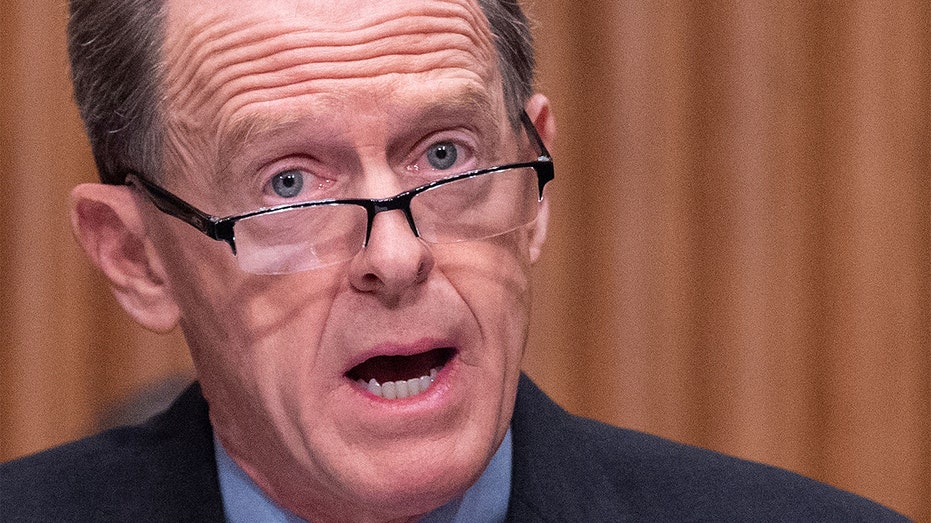
“I don’t think I’ve ever seen a more radical choice for any regulatory spot in our federal government,” Sen. Pat Toomey, R-Pa., said during an October speech opposing her confirmation.

“You could ask yourself, ‘Where would a person even come up with these ideas?'” he continued. “Well, maybe a contributing factor could be in if a person grew up in the former Soviet Union, and went to Moscow State University, and attended there on a Vladimir Lenin Academic Scholarship.”

Ranking member Pat Toomey. (Photo by JIM WATSON/AFP via Getty Images) (JIM WATSON/AFP via Getty Images / Getty Images)

The battle over her nomination led her to withdraw from consideration, a decision Biden accepted Tuesday while praising her qualifications and accomplishments.

“I nominated Saule because of her deep expertise in financial regulation and her long-standing, respected career in the private sector, the public sector, and as a leading academic in the field,” Biden said. “She has lived the American dream, escaping her birthplace in the former Soviet Union and immigrating to America, where she went on to serve in the Treasury Department under President George W. Bush and now works as a professor at Cornell Law School.”

GET FOX BUSINESS ON THE GO BY CLICKING HERE

In a letter requesting her name be withdrawn from consideration, Omarova called it an “honor” to be nominated by the president for the role.

Saule Omarova. (AP Photo/Manuel Balce Ceneta) (AP Photo/Manuel Balce Ceneta / AP Newsroom)

“It was a great honor and a true privilege to be nominated by President Biden to lead the Office of the Comptroller of the Currency overseeing the U.S. national banking system,” Omarova said. “I deeply value President Biden’s trust in my abilities and remain firmly committed to the Administration’s vision of a prosperous, inclusive, and just future for our country. At this point in the process, however, it is no longer tenable for me to continue as a Presidential nominee.”

San Francisco restaurant that kicked out cops says it ‘handled this badly,’ won’t rule out doing it again

San Francisco restaurant that kicked out cops says it ‘handled this badly,’ won’t rule out doing it again

The owners of a San Francisco restaurant are now apologizing after denying service to three uniformed police officers who were on-duty.

Hilda and Jesse initially denied service to the three San Francisco Police Department officers on Friday after they were seated at the restaurant. 

According to ABC7 News, one of the owners said that the on-duty police officers’ “presence” made staff at the restaurant feel “uncomfortable.”

“It’s not about the fact that we are anti-police,” co-owner of Hilda and Jesse, Rachel Sillcocks said. “It is about the fact that we do not allow weapons in our restaurant. We were uncomfortable, and we asked them to leave. It has nothing to do that they were officers. It has everything to do that they were carrying guns.”

SAN FRANCISCO RESTAURANT DEFENDS DENYING SERVICE TO ARMED POLICE OFFICERS: ‘WE WERE UNCOMFORTABLE’

Hilda and Jesse Storefront (Fox 2 San Francisco)

According to Sillcocks, the officers are welcome to come back and dine in the restaurant but without their weapons.

In a new Instagram post on Sunday afternoon, the co-owners apologized for asking the on-duty officers to leave.

“We made a mistake and apologize for the unfortunate incident on Friday when we asked members of the San Francisco Police Department to leave our restaurant,” co-owners Rachel Sillcocks and Kristina Liedags Compton said. “We are grateful to all members of the force who work hard to keep us safe, especially during these challenging times.”

The co-owners continued, stating that they hope the incident will be a “teachable moment” but stopped short of saying whether on-duty officers are welcome in the establishment.

San Francisco police officers (Fox 2 San Francisco)

SAN FRANCISCO GUARD, A FORMER COP, SHOT AND KILLED PROTECTING NEWS CREW COVERING A SMASH-AND-GRAB

The online restaurant review platform Yelp announced they are temporarily suspending the ability for individuals to make reviews for the Hilda and Jesse restaurant because of “increased public attention.”

“This business recently received increased public attention, which often means people come to this page to post their views on the news. While we don’t take a stand one way or the other when it comes to this incident, we’ve temporarily disabled the posting of content to this page as we work to investigate the content you see here reflects actual consumer experiences rather than the recent events,” the announcement reads.

Logo for the Hilda and Jesse restaurant in San Francisco. (KTVU FOX 2)

After the incident on Friday, the business received a number of one-star reviews bashing the restaurant for asking the on-duty police officers to leave.

“Given that this business has decided to Discriminate against first responders, I reserve the right to Call For A Boycott Of Hilda and Jesse,” one Yelp user wrote.

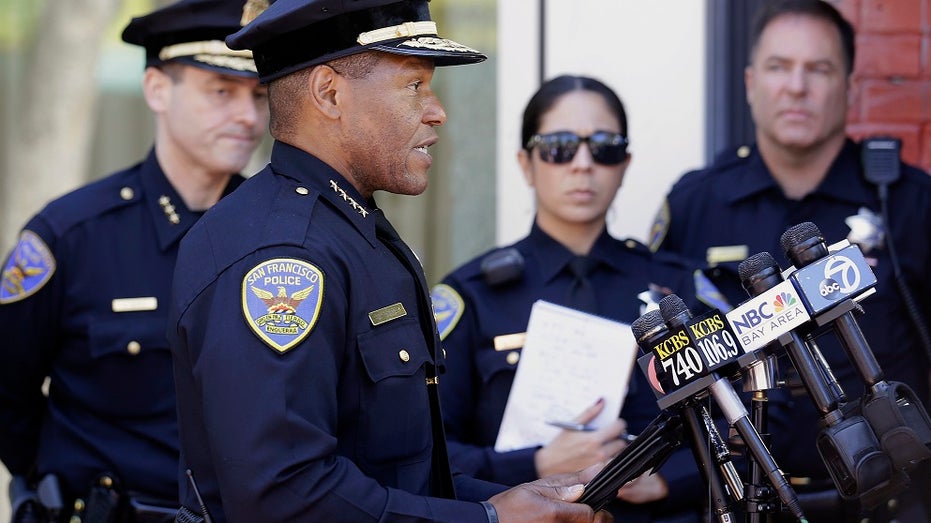
The San Francisco Police Department Chief William Scott said in a Twitter post on Saturday that he found the incident “discouraging and personally disappointing.”

CLICK HERE TO GET THE FOX NEWS APP

San Francisco Police Chief Bill Scott speaks to reporters. (AP Photo/Jeff Chiu, File) (AP Newsroom)

“The San Francisco Police Department stands for safety with respect, even when it means respecting wishes that our officers and I find discouraging and personally disappointing,” Scott said on Twitter. “I believe the vast majority of San Franciscans welcome their police officers, who deserve to know that they are appreciated for the difficult job we ask them to do – in their uniforms – to keep our neighborhoods and businesses safe.”

A spokesperson for Yelp told FOX Business that the company takes a very “proactive approach” when dealing with “review bombing.”

“For years, Yelp has taken a very proactive approach to dealing with ‘review bombing’ incidents through our Consumer Alerts program. We place Unusual Activity Alerts on a Yelp page when we uncover an influx of activity in response to a business gaining public attention, caused by people coming to Yelp to express their views on an issue instead of describing their actual interaction with a business. It’s our policy that all reviews on Yelp must be based on a first-hand consumer experience with the business.  After this activity has dramatically decreased or stopped, our moderators will remove the alert and clean up the page so only first-hand consumer experiences are reflected. Factoring this type of content out of the equation protects the interests of both consumers and business owners,” the spokesperson said.

FOX Business reached out to Hilda and Jesse for comment.

Fox News’ Emma Colton contributed to this report

US hiring stumbles in November as economy adds just 210,000 new jobs

US hiring stumbles in November as economy adds just 210,000 new jobs

U.S. job growth significantly undershot expectations in November, suggesting that difficulty in attracting new workers is weighing on the labor market’s recovery from the pandemic, even as COVID-19 cases dissipated nationwide. 

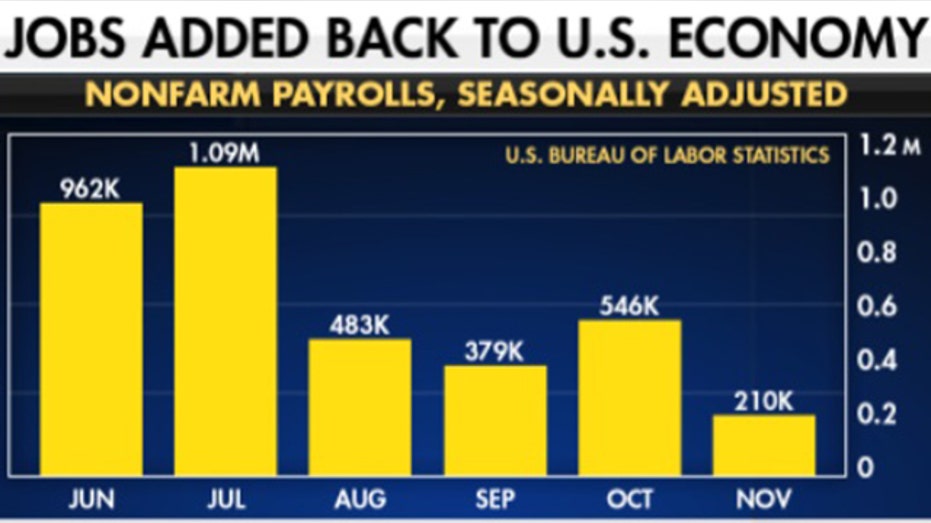
The Labor Department said in its monthly payroll report released Friday that payrolls in November rose by just 210,000, well below the 550,000 jobs forecast by Refinitiv economists. It marked the worst month for job creation so far this year. The unemployment rate (which is calculated based on a separate survey) dropped more than expected to 4.2{21df340e03e388cc75c411746d1a214f72c176b221768b7ada42b4d751988996} from 4.6{21df340e03e388cc75c411746d1a214f72c176b221768b7ada42b4d751988996} — the lowest level since the pandemic began.

The labor market had been gaining momentum after a delta-induced slowdown over the summer, but the latest figure represents a significant drop from October’s upwardly revised number of 546,000 and September’s upwardly revised 379,000. There are still about 3.9 million fewer jobs than there were last February, before the crisis began. 

FED TO TAPER BOND PURCHASES BY $15B A MONTH AS IT EXITS PANDEMIC-ERA POLICY

“Today’s employment report is doubly disappointing, because the reference week occurred just as it looked like Covid was on the retreat,” said Justin Wolfers, a University of Michigan economist. “This was a moment for people to return to malls and to return to work. The COVID-related news has only gotten worse since then.” 

  (U.S. Bureau of Labor Statistics)

The report wasn’t all bad news, however: The labor force participation rate rose to 61.8{21df340e03e388cc75c411746d1a214f72c176b221768b7ada42b4d751988996}, wages rose 4.8{21df340e03e388cc75c411746d1a214f72c176b221768b7ada42b4d751988996} from a year ago and the survey of households offered a brighter outlook, pointing to an employment gain of 1.13 million for the month. (The jobs report consists of two surveys – one based on employers and the other on households).

RSM chief economist Joe Brusuelas described the report as a “tale of two surveys.” 

“Rarely has the estimate produced by the good folks at the Bureau of Labor Statistics resulted in such divergent results as that illustrated by the twin establishment and household surveys that are the foundation of the monthly tally,” Brusuelas said. 

Prospective employers and job seekers interact during a job fair Wednesday, Sept. 22, 2021, in the West Hollywood section of Los Angeles. (AP Photo/Marcio Jose Sanchez, File)

The job growth stumble comes before the emergence of the newly identified omicron variant of COVID-19, which could jeopardize the global economy’s recovery. There is still a lack of clarity over how dangerous the new variant is, including whether it is more transmissible or capable of causing more severe illness. Early evidence suggests an increased risk of reinfection. 

Public health officials have urged caution against panic. 

But the economic impacts of the new strain – which has been found in at least 38 countries including the U.S. – have already been felt, with the U.S. and at least 10 European nations suspending air travel from southern Africa. The 27-nation European Union also recommended an “emergency brake” on travel from southern Africa, citing the “very concerning” new variant.

Surveys for the November jobs report were conducted about three weeks ago, before the new variant was detected.

Leisure and hospitality, one of the hardest-hit sectors that has become a bellwether of sorts for the economy’s recovery, saw a gain of just 23,000 new jobs last month. By comparison, it added 170,000 new jobs in October. The sector, which includes bars, restaurants and hotels, has recovered about 7 million of the jobs it lost during the pandemic, but remains about 1.3 million below its February 2020 level. 

Federal Reserve Board Chair Jerome Powell testifies before Senate Banking, Housing, and Urban Affairs hearing to examine the Semiannual Monetary Policy Report to Congress, Thursday, July 15, 2021, on Capitol Hill in Washington. (AP / AP Newsroom)

A mixed bag of industries accounted for growth last month. Substantial gains took place in professional and business services (90,000), transportation and warehousing (50,000), and construction (31,000). But retail employment fell by 20,000 last month on a seasonally adjusted basis, despite the upcoming holiday season. 

Stocks in this Article

$34580.08

-59.71 (-0.17{21df340e03e388cc75c411746d1a214f72c176b221768b7ada42b4d751988996})

$15085.471504

-295.85 (-1.92{21df340e03e388cc75c411746d1a214f72c176b221768b7ada42b4d751988996})

Markets remained relatively calm, despite the disappointing report.

Federal Reserve policymakers have been closely watching the labor market for signs that employment is reaching pre-crisis levels after the pandemic triggered one of the steepest – but shortest – recessions in nearly a century. 

Although the jobs figure came in well below economists’ expectations, the U.S. central bank may plow ahead with tentative plans to begin more aggressively unwinding the economic support put in place in March 2020 in order to curtail surging inflation. 

“If you think this report will push back the accelerated taper mentioned by Fed Chairman Jerome Powell this week, you would be mistaken,” said Jamie Cox, managing partner for Harris Financial Group.

GET FOX BUSINESS ON THE GO BY CLICKING HERE

The central bank has been purchasing $120 billion in bonds each month throughout most of the pandemic in order to keep credit cheap and stabilize the financial markets. In November, Fed officials announced plans to scale back the program by $15 billion a month, a timeline that would end the program by late June. 

Chairman Jerome Powell suggested this week that Fed officials may accelerate their plan to reduce their monthly purchases of bonds and mortgage-backed securities later this month. 

“At this point, the economy is very strong, and inflationary pressures are high,” Powell said on Tuesday. “It is therefore appropriate in my view to consider wrapping up the taper of our asset purchases, which we actually announced at our November meeting, perhaps a few months sooner.”

Today’s Live Business News: Jobs Report, Inflation and Stocks

Today’s Live Business News: Jobs Report, Inflation and Stocks

The United States faces a default sometime between Dec. 21 and Jan. 28 if Congress does not act to raise or suspend the debt ceiling, a Washington think tank warned on Friday.

The projection from the think tank, the Bipartisan Policy Center, was a narrower window than it provided last month, and the nonpartisan group suggested that the actual deadline, or X-date, could be toward the earlier end of that range.

Democrats and Republicans appear to have tempered their tone around raising the debt limit this time around. While lawmakers have not settled on a path to lifting the borrowing cap, they are exploring a series of ways to raise it, including some that could ultimately hand more power to the White House to avoid the kind of standoffs that have routinely crippled Washington.

Republicans continue to publicly insist that Democrats must act alone to address the issue, while Democrats have countered that raising the borrowing cap is a shared responsibility given that both political parties have incurred big debts over the last several years.

“Those who believe the debt limit can safely be pushed to the back of the December legislative pileup are misinformed,” said Shai Akabas, the director of economic policy at the Bipartisan Policy Center. “Congress would be flirting with financial disaster if it leaves for the holiday recess without addressing the debt limit.”

Treasury Secretary Janet L. Yellen warned lawmakers in November that the United States could be unable to pay its bills soon after Dec. 15. During testimony before the Senate Banking Committee this week, she underscored the urgency of the matter.

“I cannot overstate how critical it is that Congress address this issue,” Ms. Yellen said. “America must pay its bills on time and in full. If we do not, we will eviscerate our current recovery.”

In September, Ms. Yellen called for the debt limit to be eliminated, explaining that it had become a destructive policy that posed unnecessary risks to the economy. After approaching the first default in American history, Congress in October raised the statutory debt limit by $480 billion, an amount the Treasury Department estimated would allow the government to continue borrowing through early December.

Congressional leaders have been quietly discussing ways to address the debt ceiling, after Republicans warned that they would not help Democrats clear the 60-vote threshold needed to break a Republican filibuster against legislation to raise the borrowing cap.

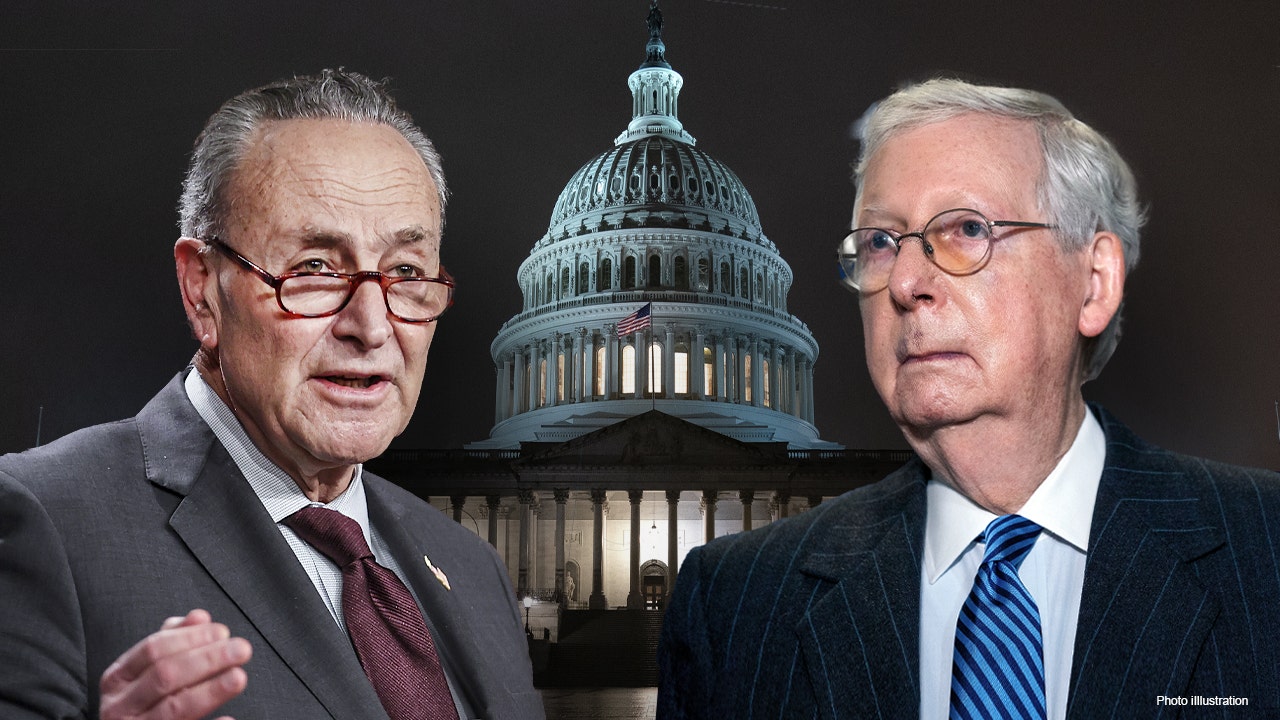
Senators Chuck Schumer of New York, the majority leader, and Mitch McConnell of Kentucky, the minority leader, have spoken repeatedly in recent weeks about the issue, but they have remained tight-lipped in public about a possible solution.

The debate has been further complicated by former President Donald J. Trump and his continued influence over the Republican Party. He has repeatedly railed at Mr. McConnell and the other Republican senators who backed a procedural vote in October that cleared the way for Democrats to raise the debt limit.

But Mr. McConnell, while pushing for Democrats to raise the borrowing cap without help from his conference, pledged this week that a default would be avoided.

Credit…Al Drago for The New York Times

“Let me assure everyone the government will not default, as it never has,” Mr. McConnell said on Tuesday. Pressed further, he added, “We’re having useful discussions about the way forward.”

Cut out of both the $1.9 trillion coronavirus relief package that passed in March and the $2.2 trillion climate, tax and spending plan that Democrats are trying to push through the Senate, Republicans have refused to help Democrats accommodate debt incurred by both parties. They have taken that position even though leaders of both parties signed off on the spending that helped the debt balloon.

Democrats, in turn, have balked at a Republican demand to use a fast-track process known as budget reconciliation to raise the debt limit without Republican votes. Democrats used the process to pass the coronavirus relief package and they are using it again for the climate, tax and spending plan, but they have argued that Republicans should help keep the government from defaulting.

Aides in both parties, while cautioning that a solution has not been agreed to, noted that party leaders had so far refrained from publicly trading blame over the issue.

As a way of navigating around the impasse, some officials have discussed the possibility of handing the authority of raising the debt limit to the administration, while granting Congress the ability to disapprove the decision with just a simple majority.

Some lawmakers, however, may be unwilling to hand that power to the White House or lose a cudgel often used by the minority party to exert pressure, particularly while 60 votes are needed to end a filibuster in the Senate.

Other officials have floated attaching legislation raising the debt limit to the sprawling annual defense policy bill, which is the last major must-pass piece of legislation that lawmakers plan to approve in December.

But it is unclear whether such a plan would be successful: Attaching a debt ceiling increase could jeopardize the Republican votes needed to counter the bloc of liberal Democrats who typically oppose the defense bill in protest of military spending. Representative Kevin McCarthy, Republican of California and the minority leader, warned on Friday that such a maneuver could tank passage of the entire package.

The Bipartisan Policy Center said that there was additional uncertainty surrounding the debt limit this year because of the pandemic and the various economic relief programs that are still ongoing.

Dec. 15 is a particularly important date because the Treasury Department is required to make a $118 billion payment to the Highway Trust Fund. If corporate tax receipts that are due that day come in weak, Treasury could face a cash crunch and the United States could be unable to meet all of its obligations, such as paying out Social Security and funding military paychecks.

The Congressional Budget Office said this week that it expected that Treasury might run out of cash by the end of December if Congress failed to act. The budget office suggested, however, that Treasury might be able to defer some Highway Trust Fund payments that were mandated in the recently passed infrastructure law, potentially staving off a default until sometime in January.

Along with its updated projection, the Bipartisan Policy Center unveiled a new proposal for dealing with the debt limit, although it is unlikely to help lawmakers this time around.

The proposal, which is being introduced by Representatives Jodey C. Arrington, Republican of Texas, and Scott Peters, Democrat of California, would establish a process giving the president authority to suspend the debt limit through the following fiscal year as long as Congress does not pass a resolution blocking the move within 30 days. The president would then have to offer a debt reduction proposal for Congress to consider separately.

Senate passes funding bill despite vaccine mandate flap, averting shutdown

Senate passes funding bill despite vaccine mandate flap, averting shutdown

Senate lawmakers voted Thursday night to approve a bill that funds the government through Feb. 18, avoiding a government shutdown with roughly 24 hours to spare despite a partisan clash regarding President Biden’s federal vaccine mandate.

The Senate voted 69-28 in favor of the continuing resolution, which approves government funding at the prior year’s levels until a new bipartisan agreement is reached. The resolution includes $7 billion in new funding to support Afghan refugees.

The bill now proceeds to Biden’s desk for final approval.

Senate Majority Leader Chuck Schumer, D-N.Y., arrives at the Capitol in Washington, Thursday, Sept. 30, 2021. (AP Photo/J. Scott Applewhite) (Associated Press)

“I am glad that in the end, cooler heads prevailed. The government will stay open,” Senate Majority Leader Chuck Schumer, D-N.Y., said. “And I thank the members of this chamber for walking us back from the brink of an avoidable, needless and costly shutdown.”

Moderate Democratic Sen. Joe Manchin of West Virginia was among the senators who voted in favor of the continuing resolution.

“In the midst of the COVID-19 pandemic and as the new Omicron variant emerges, I will not vote to shut down the government for purely political reasons,” Manchin said in a statement. 

A standoff between Senate Democrats and a handful of Republicans over the federal vaccine mandate nearly derailed the vote. Republican Sens. Ted Cruz of Texas, Mike Lee of Utah and Roger Marshall of Kansas demanded a separate vote on an amendment to bar funding for the Occupational Safety and Health Administration, the entity responsible for implementing Biden’s mandate. 

Schumer allowed the vote on the amendment to proceed ahead of the vote on the continuing resolution. 

Sen. Ted Cruz, R-Texas, speaks at a news conference on Capitol Hill in Washington, Wednesday, Oct. 6, 2021, to speak about immigration at the U.S.- Mexico boarder. (AP Photo/Andrew Harnik) (Associated Press)

Senators voted to reject Marshall’s amendment on the vaccine mandate. The amendment fell short of the 51 votes required to pass. Manchin and fellow moderate Democrat Sen. Kyrsten Sinema of Arizona each voted against the measure.

Republicans widely oppose the mandate, which forces companies with 100 or more employees to ensure their employees are vaccinated against COVID-19 or undergo regular testing. GOP lawmakers argue the mandate is too broad and constitutes federal overreach.

“No precedent exists in American history for punishing private employers who don’t enforcement government vaccination edicts,” Marshall said in a floor speech ahead of the vote on his amendment.

Lee said millions of Americans were “being threatened right now with losing their jobs” due to the mandate. He argued that Democrats, not Republicans, risked the shutdown in their effort to prevent a vote on the amendment.

Senate Minority Leader Mitch McConnell, R-Ky., arrives at the Capitol in Washington, Wednesday, Oct. 6, 2021, as a showdown looms with Democrats over raising the debt limit. (AP Photo/J. Scott Applewhite) (Associated Press)

GET FOX BUSINESS ON THE GO BY CLICKING HERE

“Those in this chamber who shamefully were refusing over and over again to even let us cast a vote on that simple measure threatened to shut down all of government because they didn’t want us to have a chance, as the people’s elected lawmakers, to decide whether or not we should proceed with vaccine mandate enforcement,” Lee said.

The vote on the continuing resolution brought the Senate in sync with House lawmakers, who hours earlier voted 221-212 in favor of the continuing resolution to fund the government through Feb. 18. Rep. Adam Kinzinger, R-Ill., was the lone GOP representative to vote in favor of the resolution.