Financial Market Conditions during Monetary Tightening

Financial Market Conditions during Monetary Tightening

Simon H. Kwan and Louis Liu

The current round of federal funds rate increases is expected to reverse a historically large gap between the real funds rate and the neutral rate at the beginning of the tightening cycle. Financial markets have reacted faster and more strongly than in past monetary tightening cycles, in part because of this large gap and the Federal Reserve’s forward guidance. Historical experiences suggest financial conditions could tighten even more given the size of the gap.


Financial markets play a central role in how business cycles fluctuate and spread through the U.S. economy. As monetary policy works through various transmission channels to impact real economic activity, financial market channels are first and foremost in determining both the speed and the extent of policy transmission (Bernanke, Gertler, and Gilchrist 1999). Thus, understanding how much financial conditions have tightened provides important feedback for calibrating monetary policy.

In past monetary tightening episodes, the degree of tightening in overall financial conditions depended on how much and how long monetary tightening continued, as well as prevailing economic conditions when tightening began. Specifically, the extent of monetary tightening depends on inflationary pressures and how strong the economy is when tightening starts. In past cycles, federal funds rate increases ranged from about 1 percentage point (1965–66) to over 10 percentage points (1977–80).

This Economic Letter compares the size and the speed of financial market responses between current and past cycles of monetary tightening. We focus on analyzing long-term interest rates, stock prices, and credit spreads because they directly affect the cost of capital and thus real economic activity. Since the current tightening cycle is likely still ongoing, the financial market response could still change substantially. Nevertheless, comparing current financial market changes to those during previous tightening cycles sheds light on the speed of adjustment.

Monetary tightening cycles

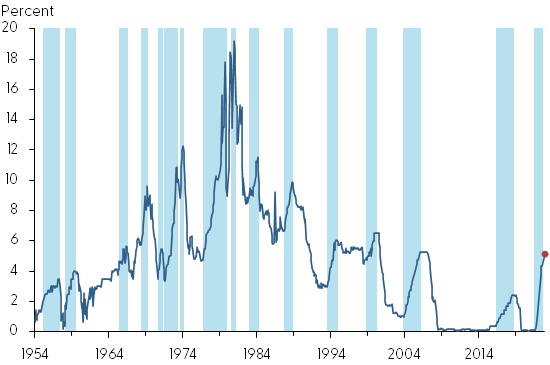
Figure 1 shows the 15 postwar monetary tightening cycles. The first 11 cycles are identified following the methodology in Adrian and Estrella (2008). This assumes that a tightening cycle starts when the federal funds rate rises by 0.25 percentage point (25 basis points) or more in two consecutive months. A tightening cycle ends when either (1) the federal funds rate is higher than at any time from 12 months before to 9 months after and is at least 0.5 percentage point higher than at the beginning of this period, or (2) the federal funds rate is higher than at any time from 6 months before to 6 months after and is 1.5 percentage points higher than the average at these end points.

Figure 1
Effective federal funds rate
Effective federal funds rate

Source: Federal Reserve Board of Governors and authors’ calculations.

Note: Blue shading indicates periods of monetary policy tightening as described in text.

Since the late 1990s, forward guidance became a prominent monetary policy tool (Bernanke 2020). We therefore identify the tightening cycles based on the Federal Open Market Committee (FOMC) communications, as financial markets are always forward looking. For example, forward-looking language first appeared in the post-meeting FOMC press release in May 1999. Although the Committee decided not to raise rates at that meeting, the post-meeting press release signaled the FOMC’s bias toward the possibility of a firming in the stance of monetary policy. We therefore assume the 1999–2000 tightening cycle started in May, even though the policy rate did not increase until June.

For the current tightening cycle, the Committee expected after its January 2022 meeting that “it will soon be appropriate to raise the target range for the federal funds rate.” In the December 2022 FOMC Summary of Economic Projections (SEP), the median projection of the federal funds rate for 2023 by FOMC participants was 5.1{21df340e03e388cc75c411746d1a214f72c176b221768b7ada42b4d751988996}, compared to 4.4{21df340e03e388cc75c411746d1a214f72c176b221768b7ada42b4d751988996} for 2022. In this Letter, we make the straightforward assumption that the federal funds rate will reach 5.1{21df340e03e388cc75c411746d1a214f72c176b221768b7ada42b4d751988996} about the middle of this year, based on the contour of the federal funds futures. Hence, the current tightening cycle is assumed to last from January 2022 to May 2023, lifting the federal funds rate from 0.08{21df340e03e388cc75c411746d1a214f72c176b221768b7ada42b4d751988996} to 5.1{21df340e03e388cc75c411746d1a214f72c176b221768b7ada42b4d751988996}.

The federal funds rate

Each tightening cycle has been unique in terms of the duration and the change in the federal funds rate. Not all tightening cycles have been followed by recessions. The median increase in the federal funds rate in past tightening cycles was 2.57 percentage points, and the median pace of tightening was 0.20 percentage point per month. For the current cycle, based on the SEP projections, the expected tightening is 5.02 percentage points at an average pace of 0.31 percentage point per month, both of which are well above the median.

To control for monetary conditions at the onset of tightening, we compute the real funds rate gap by subtracting the inflation rate and the real neutral rate from the nominal federal funds rate. The smaller or more negative the real funds rate gap is, the more monetary accommodation is in the economy. We use the past 12-month change in the consumer price index (CPI) to measure the inflation rate. Although current CPI inflation is an imperfect proxy for expected inflation, the Survey of Professional Forecasters’ expected one-year-ahead inflation rate, which did not start until 1980, provides qualitatively similar results for the last six tightening cycles. We use the real neutral rate estimated by Laubach and Williams (2003). For the current cycle, we use a real neutral rate of 0.5{21df340e03e388cc75c411746d1a214f72c176b221768b7ada42b4d751988996}, which is the difference between the median long-run funds rate of 2.5{21df340e03e388cc75c411746d1a214f72c176b221768b7ada42b4d751988996} from the December SEP and the 2{21df340e03e388cc75c411746d1a214f72c176b221768b7ada42b4d751988996} target inflation rate.

Figure 2 shows the real funds rate gap (blue bars) at the beginning of each tightening cycle. The real funds rate gap of –7.9{21df340e03e388cc75c411746d1a214f72c176b221768b7ada42b4d751988996} at the beginning of the current cycle is the largest among all tightening cycles, in part due to high inflation. Figure 2 also shows the difference in the real funds rate gap between the end and the beginning of each tightening cycle—which reflects how much the gap was closed (green bars). Assuming the inflation rate at the end of the current tightening cycle will be 3.1{21df340e03e388cc75c411746d1a214f72c176b221768b7ada42b4d751988996} based on the December SEP, the real funds rate gap at the end of the current cycle would be 1.5{21df340e03e388cc75c411746d1a214f72c176b221768b7ada42b4d751988996}. If the Fed successfully closes the funds rate gap by 9.4{21df340e03e388cc75c411746d1a214f72c176b221768b7ada42b4d751988996} by the end of the current cycle—through both raising the interest rate and bringing down inflation—it would be the largest gap closure on record.

Figure 2
Real funds rate gap: Initial levels and changes over cycle
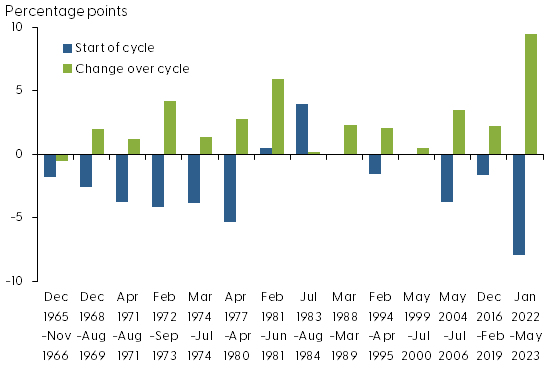
Real funds rate gap: Initial levels and changes over cycle

Source: Laubach and Williams (2003), Bureau of Labor Statistics, Federal Reserve Board of Governors and authors’ calculations.

Note: Last cycle includes assumptions based on December 2022 SEP projections.

Long-term rates and stock prices

The current increase in the 10-year Treasury rate is the second largest increase of all tightening cycles, shown by the blue bars in Figure 3. Moreover, the green bars show that the speed of this increase has been unprecedented. Research shows that the response of asset prices to anticipated monetary policy changes is essentially zero, while their response to unanticipated movements is large and highly significant (Kuttner 2000). Thus, before forward guidance, each monetary policy tightening may have contained unanticipated information that had not been fully incorporated into asset prices; therefore, without advance communication, financial markets would have reacted to each tightening until the cycle ended.

Figure 3
Percentage point changes in 10-year Treasury yield
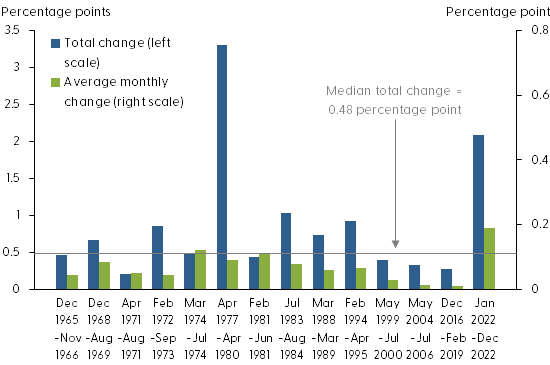
Percentage point changes in 10-year Treasury yield

Source: Federal Reserve Board of Governors and authors’ calculations.

With forward guidance, market participants can form expectations about tightening cycles, including the expected duration and amount of tightening. Because the expected tightening is fully incorporated into asset prices well before the completion of the tightening cycle, this partially explains the speed of the increase in long-term rates in the current cycle.

A widely held view by economists is that long-term interest rates tend to have relatively bigger effects on real economic activities than short-term rates. This is in part due to the large share of long-term debt contracts with a fixed interest rate in our financial system, including fixed-rate mortgages, term loans, and corporate bonds, whose rates are often tied to long-term Treasury rates. Thus, the rapid increase in long-term rates would cool the economy relatively faster than in previous cycles.

The contract interest rate above the Treasury rate, known as the spread, is another determinant of financial conditions. The spread reflects the risk premium demanded by the lender in providing debt financing to risky borrowers. In past tightening cycles, bond spreads haven’t always tightened, and the median change in the benchmark Baa bond spread was close to zero. Currently, the Baa spread has widened only about 0.06 percentage point, which is small relative to the large increase in the long-term Treasury rate.

In previous tightening episodes, stock prices initially fell but sometimes rebounded to end the tightening cycle with a net gain. Figure 4 shows that stock prices declined on net in five of the past 15 tightening episodes. The median change in the Standard & Poor’s 500 in previous cycles was +2.53{21df340e03e388cc75c411746d1a214f72c176b221768b7ada42b4d751988996}. Both the current decline in stock prices and the speed of the decline, as measured by the average monthly change in stock prices, are large relative to the historical average. Stock valuations, such as the price-to-earnings ratio, exhibit similar patterns.

Figure 4
Percent changes in Standard & Poor’s 500
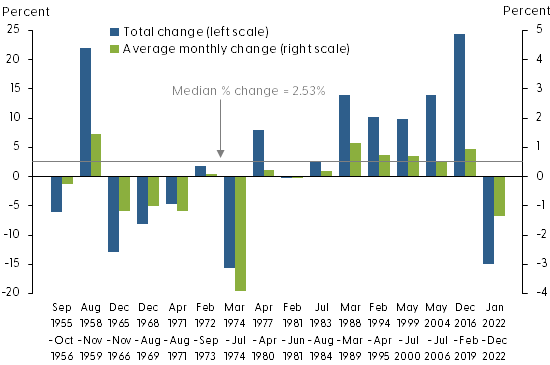
Percent changes in Standard & Poor’s 500

Source: Bloomberg, Federal Reserve Board of Governors and authors’ calculations.

Comparing the current changes in bond rates and stock prices to those in previous completed tightening cycles that lasted longer reflects the notion that forward guidance has front-loaded the financial market response in the current cycle. This is consistent with the stance of monetary policy being tighter than what is implied by the federal funds rate (Choi et al. 2022). Repeating the analysis to control for cycle duration yields qualitatively similar results.

Insights from the past

What can we learn from history to understand how financial conditions could play out through the end of this tightening cycle? The historical relation between monetary conditions at the onset of tightening cycles and tightening in interest rates and stock prices may provide some clues. Regressing the real funds rate gap on the change in the federal funds rate yields a significantly negative relationship: a more negative real funds rate gap tends to be followed by a bigger increase in the federal funds rate. Given the large negative real funds rate gap in the current cycle, history suggests that the total increase in the federal funds rate could be bigger than expected.

Regressing the real funds rate gap on the change in stock prices yields a significantly positive relationship, implying that the more negative the real funds rate gap, the larger the decline in stock prices during a tightening cycle. When we use this historical relationship to evaluate stock prices at the large negative funds rate gap, stock prices are projected to decline further. The historical relationship between the funds rate gap and bond spreads also calls for more tightening in the bond market. Taken together, with the historically large funds rate gap at the onset of the current cycle, past experiences indicate that more tightening of financial conditions could follow.

Conclusions

Current increases in the federal funds rate are expected to reverse a historically large negative real funds rate gap at the beginning of the cycle. Successfully closing the real funds rate gap will hinge on substantially reducing the inflation rate. Relative to history, both the size and the speed of tightening in Treasury bonds and common stocks have been large in the current cycle, in part because of the large gap and the Federal Reserve’s forward guidance. While the rapid tightening of financial conditions is expected to slow the economy relatively quickly, historical experiences raise the possibility of even more tightening in financial conditions given the large real rate gap that needs to be closed.

Simon H. Kwan

Senior Research Advisor, Economic Research Department, Federal Reserve Bank of San Francisco

Louis Liu

Research Associate, Economic Research Department, Federal Reserve Bank of San Francisco

References

Adrian, Tobias, and Arturo Estrella. 2008. “Monetary Tightening Cycles and the Predictability of Economic Activity.” Economics Letters 99(2), pp. 260–264.

Bernanke, Ben S. 2020. “The New Tools of Monetary Policy.” American Economic Review 110(4, April), pp. 943–983.

Bernanke, Ben S., Mark Gertler, and Simon Gilchrist. 1999. “The Financial Accelerator in a Quantitative Business Cycle Framework.” Chapter 21 in Handbook of Macroeconomics 1, part C, eds. J.B. Taylor and M. Woodford. Amsterdam: Elsevier, pp. 1,341–1,393.

Choi, Jason, Taeyoung Doh, Andrew Foerster, and Zinnia Martinez. 2022. “Monetary Policy Stance Is Tighter than Federal Funds Rate.” FRBSF Economic Letter 2022-30 (November 7).

Kuttner, Kenneth N. 2001. “Monetary Policy Surprises and Interest Rates: Evidence from the Fed Funds Futures Market.” Journal of Monetary Economics 47(3, June), pp. 523–544.

Laubach, Thomas, and John C. Williams. 2003. “Measuring the Natural Rate of Interest.” Review of Economics and Statistics 85(4, November), pp. 1,063–1,070.

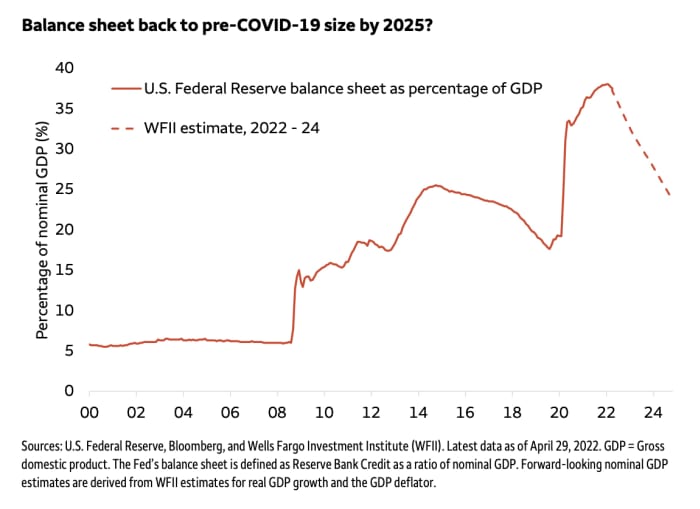
Fed’s quantitative tightening is about to arrive: What that might mean for markets

Fed’s quantitative tightening is about to arrive: What that might mean for markets

The Federal Reserve’s virtually $9 trillion portfolio is about to be diminished starting up on Wednesday, in a process meant to dietary supplement price hikes and buttress the central bank’s struggle versus inflation.

Even though the precise impression of “quantitative tightening” in economical markets is even now up for discussion, analysts at the Wells Fargo Financial investment Institute and Money Economics concur that it is possible to deliver yet another headwind for stocks. And which is a problem for traders struggling with many dangers to their portfolios at the minute, as governing administration bonds marketed off and shares nursed losses on Tuesday.

In a nutshell, “quantitative tightening” is the opposite of “quantitative easing”: It’s basically a way to lower the funds offer floating all around in the economy and, some say, will help to increase level hikes in a predictable method — although, by how much remains unclear. And it might change out to be everything but as uninteresting as “watching paint dry,” as Janet Yellen described it when she was Fed chair in 2017 — the final time when the central lender initiated a similar course of action.

QT’s major impact is in the monetary markets: It is observed as possible to generate up authentic or inflation-altered yields, which in change makes stocks relatively much less interesting. And it must put upward strain on Treasury time period premia, or the compensation investors have to have for bearing curiosity-amount pitfalls more than the daily life of a bond.

What’s much more, quantitative tightening comes at a time when traders are presently in a really foul mood: Optimism about the quick-phrase path of the stock industry is below 20{21df340e03e388cc75c411746d1a214f72c176b221768b7ada42b4d751988996} for the fourth time in 7 months, in accordance to the outcomes of a sentiment study produced Thursday by the American Association of Particular person Traders. Meanwhile, President Joe Biden met with Fed Chairman Jerome Powell Tuesday afternoon to deal with inflation, the subject matter at the forefront of lots of investors’ minds.

Browse: Biden pledges adherence to central-bank independence as he meets with Fed chief Powell and Biden’s assembly on inflation with Fed’s Powell found as ‘good for the president politically’

“I never consider we know the impacts of QT just however, in particular since we haven’t performed this slimming down of the stability sheet considerably in history,” stated Dan Eye, main financial commitment officer of Pittsburgh-centered Fort Pitt Funds Team. ”But it’s a safe and sound guess to say that it pulls liquidity out of the industry, and it is fair to consider that as liquidity is pulled out, it impacts multiples in valuations to some diploma.”

Beginning on Wednesday, the Fed will start out minimizing its holdings of Treasury securities, agency personal debt, and agency house loan-backed securities by a blended $47.5 billion for every thirty day period for the 1st a few months. Immediately after this, the full volume to be minimized goes up to $95 billion a thirty day period, with coverage makers well prepared to adjust their solution as the economic system and economic marketplaces evolve.

The reduction will come about as maturing securities roll off the Fed’s portfolio and proceeds are no for a longer time reinvested. As of September, the rolloffs will be happening at “a substantially faster and additional aggressive” tempo than the procedure which started out in 2017, in accordance to the Wells Fargo Expenditure Institute.

By the institute’s calculations, the Fed’s stability sheet could shrink by nearly $1.5 trillion by the conclusion of 2023, taking it down to close to $7.5 trillion. And if QT continues as predicted, “this $1.5 trillion reduction in the balance sheet could be equivalent to an additional 75 – 100 basis points of tightening,” at a time when the fed-resources charge is expected to be all-around 3.25{21df340e03e388cc75c411746d1a214f72c176b221768b7ada42b4d751988996} to 3.5{21df340e03e388cc75c411746d1a214f72c176b221768b7ada42b4d751988996}, the institute claimed in a notice this month.

The goal selection of the fed-money level is at present concerning .75{21df340e03e388cc75c411746d1a214f72c176b221768b7ada42b4d751988996} and 1{21df340e03e388cc75c411746d1a214f72c176b221768b7ada42b4d751988996}.


Resources: Federal Reserve, Bloomberg, Wells Fargo Expenditure Institute. Facts as of April 29.

“Quantitative tightening might include to upward force on serious yields,” the institute said. “Along with other forms of tightening in economic conditions, this represents a even more headwind for danger property.”

Andrew Hunter, a senior U.S. economist at Capital Economics, mentioned that “we hope the Fed to lessen its asset holdings by a lot more than $3 trillion over the upcoming few of decades, adequate to convey the balance sheet back again in line with its prepandemic level as a share of GDP.” Though that should not have a significant impression on the economy, the Fed may well quit QT prematurely if financial conditions “sour,” he claimed.

“The main influence will arrive indirectly by using the outcomes on economic conditions, with QT putting upward force on Treasury term rates which, alongside a more slowdown in economic expansion, will increase to the headwinds going through the inventory sector,” Hunter said in a observe. The essential uncertainty is how extended the Fed’s rundown will very last, he mentioned.

On Tuesday, all a few main U.S. inventory indexes completed decrease, with Dow industrials
DJIA,
-.67{21df340e03e388cc75c411746d1a214f72c176b221768b7ada42b4d751988996}
sliding .7{21df340e03e388cc75c411746d1a214f72c176b221768b7ada42b4d751988996}, the S&P 500
SPX,
-.63{21df340e03e388cc75c411746d1a214f72c176b221768b7ada42b4d751988996}
down .6{21df340e03e388cc75c411746d1a214f72c176b221768b7ada42b4d751988996}, and the Nasdaq Composite
COMP,
-.41{21df340e03e388cc75c411746d1a214f72c176b221768b7ada42b4d751988996}
off by .4{21df340e03e388cc75c411746d1a214f72c176b221768b7ada42b4d751988996}. Meanwhile, Treasury yields have been greater as bonds marketed off across the board.

Stocks fall for a second day, Nasdaq slides another 2{21df340e03e388cc75c411746d1a214f72c176b221768b7ada42b4d751988996} as Fed gives policy tightening plans

Stocks fall for a second day, Nasdaq slides another 2{21df340e03e388cc75c411746d1a214f72c176b221768b7ada42b4d751988996} as Fed gives policy tightening plans

Stocks fell for a second working day on Wednesday and premiums soared to new heights right after the Federal Reserve gave more advice on how speedy it will tighten financial plan to battle inflation, increasing considerations it may well gradual the economic system.

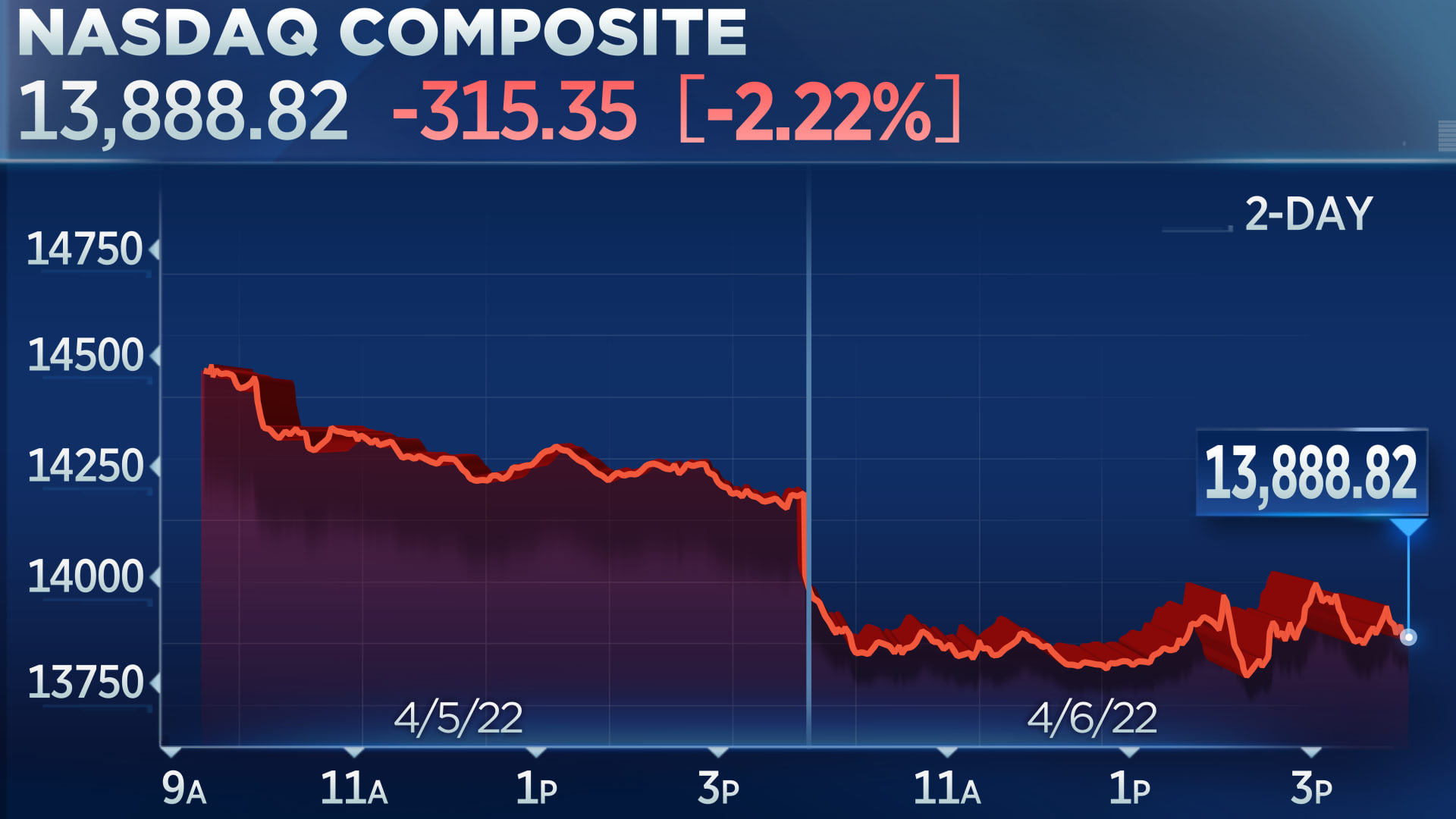
The Dow Jones Industrial Ordinary fell 144.67 factors, or .42{21df340e03e388cc75c411746d1a214f72c176b221768b7ada42b4d751988996}, to 34,496.51. The S&P 500 slid .97{21df340e03e388cc75c411746d1a214f72c176b221768b7ada42b4d751988996} to 4,481.15, and the Nasdaq Composite sank an additional 2.22{21df340e03e388cc75c411746d1a214f72c176b221768b7ada42b4d751988996} to 13,888.82 immediately after falling about 2.3{21df340e03e388cc75c411746d1a214f72c176b221768b7ada42b4d751988996} on Tuesday.

“It was a warning to any individual who thinks that the Fed is likely to be extra dovish in their fight towards inflation,” stated Quincy Krosby, main equity strategist at LPL Economic. “Their information is, ‘You’re improper.'”

The Fed’s release of its assembly minutes indicated on Wednesday afternoon that officers “typically agreed” it need to shrink its equilibrium sheet by $95 billion for each thirty day period. The minutes also confirmed central bank officers were being thinking of larger sized price hikes than the usual 25-foundation-place, or quarter-level, increments. Shares dipped to session lows just after the release of the minutes but bounced back somewhat to close the day.

“Lots of contributors famous that — with inflation effectively earlier mentioned the Committee’s aim, inflationary pitfalls to the upside, and the federal funds price very well below participants’ estimates of its longer-operate level — they would have most well-liked a 50 basis place enhance in the goal array for the federal resources amount at this meeting,” the minutes explained.

Meanwhile, the 10-calendar year Treasury yield jumped previously mentioned 2.65{21df340e03e388cc75c411746d1a214f72c176b221768b7ada42b4d751988996} to a 3-calendar year higher on Wednesday and remained close to that large following the launch of the Fed meeting minutes. The level finished Monday at 2.40{21df340e03e388cc75c411746d1a214f72c176b221768b7ada42b4d751988996}. The minutes were from the Fed’s March conference when it elevated prices by a quarter issue and indicated six additional hikes of that magnitude have been coming this 12 months.

“I imagine the inventory current market is finding the strategy that $60 billion Treasurys and $35 billion in home loans is setting up to get authentic,” reported James Caron of Morgan Stanley Financial investment Management. “If they do a further 50 foundation points hike in Could and yet another 50 in June, it is really starting to get additional actual. It is surely not a tailwind for stocks.”

Tech shares led Wednesday’s slide, slipping all over again for a next day as traders rotated out of the group and braced for greater costs to sluggish the overall economy. Apple, Microsoft, Amazon and Tesla contributed to the sector’s decrease. Chipmakers like Nvidia and Marvell Technology also continued their descent, falling about 5.9{21df340e03e388cc75c411746d1a214f72c176b221768b7ada42b4d751988996} and 2.6{21df340e03e388cc75c411746d1a214f72c176b221768b7ada42b4d751988996}, respectively.

Traders ongoing to look for for shares with stable profits, shying absent from all those offering long run progress. Utilities, wellbeing treatment and purchaser staples sectors continued to climb Wednesday, with Amgen and Johnson & Johnson rising extra than 2{21df340e03e388cc75c411746d1a214f72c176b221768b7ada42b4d751988996} just about every. Purchaser staples this sort of as Coca-Cola and Procter & Gamble inched far more than 1{21df340e03e388cc75c411746d1a214f72c176b221768b7ada42b4d751988996} larger. Walmart jumped 2.3{21df340e03e388cc75c411746d1a214f72c176b221768b7ada42b4d751988996}.

“These days and yesterday you’re seriously beginning to see the equity marketplace catch up with the bond current market,” said Chris Zaccarelli, CIO at Unbiased Advisor Alliance. “And by that, I suggest equities are beginning to rate in a a lot more aggressive Fed. You might be starting off to see a bid for basic safety, you happen to be seeing that common danger-off shift.”

Inventory picks and investing developments from CNBC Pro:

Officials in latest times have tried using to warn buyers even speedier policy tightening could be ahead. The findings, coupled with latest remarks from Fed Governor Lael Brainard and other individuals, seemed to sign that sentiment.

Earlier Wednesday, Philadelphia Federal Reserve President Patrick Harker said that he is “acutely concerned” about soaring inflation, noting that he expects “a series of deliberate, methodical hikes as the yr proceeds and the info evolve.”

His reviews come less than a day following Brainard indicated support for higher fascination charges and stated a “speedy” reduction of the central bank’s stability sheet could arrive as before long as May well. The remarks pushed shares reduce in the previous session.

“It is of paramount significance to get inflation down,” Brainard stated in the course of a Minneapolis Fed webinar. San Francisco Fed President Mary Daly echoed related sentiments toward inflation on Tuesday.

“What that implies for the marketplaces are ongoing volatility around the uncertainty to greater costs and reduced-revenue cash move stocks, growth variety stocks possibly continuing to get discounted as fees increase,” Cliff Corso of Advisors Asset Management stated on CNBC’s “Globally Exchange.”

Earnings in advance

Traders were also bracing Wednesday for the start out of the corporate earnings season.

Goldman Sachs chief U.S. fairness strategist David Kostin stated Wednesday on CNBC’s “Squawk on the Avenue” that shares with “resilient margins” are much better prepared to climate the present-day surroundings. That contains names this sort of as Alphabet and Nike — which have managed “higher and stable margins” even amid the pandemic, he reported.

“Total, the U.S. equities market probably has 5{21df340e03e388cc75c411746d1a214f72c176b221768b7ada42b4d751988996} upside from these likes between now and the close of the 12 months,” Kostin explained. “Really should we be likely into a recession it will be significant downside, but which is not the base situation suitable now.”

CNBC’s Patti Domm and Jeff Cox contributed reporting

The Fed is scaring markets with the triple threat of policy tightening

Investors have been preparing for the Federal Reserve to start off climbing desire fees. They also know the central bank is reducing the total of bonds it purchases every thirty day period. On leading of that, they figured, inevitably, the tapering would direct to a reduction in the virtually $9 trillion in assets the Fed is keeping.

What they did not hope have been all 3 points occurring at the similar time.

But minutes from the Fed’s December assembly, launched Wednesday, indicated that could properly be the situation.

The meeting summary confirmed associates ready to not only start boosting interest premiums and tapering bond obtaining, but also currently being organized to engage in a substantial-stage discussions about decreasing holdings of Treasurys and property finance loan-backed securities.

Whilst the moves are designed to combat inflation and as the work market heals, the jolt of a Fed triple danger of tightening despatched the market place into a tailspin Wednesday. The end result noticed shares give back their Santa Claus rally gains and then some as the prospect of a hawkish central lender forged a haze of uncertainty above the investing landscape.

Markets were combined Thursday as traders tried to figure out the central bank’s intentions.

“The reason the industry experienced a knee-jerk reaction yesterday was it sounds like the Fed is going to arrive rapid and furious and just take liquidity out of the market,” mentioned Lindsey Bell, chief industry strategist at Ally Economical. “If they do it in a continuous and gradual method, the sector can complete very well in that environment. If they occur rapidly and furious, then it really is heading to be a different story.”

Fed officials mentioned through the conference that they keep on being knowledge-dependent and will be guaranteed to talk their intentions evidently to the community.

However, the prospect of a significantly far more intense Fed was bring about for stress after nearly two years of the most accommodative monetary plan in U.S. background.

Bell reported buyers are probable worrying way too much about policy from officials who have been very clear that they do not want to do nearly anything to sluggish the recovery or to tank financial markets.

“The Fed appears like they are going to be a large amount faster in action,” she mentioned. “But the fact is we really don’t truthfully know how they’re likely to shift and when they are going to shift. Which is heading to be determined above the next quite a few months.”

Clues coming soon

Indeed, the market would not have to wait around long to listen to exactly where the Fed is headed.

Multiple Fed speakers presently have weighed in around the earlier few times, with Governor Christopher Waller and Minneapolis Fed President Neel Kashkari having a extra intense tone. In the meantime, San Francisco Fed President Mary Daly mentioned Thursday she thinks the start off of balance sheet reduction is not always imminent.

Chairman Jerome Powell will speak subsequent 7 days for the duration of his confirmation listening to, and a second time this thirty day period adhering to the Fed assembly on Jan. 25-26, when he may strike a a lot more dovish tone, reported Michael Yoshikami, founder and chairman of Vacation spot Wealth Management.

Inventory picks and investing tendencies from CNBC Pro:

A person massive component Yoshikami sees is that although the Fed is established to battle inflation, it also will have to offer with the destructive affect of the omicron variant.

“I anticipate the Fed to appear out and say every thing is based on the pandemic blowing above. But if omicron seriously does continue to be a issue for the next 30 or 45 days, it is heading to effects the overall economy and could possibly result in us to hold off elevating charges,” he stated. “I hope that commentary to occur out in the subsequent 30 times.”

Past that, there are some certainties about plan: The market knows, for instance, that the Fed beginning in January will be purchasing just $60 billion of bonds each thirty day period — fifty percent the stage it experienced been paying for just a couple of months in the past.

Fed officials in December also experienced penciled in a few quarter-proportion-place rate hikes this year right after beforehand indicating just a person, and markets are pricing in close to a 50-50 probability of a fourth hike. Also, Powell experienced indicated that there was discussion about harmony sheet reduction at the conference, even though he appeared to participate in down how deeply his colleagues delved into the matter.

So what the sector will not know ideal now is how aggressive the Fed will be cutting down its balance sheet. It’s an crucial situation for traders as central financial institution liquidity has helped underpin marketplaces for the duration of the Covid tumult.

All through the last balance sheet unwind, from 2017 until finally 2019, the Fed allowed a capped amount of proceeds from its bond portfolio to operate off. The cap started out at $10 billion every single thirty day period, then amplified by $10 billion quarterly until eventually they arrived at $50 billion. By the time the Fed experienced to retreat, it had operate off just $600 billion from what had been a $4.5 trillion balance sheet.

With the stability sheet now approaching $9 trillion — $8.3 trillion of which is comprised of the Treasurys and home loan-backed securities the Fed has been getting — the initial watch from Wall Street is that the Fed could be much more aggressive this time.

‘Uncharted waters’

Estimates bandied about next Wednesday’s news ranged from greatest caps of $100 billion from JPMorgan Chase to $60 billion at Nomura. Fed officers have not specified any numbers still, with Kashkari earlier this 7 days only indicating that he sees the finish of the runoff nonetheless leaving the Fed with a big balance sheet, likely bigger than right before Covid.

One other possibility is that the Fed could market assets outright, mentioned Michael Pearce, senior U.S. economist at Money Economics.

There would be many explanations for the central financial institution to do so, notably with long-dated desire rates so very low, the Fed’s bond profile remaining reasonably lengthy in period and the sheer size of the stability sheet — virtually 2 times what it was past time all around.

“While extended phrase yields have rebounded in latest times, if they have been to continue to be stubbornly low and the Fed is faced with a promptly flattening produce curve, we feel there would be a very good situation that the Fed should health supplement its harmony sheet runoff with outright revenue of for a longer period-dated Treasury securities and MBS,” Pearce explained in a be aware to consumers.

That leaves buyers with a multitude of opportunities that could make navigating the 2022 landscape tough.

In that very last tightening cycle, the Fed waited from the initially hike just before it began reducing the harmony sheet. This time, policymakers seem established to get issues shifting much more immediately.

“Marketplaces are concerned that we have never viewed the Federal Reserve equally lift desire prices off zero and lower the dimensions of its harmony sheet at the very same time. There was a two-12 months hole in between people two activities in the very last cycle, so it is a valid issue. Our tips is to make investments/trade really meticulously the following several days,” DataTrek co-founder Nick Colas stated in his every day notice Wednesday evening. “We’re not predicting a meltdown, but we get why the current market swooned [Wednesday]: these are really uncharted waters.”