
As an investor, Ray Dailo eyes the rearview mirror to see what’s ahead. If this paradox makes sense, then you likely agree with the view of history that “those who cannot remember the past are condemned to repeat it.”
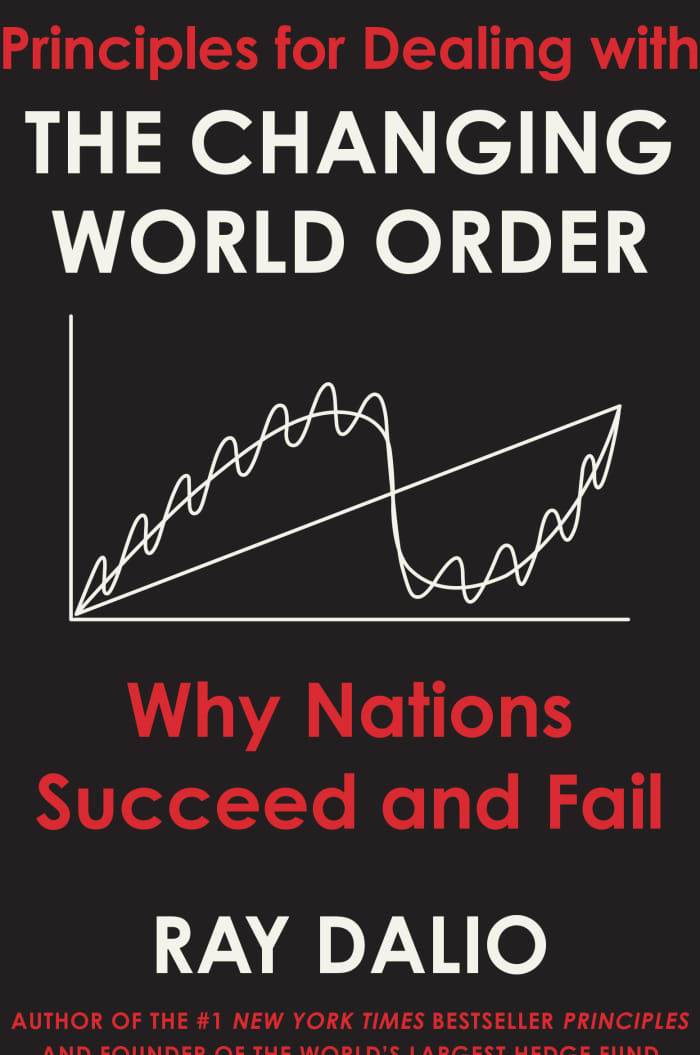
Put another way, it’s hard to know where you’re going if you don’t know where you’ve been. In his latest book, “Principles for Dealing with the Changing World Order: Why Nations Succeed and Fail,” Dalio, the founder and co-chairman of hedge fund Bridgewater Associates, shows investors their future by taking them back in time to study the rise and fall of great countries and powerful currencies. Because the question you never want to ask about either your money or your situation in life is “how did I get here?”
In almost 600 pages of narrative and charts, the book paints Dalio’s interpretation of the tectonic shifts now reshaping global politics and financial markets in ways that loudly echo the past but are yet to be determined — namely the competitive, complex relationship between the U.S. and China.
How the world’s two most-formidable nations coexist — or not — is affecting and will continue to impact not only your wealth and opportunities in the 21st century, but your children’s and their children’s as well. Says Dalio: “[Americans] have to do three things: We have to earn more than we spend by being productive and get our finances in order; we have to work well together economically and politically, and we have to avoid war with China.”
In this interview, which has been edited for clarity and length, Dalio offers insights about the similarities between the current economic and political cycle and previous ones, the disturbing external and internal threats to American democracy and influence, and how to and what to hold in your investment portfolio, including bitcoin, as history unfolds.
MarketWatch: Your new book is the latest in a series where you share your fundamental principles for investing in and living with the world as it is — essentially ways to accept and play the hand you’re dealt. What conditions and circumstances concern the United States right now that you want investors to understand, and why look to the past for answers?
Dalio: In my investing, I learned a lesson that many things that surprised me hadn’t happened in my lifetime but had happened before. The first time that happened was in August 1971 when the U.S. broke its promise to exchange dollars for gold so that it could print a lot of money, which led to the devaluation of the U.S. dollar. I was working on the floor of the New York Stock Exchange. I was surprised that the stock market rose a lot, so I looked into history and I found that same thing happened in March 1933. And I learned why.
As a result of that, I always study what drove major economic and market movements in history. My study of the Great Depression is the reason we anticipated the 2008 financial crisis.
Many people are interested in the news of the day but they’re not interested in the history and lessons of the past. But you won’t understand what’s going on if you just react to the news of the day. My approach has always been like a doctor, that if I haven’t seen many cases of it before, I want to go back and study all the cases in history so I can make decisions today.
There are three things happening now that I needed to study:
- Zero interest rates with the creation of a lot of debt and a lot of money-printing to finance that debt.
- The internal conflict between left and right, rich and poor, Democrats and Republicans, which is producing a level of conflict in the U.S. that is the highest since 1900. This also has tax implications. There is an anti-capitalist swing under way that will affect U.S. tax policy, where people live, and how they are with each other.
- The rise of a great power to challenge an existing great power and the existing world order. The existing world order began in 1945 and it was the American world order. Now China is rising to challenge the United States.
These things are big. Almost every day we’re going to be talking about these three things and what’s happening with them. The last time that happened was in the 1930-1945 period. They happened many times in history basically for the same reasons in the same way.
MarketWatch: The political and social divisions in the U.S. affect so much of what Americans take for granted, and maybe it’s because they’re taken for granted that they confront us now. Can this country move forward together?
Dalio: The fundamentals are clear. We have to do three things: We have to earn more than we spend by being productive and get our finances in order; we have to work well together economically and politically, and we have to avoid war with China. When I look at different countries, I judge them based on whether or they have good finances, internal order and external peace.
“‘If the causes people are behind are more important to them than the system, the system is in jeopardy. I worry that’s where the U.S. is now.’”
We have the ability to do these things but I worry about us being our own worst enemy. History has shown that if the causes people are behind are more important to them than the system, the system is in jeopardy. I worry that’s where the U.S. is now.
There is a great polarity, a fight-and-win-at-all-costs mentality. Looking ahead, in the 2022 election we will see the primary battle between the extremists and the moderates in both political parties and probably see moves to greater extremism. In the general election, there is a good chance that neither side will accept being the loser.
This type of fight-to-the-death mentality could lead to some form of “civil war.” What I mean by civil war is a series of battles not resolved by the law or the Constitution, in which power is used instead — including the failure of our democracy to work.
Also, as I look ahead economically for the U.S. I see a worsening of the situation. Because of all the money that has been pumped out we’re now on a sugar high, but we are beginning to see that inflation will pick up, and the stimulus checks that came in won’t come in at the same rate, causing conditions to worsen.
It all comes down to a couple of basics. To be successful we have to be financially strong and be good with each other. That’s it.
MarketWatch: Easier said than done. There doesn’t seem to be much political will right now in Washington or among the U.S. states to work together.
Dalio: I know. In these cases — the French Revolution, the Russian Revolution, the Chinese Revolution, for example — the divides became greater and greater. And then you have to pick a side and fight for that side. We are starting to see this in the U.S. by the movement of Americans to different states. It’s not just a tax issue. It’s a values issue.
Most likely you’re going to see disagreements between the federal government and state governments on the matter of what is states’ rights that probably won’t be all settled legally, so they will be settled through tests of power. There will be places that people won’t want to be because it’ll be threatening. People will want to be with their own kind.
I want individuals to understand the mechanics of this, which is why I wrote the book. For example, I’d like them to see historical cases and fundamental cause-effect relationships to understand what it means to produce a lot of debt and a lot of money, so I wrote a chapter on the value of money.
MarketWatch: What could this situation mean for U.S. investors? You’re describing a very different America to consider.
Dalio: Right. I want people to be well-informed and worry about what they should worry about.
I have a principle: If you worry, you don’t have to worry. And if you don’t worry, you have to worry. If you worry, you’ll take care of the thing you’re worried about. If people worry about the fighting and they worry about the finances, then they can work together and deal with these things.
“‘People think the safest investment is cash but they don’t look at the inflation-adjusted return.’”
Financially, the way it works is when the government needs to send out checks, it could either get the money from taxes or from borrowing. If it can’t get all the money it needs from borrowing, the central bank can print the money. That devalues the value of money.
Central banks can create a lot more money and debt, but that won’t raise living standards. I’d like to help people see how money and credit move through the system to drive things. I’d like to show people how money and credit are created and how person who gets the money and credit buys goods, services and financial assets, which makes those things go up in price.
I’d like to help them understand the reasons why cash is so bad in this type of environment. People think the safest investment is cash but they don’t look at the inflation-adjusted return.
Don’t hold cash. It’s better to hold a liquid, diversified portfolio of assets — if it’s balanced. Make sure you’re well-diversified outside of cash — stocks
SPX,
bonds
TMUBMUSD10Y,
inflation-indexed bonds, commodities and gold
GLD,
and across many countries, particularly those with stronger income statements and balance sheets. An “all-weather” portfolio has currency diversification, asset class diversification, country diversification and industry diversification.
MarketWatch: So you’re thinking that higher U.S. inflation is not transitory. It’s going to stick.
Dalio: Yes. There’s two types of inflation. There’s inflation when the demand for goods and services rises against the capacity to produce them. That’s normal, cyclical inflation. Then there’s monetary inflation — the creation of a lot of money and credit relative to the quantity of goods and services. The U.S. is having both.
When I look at the country’s financials going forward, what the size of the deficit will be and how much money is produced, that’s a concern. There’s also the risk, or even the probability, that those who are holding cash and bonds will choose to sell those to move into other things. If that happens, the U.S. central bank will have to decide if it raises interest rates, which will hurt the economy — and I don’t believe they can do that in a significant way. It would be bad for the economy, politics and the markets if they tried to rectify that by allowing interest rates to rise. So they’re probably going to have to print more money, and that causes more monetary inflation.
Today it doesn’t cost anything to borrow. Right now if you take out debt, you have practically no interest rate and principal payments can be deferred, so money is essentially free. With the cost of money negative and below the nominal growth rate, it’s very profitable to borrow and invest in anything that can grow at the inflation rate or more. That’s what’s priced into the markets now. And if they change things — raise interest rates to be higher than is priced into the markets — asset prices will go down and there will be more of an economic problem.
“Central bankers, especially the Fed, are between a rock and a hard place. They need to tighten quite a lot to restrain inflation, yet if they do they will hurt the economy.”
Central bankers, especially the Fed, are between a rock and a hard place. They need to tighten quite a lot to restrain inflation, yet if they do they will hurt the economy. Imagine what would happen if there was a tightening of monetary policy in the classic way of first causing asset prices to go down and then the economy to contract.
Politically, imagine what that would be like. People are at each other’s throats and they’ve been given a lot of money. I’m afraid of another economic downturn. We can’t even get along on whether we can wear masks or not. You can’t allow another economic downturn. You can’t raise interest rates enough to bite. Interest rates have to be significantly below both the inflation rate and the nominal GDP growth rate.
It’s easy to see what type of policy biases will exist by looking at whether circumstances favor debtors or creditors being favored. High real interest rates will exist when circumstances make it better for the creditor to be helped and credit growth to show while low real rates will exist when central banks want to help debtors and want to stimulate credit growth.
History shows that when countries need more money and don’t have other ways of getting it that they will produce more money. Producing money doesn’t take money away from anyone so it’s politically easier because it’s a hidden tax. Nobody’s complaining about where the money came from. If you get it through taxes, everybody squawks. History has shown that the easiest way is to print more money and give it out. If instead you tighten, it has consequences.
MarketWatch: Bitcoin and other cryptocurrency also is politicized. Crypto has become a political statement as much as a way to make and lose money.
Dalio: There’s a lot of money chasing all sorts of things, crypto among them. It has been an amazing accomplishment for bitcoin
BTCUSD,
to have achieved what it has done, from writing that program, not being hacked, having it work and having it adopted the way it has been. I believe in the blockchain technology; there’s going to be that revolution, so it has earned credibility.
“I’m not an expert on bitcoin, but I think it has some merit as a small portion of a portfolio.”
I’m not an expert on bitcoin, but I think it has some merit as a small portion of a portfolio. Bitcoin is like gold, though gold is the well established blue-chip alternative to fiat money.
However, bitcoin has a number of other issues. If it is a threat to governments, it will probably be outlawed in some places when it becomes relatively attractive. It may not be outlawed in all places. I don’t believe that central banks or major institutions will have a significant amount in it.
I have a little bit of it because I believe a portfolio should start off with, under a worst-case scenario, what assets protect it and make sure it’s diversified. It’s almost a younger generation’s alternative to gold and it has no intrinsic value, but it has imputed value and it has therefore some merit.
More: Can the Federal Reserve taper without causing a tantrum in the markets? So far, so good
Also read: Why it matters that workers feel they matter: Valued employees do a better job for employers and customers