SEC chair Gensler seeks tougher SPAC disclosure, liability rules

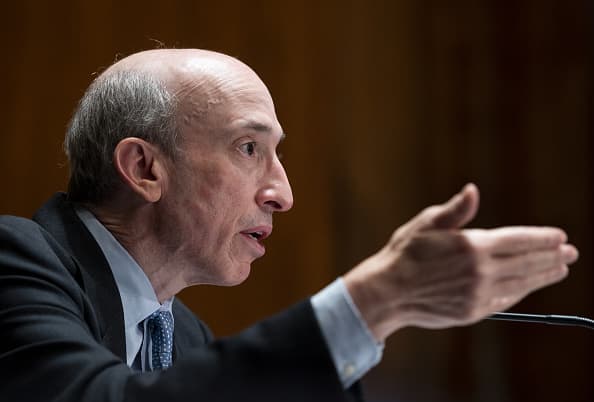
Gary Gensler, chairman of the U.S. Securities and Exchange Commission (SEC), speaks during a Senate Banking, Housing and Urban Affairs Committee hearing in Washington, D.C., U.S., on Tuesday, Sept. 14, 2021.

Bill Clark | Bloomberg | Getty Images

Securities and Exchange Commission Chairman Gary Gensler on Thursday floated several potential SPAC rules he hopes the regulator will consider as it works to oversee one of Wall Street’s up-and-coming ways to take companies public.

Among the ideas Gensler pitched were new rules around marketing practices, tougher disclosure requirements and liability obligations for SPAC “gatekeepers,” which could include sponsors, financial advisors and other bookkeepers.

Specifically, the SEC chief said he’d like to see new rules that compel SPACs to provide investors with more information about fees, expected equity dilution and conflicts, as well as better ways to access that information before an investment is made.

SPACs, or special-purpose acquisition companies, have been around for decades without much fanfare.

Also known as a blank-check company, a SPAC is a shell company that raises money and trades on public markets while looking to merge with a private company. Their eventual marriage will bring the private firm into the public marketplace, meaning that investors in the public SPAC will have an opportunity to own a piece of the still-private target.

The public push for new SPAC rules comes days after news broke that the SEC and other federal regulators are investigating a SPAC merger involving former President Trump’s fledgling media company.

The SPAC, called Digital World Acquisition Corp., disclosed in a filing earlier this week that regulators began asking for information about certain stock trades “that preceded the public announcement of the October 20, 2021 Merger Agreement” with Trump’s firm.

Gensler said Thursday that he is concerned by a disconnect between the amount of information that companies are required to provide through a traditional initial public offering versus the disclosures required from SPACs.

“Currently, I believe the investing public may not be getting like protections between traditional IPOs and SPACs,” the SEC chair said in remarks at the virtual Healthy Markets Association Conference. “Due to the various moving parts and SPACs’ two-step structure, I believe these vehicles may have additional conflicts inherent to their structure.”

Appointed by President Joe Biden earlier this year, Gensler said added rules clamping down on marketing prior to proper disclosure may also be needed to help anchor the value of the SPAC’s shares closer to the business’s actual worth.

Glitzy corporate presentation decks, hyped press releases and celebrity endorsements can balloon a SPAC’s equity well beyond a reasonable value long before proper disclosures are filed, Gensler said.

CNBC Politics

Read more of CNBC’s politics coverage:

In the past two years, SPACs have blossomed into a popular alternative to traditional initial public offerings and a way to invest in start-ups.

The allure of possibly finding the next Amazon or Apple, prior to a young company’s entrance to public markets, has drawn billions from Wall Street in 2021. SPACs have raised as much money as traditional IPOs this year thanks to the support of big banks and investment firms.

But Gensler and others worry that insufficient SPAC disclosures leave investors open to steep losses in the future.

While Gensler did not offer more specific details on the rules he wants to see from SEC staff, his speech reinforces Wall Street’s belief that his tenure will result in a hands-on approach and that the chairman will serve as a stricter “cop on the beat” toward Wall Street.

He said he wants the SEC to ensure SPAC directors, officers, sponsors and financial advisors aren’t misleading investors with inflated financial projections only to stiff them with a backlog of bills — or a mediocre business — after the merger is complete.

“In traditional IPOs, issuers usually work with investment banks,” he said. “Thus, a lot of people think the term ‘underwriters’ solely refers to investment banks.”

“There may be some who attempt to use SPACs as a way to arbitrage liability regimes,” Gensler continued. “Many gatekeepers carry out functionally the same role as they would in a traditional IPO but may not be performing the due diligence that we’ve come to expect.”

While some take-public SPACs have seen success on Wall Street — electric-vehicle maker Lucid Group or personal-finance company SoFi, for example — others have seen mixed trading among investors.

Some of the well-known public companies resulting from SPAC mergers include space-tourism firm Virgin Galactic and online real-estate company Opendoor. Both have seen their equity slide more than 30{21df340e03e388cc75c411746d1a214f72c176b221768b7ada42b4d751988996} this year.

The proprietary CNBC SPAC Post Deal Index, which is comprised of the largest SPACs that have already completed a SPAC merger within the last two years, is down more than 33{21df340e03e388cc75c411746d1a214f72c176b221768b7ada42b4d751988996} in 2021.
China to tighten rules for tech companies seeking foreign funding

China is preparing a blacklist that is expected to tightly restrict the main channel used by start-ups to attract international capital and list overseas, in a bid to limit the role of foreign shareholders in the country’s next generation of tech companies.

The blacklist will target new companies in sensitive sectors that use so-called variable interest entities to run their China businesses, according to four people familiar with the matter. They did not expect the changes to apply to existing companies.

VIEs are a legal structure that has been used for decades by Chinese tech groups — including industry leaders Alibaba and Tencent — to circumvent foreign investment restrictions and raise billions of dollars from international investors.

The list, which is being formulated by Chinese authorities including the state planner, commerce ministry, securities regulator and central bank, follows a tech sector crackdown over the past year that culminated in an announcement last week by ride-hailing group Didi Chuxing that it would delist from the New York Stock Exchange.

It was not yet clear how wide-reaching the list will be, but people familiar with the matter said the new negative list for VIEs could include sectors that were data-intensive or involved national security concerns. The US has taken similar measures to restrict Chinese investment in Silicon Valley start-ups.

Chinese authorities have accused the country’s large consumer internet groups of focusing on eliminating competition instead of helping the country to catch up with the US in semiconductors and other advanced technologies.

Regulators have taken antitrust and data security measures against the main companies, starting with billionaire Jack Ma’s Ant Group, which was forced to cancel what would have been the world’s largest initial public offering last year.

You are seeing a snapshot of an interactive graphic. This is most likely due to being offline or JavaScript being disabled in your browser.


Two people close to financial regulators said the negative list was not intended to affect existing companies that were using the VIE structure. Instead, it was aimed at ensuring that future national champions critical to the country’s economy would not be dominated by foreign shareholders.

“VIEs are not dead entirely, but essentially they are [for future purposes],” said one of the people.

“In the future, foreign investors can put money into traditional industries as opposed to tech,” the person said, adding that such industries did not need to use the VIE structure to bring in foreign capital.

Chinese tech groups turned to VIEs two decades ago but authorities have not officially addressed the complicated legal structures, preferring to leave them in a regulatory grey area.

The system has allowed large investors such as Japan’s SoftBank and Sequoia Capital China to funnel billions of dollars from foreign pension and sovereign wealth funds, family offices and university endowments into China’s most promising internet start-ups.

This is done by taking shares in offshore holding companies set up in the Cayman Islands, which then enter into a series of contracts with the onshore Chinese businesses and their Chinese national founders, who hold their shares.

When successful, such companies float their offshore shell companies in the US or Hong Kong. Of the 241 Chinese companies listed in New York, 79 per cent use VIEs to run their China businesses, according to a Financial Times review of Capital IQ data.

Chart explaining how variable interest entities work

Beijing could publish the blacklist as early as this month, two of the people said. Another person said the list’s publication might depend on how the US handled new rules for Chinese companies trading in New York.

China’s securities regulator said on Sunday that a report by Bloomberg News that the country was banning VIEs from foreign IPOs was untrue, adding that it was also not pushing companies using the structure to delist from US exchanges.

Chinese authorities banned VIEs from investing in the country’s education sector this year. Foreign investors have also generally avoided using the structure for the most sensitive industries, such as defence or biotech companies that deal with genetic data.

Lawyers and investors said a negative list that grandfathered existing structures could help to fully legitimise the VIE legal contracts governing hundreds of Chinese tech companies.

Alex Roberts, a lawyer at Linklaters in Shanghai, said the Chinese government attempted to regulate VIEs six years ago, drafting a law that would have recategorised them based on their ultimate controllers.

“But the proposal was eventually set aside . . . arguably because of the huge economic and social benefit that some of China’s biggest businesses that use these legal constructs bring to the country,” he said.

China’s state planner, commerce ministry, securities regulator and central bank did not immediately respond to a request for comment.

Additional reporting by Andy Lin in Hong Kong

Unhedged — Markets, finance and strong opinion

Robert Armstrong dissects the most important market trends and discusses how Wall Street’s best minds respond to them. Sign up here to get the newsletter sent straight to your inbox every weekday

Metaverse will disrupt human life — here are 7 companies that may win big

The metaverse will be disruptive to society once it gains its true form over the next decade Jefferies analyst Simon Powell argues. But several companies could be poised to benefit greatly from the new digital ecosystem. 

“A single metaverse could be more than a decade away, but as it evolves it has the potential to disrupt almost everything in human life that has not yet already been disrupted,” said Powell in a lengthy research note on Monday titled “The Digitization of Everything.” 

“The pandemic accelerated the adoption of various technologies. Many people were forced to spend even more of their lives online from socializing to working, from education to entertainment. This shift to an online world will continue.”

The metaverse arguably burst into the public lexicon for the first time this year as Facebook founder Mark Zuckerberg has hyped the digital world’s potential (and changed its holding company name to Meta in a show of support). Microsoft (Yahoo Finance’s Company of the Year) has also talked increasingly about the metaverse and how it will play in it moving forward. 

In its simplest form, the metaverse is an online world that includes augmented reality, virtual reality, and 3D avatars. As this world takes form, how things are done stand to change dramatically. Explains Powell, “The digitization of everything will create a new world that we can all move in and out of. The metaverse can be viewed as a new platform for the digital age. We see it as a wrapper that will roll up other digital platforms. It will not replace the internet, but instead build on top of it and, when combined with other technologies and interfaces, will allow us to essentially step into, and perhaps live in it.”

INDIA - 2021/11/30: In this photo illustration, a Metaverse logo seen displayed on a smartphone with a facebook logo in background. (Photo Illustration by Avishek Das/SOPA Images/LightRocket via Getty Images)

INDIA – 2021/11/30: In this photo illustration, a Metaverse logo seen displayed on a smartphone with a facebook logo in background. (Photo Illustration by Avishek Das/SOPA Images/LightRocket via Getty Images)

This virtual environment is not only expected to change how people interact with the physical world, but also how we work with other. 

“We are building towards a metaverse. I am really excited about the vision,” said Dropbox founder and CEO Drew Houston recently on Yahoo Finance Live. “Where Dropbox fits in if you are working in that kind of environment or in the metaverse, you need stuff. So for your digital content, Dropbox could help and that is what we are building towards. It is very early. It is a long journey, but it is exciting.”

Jefferies’ Powell acknowledges it’s still early for investors to pick definitive metaverse winners. But investors could begin mapping out a plan of attack. 

“Focus initially on the hardware needed to lift the internet to become the metaverse. Then look at the software that will design and host it, and ultimately the businesses that create use cases on it,” adds Powell. 

The analyst outlines several potential winners from the metaverse, mostly relegated to the social media and gaming sectors. 

“Facebook (Meta) /SNAP are both working on hardware to access the metaverse while having social platforms with significant reach. Roblox (RBLX) is the closest to being an early stage metaverse. TakeTwo (TTWO) is currently running three games that arguably could be early stage metaverses. Electronic Arts (EA) has several IPs that would be ripe to be turned into walled garden metaverses: Skate, Sims, SimCity, and even its sports franchises. Activision Blizzard (ATVI) has one of the innovators in early metaverse with World of Warcraft in its library. Moreover, Call of Duty could use many of the tools in building a metaverse to better monetize and engage users (cross platform, cross universe, single currency economy). Music will likely play a role along the way from here to there … Warner Music (WMG) already sees this as it has invested in several start ups that are building tools/platforms in the metaverse,” notes Powell.

Brian Sozzi is an editor-at-large and anchor at Yahoo Finance. Follow Sozzi on Twitter @BrianSozzi and on LinkedIn.

Read the latest financial and business news from Yahoo Finance

Follow Yahoo Finance on Twitter, Instagram, YouTube, Facebook, Flipboard, and LinkedIn

Alibaba finance chief to step down in company restructuring

Alibaba’s longtime finance chief Maggie Wu is stepping down as the Chinese ecommerce giant shakes up its organisation to reverse slowing growth and halt the fall of its share price to a five-year low.

The ecommerce group founded by Jack Ma more than two decades ago has been under pressure since Ma criticised Chinese regulators in a Shanghai speech last year that led to the suspension of sister company Ant Group’s blockbuster initial public offering.

Alibaba’s US-listed shares have tumbled 64 per cent since the IPO was derailed, and the group was fined a record $2.8bn for antitrust abuses this year. Analysts said it had poorly navigated Beijing’s campaign to rein in tech companies.

“This year, Alibaba has raised its share buybacks while competitors like Tencent have spent big to fulfil the government’s common prosperity aims,” said Robin Zhu of Bernstein, referring to Beijing’s policy to encourage wealth redistribution.

“Investors have been discussing accountability in management so [Wu’s departure] is not a total surprise,” added Zhu, noting she had led the company for many years.

Deputy finance chief Toby Xu, who joined Alibaba from accounting firm PwC three years ago, will take over the role from Wu in April.

Alibaba last month slashed its growth prospects in response to China’s slowing economic momentum and mounting competition from rivals.

The ecommerce company, the largest Chinese group listed in the US, has come under additional pressure after ride-hailing leader Didi Chuxing announced on Friday it would delist from the New York Stock Exchange just five months after its IPO.

Didi’s delisting plan has stoked concerns about the future of other Chinese companies listed overseas. China’s securities regulator said on Sunday it was not pushing companies to withdraw from US exchanges, adding that it was working with Washington to resolve a stand-off over access to audit papers that could result in all Chinese groups being kicked off Wall Street within three years.

Alibaba chief Daniel Zhang on Monday outlined further structural changes that will consolidate the company’s international business under the leadership of 36-year-old executive Jiang Fan, while co-founder Trudy Dai takes over its domestic ecommerce business.

Jiang ably helmed Taobao’s push into mobile and was seen as a contender to take the reins of the entire group until a personal scandal turned into a public relations crisis for Alibaba last year.

Wu, who managed Alibaba’s books through three public listings, was known for taking subtle jabs at less frugal competitors in earnings calls and for her steady hand in the company.

“Maggie is forever calm and unflappable, regardless of ups and downs in the global capital markets and macro environment,” said Zhang.

“She is humble and resilient, and has been my irreplaceable and closest partner over the years,” he added. Wu will remain at Alibaba as a partner and director.

Wu called her resignation the “culmination of extensive preparation over many years” and a step to promote a new generation of leaders at the company.

“The markets will always have ups and downs, but Alibaba has ambitious long-term goals,” she said.

#techAsia newsletter

Your crucial guide to the billions being made and lost in the world of Asia Tech. A curated menu of exclusive news, crisp analysis, smart data and the latest tech buzz from the FT and Nikkei

Sign up here with one click

We Wouldn’t Be Too Quick To Buy The Williams Companies, Inc. (NYSE:WMB) Before It Goes Ex-Dividend

It looks like The Williams Companies, Inc. (NYSE:WMB) is about to go ex-dividend in the next four days. The ex-dividend date is usually set to be one business day before the record date which is the cut-off date on which you must be present on the company’s books as a shareholder in order to receive the dividend. It is important to be aware of the ex-dividend date because any trade on the stock needs to have been settled on or before the record date. This means that investors who purchase Williams Companies’ shares on or after the 9th of December will not receive the dividend, which will be paid on the 27th of December.

The company’s upcoming dividend is US$0.41 a share, following on from the last 12 months, when the company distributed a total of US$1.64 per share to shareholders. Last year’s total dividend payments show that Williams Companies has a trailing yield of 6.0{21df340e03e388cc75c411746d1a214f72c176b221768b7ada42b4d751988996} on the current share price of $27.11. Dividends are a major contributor to investment returns for long term holders, but only if the dividend continues to be paid. As a result, readers should always check whether Williams Companies has been able to grow its dividends, or if the dividend might be cut.

Check out our latest analysis for Williams Companies

Dividends are typically paid out of company income, so if a company pays out more than it earned, its dividend is usually at a higher risk of being cut. Williams Companies distributed an unsustainably high 196{21df340e03e388cc75c411746d1a214f72c176b221768b7ada42b4d751988996} of its profit as dividends to shareholders last year. Without more sustainable payment behaviour, the dividend looks precarious. That said, even highly profitable companies sometimes might not generate enough cash to pay the dividend, which is why we should always check if the dividend is covered by cash flow. Over the last year it paid out 75{21df340e03e388cc75c411746d1a214f72c176b221768b7ada42b4d751988996} of its free cash flow as dividends, within the usual range for most companies.

It’s good to see that while Williams Companies’s dividends were not covered by profits, at least they are affordable from a cash perspective. Still, if the company repeatedly paid a dividend greater than its profits, we’d be concerned. Very few companies are able to sustainably pay dividends larger than their reported earnings.

Click here to see the company’s payout ratio, plus analyst estimates of its future dividends.

historic-dividend

historic-dividend

Have Earnings And Dividends Been Growing?

Businesses with strong growth prospects usually make the best dividend payers, because it’s easier to grow dividends when earnings per share are improving. If business enters a downturn and the dividend is cut, the company could see its value fall precipitously. This is why it’s a relief to see Williams Companies earnings per share are up 4.8{21df340e03e388cc75c411746d1a214f72c176b221768b7ada42b4d751988996} per annum over the last five years.

Many investors will assess a company’s dividend performance by evaluating how much the dividend payments have changed over time. Since the start of our data, 10 years ago, Williams Companies has lifted its dividend by approximately 13{21df340e03e388cc75c411746d1a214f72c176b221768b7ada42b4d751988996} a year on average. We’re glad to see dividends rising alongside earnings over a number of years, which may be a sign the company intends to share the growth with shareholders.

The Bottom Line

Should investors buy Williams Companies for the upcoming dividend? Earnings per share have not grown all that much, and the company is paying out an uncomfortably high percentage of its income. Fortunately it paid out a lower percentage of its cash flow. With the way things are shaping up from a dividend perspective, we’d be inclined to steer clear of Williams Companies.

So if you’re still interested in Williams Companies despite it’s poor dividend qualities, you should be well informed on some of the risks facing this stock. Our analysis shows 2 warning signs for Williams Companies and you should be aware of them before buying any shares.

A common investment mistake is buying the first interesting stock you see. Here you can find a list of promising dividend stocks with a greater than 2{21df340e03e388cc75c411746d1a214f72c176b221768b7ada42b4d751988996} yield and an upcoming dividend.

Have feedback on this article? Concerned about the content? Get in touch with us directly. Alternatively, email editorial-team (at) simplywallst.com.

This article by Simply Wall St is general in nature. We provide commentary based on historical data and analyst forecasts only using an unbiased methodology and our articles are not intended to be financial advice. It does not constitute a recommendation to buy or sell any stock, and does not take account of your objectives, or your financial situation. We aim to bring you long-term focused analysis driven by fundamental data. Note that our analysis may not factor in the latest price-sensitive company announcements or qualitative material. Simply Wall St has no position in any stocks mentioned.

14 Ways Remote Teams Can Impact A Company’s Financial (And Overall) Health

Around the world, the pandemic spurred a significant rise in remote work arrangements. Regardless of industry or business model, remote teams can have significant impacts—both positive and negative—on a company’s overall financial health. In some cases, remote teams require a company to buy new technology in order for employees to accomplish their work. On the other hand, many companies are saving significant amounts of money by not maintaining a physical office—and some are even seeing increased productivity.

As more companies are beginning to make the decision on whether to continue with remote work, head back to the office or settle on an arrangement that combines the two, it’s essential for leaders to carefully consider what’s right for their unique situation. Below, 14 members of Forbes Finance Council share ways your remote team may be impacting your company’s finances.

1. Increased Procrastination And Competition For Resources

I faced one of the negative effects of remote work: increased procrastination caused by a lack of communication. Additionally, there was a cost increase caused by remote market globalization—more and more businesses began going remote, so they started hiring employees globally. Before the pandemic, we had to compete for resources locally. Now we have to compete globally. – Peter Shubenok, RNDpoint

2. Potential Communications Breakdowns

A lack of communication can create headaches for remote teams. I have worked remotely since 2005, and I have found that increased communication is critical to meeting deadlines and avoiding misunderstandings. – Paul Davis, Strategic Resource Management


Forbes Finance Council is an invitation-only organization for executives in successful accounting, financial planning and wealth management firms. Do I qualify?


3. Higher Travel Costs

As we start coming back to work, remote teams will need to begin meeting up with their broader team at a central location every few months. This will mean that employees who rarely traveled, such as product managers and engineers, will be making four to six trips in a year that they didn’t before. Finance teams need to account for enabling these remote employees to spend time together, along with the associated costs. – Robin Gandhi, TripActions Liquid

4. The Need For A Robust Culture 

Working for a remote-first fintech, remote teams are quite literally the lifeblood of our organization. It can be easy to dismiss the concept of culture in remote teams, but when created, supported and pushed to thrive, culture can have a dramatic impact on the financial and overall success of an organization. Happy, engaged employees undisputedly do better work. – Michelle Prohaska, NYMBUS

5. Lower Overhead Costs

Remote work enables companies to remove traditional fixed overhead costs from their financials. Specific expenses, including rent, office supplies, utilities and salaries based on “handcuffed” geographies tied to a central office, can be reduced or eliminated from forward-looking plans. With these savings, management can invest more in R&D or employee learning to drive top-line growth. – John Tytko, Caremerge, Inc.

6. Reduced Need For Physical Expansions

We had considered expanding the physical footprint of our business regionally and nationally before Covid. Then everyone became more comfortable meeting virtually using services such as Zoom. Now, without leaving our office, we’re meeting with clients nationwide. So we’ve expanded our business not through remote teams as much as a remote business model—working with clients in other cities virtually. – Bill Keen, Keen Wealth Advisors

7. More Time Saved For Working And Expense Savings For Employees

Remote workers don’t need to spend money on commuting, eating out, dry cleaning, pet care and so on. On average, Americans spend almost one hour per day in total commute time. If employees capture 100{21df340e03e388cc75c411746d1a214f72c176b221768b7ada42b4d751988996} of their “no-need-to-commute” expense savings but allocate 30 minutes more per day to working—splitting the time savings differential with their employer—they win, and their employers win. – Sean Brown, YCharts

8. Boosted Productivity

A hybrid model with some team members working remotely seems ideal. Less office space and resources are required, and studies have shown that working from home has boosted productivity in many ways. This is also a keen “perk” or benefit in today’s competitive recruiting landscape. Many would even take slightly less pay to be able to work from home. – Leslie Heimer, American Liberty Mortgage | Stockworth

9. Savings On Health Benefits

Offering benefits to a remote team, often scattered across the country, presents its share of unique financial challenges—but also potential savings opportunities. Extra vigilance is required when selecting and structuring benefit offerings. A high-deductible health plan paired with an employer-sponsored health savings account program can realize short- and long-term financial benefits for both the company and its employees. – Tom Torre, Bend Financial

10. Compromised Company Security

When employees are too relaxed about security compliance, it can put your entire company at risk for cyberthreats. To mitigate risk, invest in implementing automated phishing simulations and training videos and set up two-factor authentication. Educating remote teams on cybersecurity is crucial for keeping your company secure from costly threats. – Jody Grunden, Summit CPA Group

11. Access To Global Talent Pool

Remote teams empower companies to access the global talent pool at a fraction of the cost, which in turn drastically reduces recruitment costs—thereby directly impacting the bottom line of organizations that rely heavily on the brainpower of their workforce. – Anil Grandhi, AG FinTax

12. More Focus On Teamwork, Communication And Goals

Remote teams can get the business to focus on teamwork, communication and goals. There are software tools to help you monitor all areas of your business and track the output of employees. This higher level of business monitoring can help focus teams on profitability and customer-centric actions. Trusted employees may be more productive remotely with the time added to the workday and measured output. – Dave Sackett, Visibility Corporation

13. Lower Tax Liability

Among the positive financial aspects of remote teams are the cost savings that come from reduced office spaces and insurance. But other savings include not dishing out huge local payroll taxes in cities such as San Francisco and New York. Utilizing remote teams can also lead to savings for the employees, including the elimination of commuting expenses—plus, they’re not losing any time commuting, which adds to the company’s benefit. – Kurt Kunselman, AccountingSuite™

14. Better Client Engagement

Unlike the days when client meetings meant costly travel and time away for commuting, remote teams can reach clients more frequently for video or call check-ins. Technology such as Zoom meetings also allows you to keep more members of your team engaged. – Sonya Thadhani Mughal, Bailard, Inc.