A New Jersey–based financial advisor managing about $500 million in client assets is returning to RBC Wealth Management several months after leaving the firm for UBS Financial Services.
But Christopher Andreach’s return to RBC also follows a September restraining order the company filed against him and UBS, accusing Andreach of using confidential customer information to “improperly” solicit RBC customers to join UBS.
According to a court complaint, this confidential data included personal information, account numbers and balances. RBC filed the complaint and called for a restraining order shortly after Andreach departed the firm for UBS earlier this year. Andreach’s longtime assistant, Mary Guastella, joined him in the move, according to RBC’s complaint.
At the time of the suit, RBC argued that both Andreach and Guastella were bound by the firm’s code of conduct, including requirements to protect proprietary information on customers. RBC claimed that the duo resigned effective immediately and without notice on Sept. 3, 2021, and began working at UBS on the same day.
During the course of RBC’s investigation, the firm allegedly found that between Aug. 1 and Andreach’s departure, the advisor and his assistant “printed out, downloaded, and/or otherwise removed computer files” containing confidential information about RBC’s clients, including names, financial information and Social Security numbers, and both entered RBC offices to gather information in order to solicit clients.
RBC also claimed they had surveillance video from Aug. 9 showing the duo entering RBC’s Red Bank, N.J., offices and leaving multiple times with “extensive amounts of printed paper.”
RBC also alleged that Andreach had run an “extensive” number of customer portfolio reviews before leaving. According to the firm, each portfolio runs between 20 and 25 pages, and Andreach allegedly ran at least 300 of these reports in the final month of his employment. RBC said Andreach and UBS used the information to attract RBC clients, transitioning about 30 customers from RBC to UBS after Andreach left the former firm.
“Any allegation that UBS encouraged or participated in Mr. Andreach’s conduct as alleged in RBC’s complaint is unequivocally false,” a UBS spokesperson said about the complaint.
Andreach said he was “humbled” to be invited back to RBC, calling it a place he loved.
“They did identify a few honest mistakes I made on my way out, but the fact that I am welcomed back speaks volumes of the firm’s culture,” he said.
RBC Wealth Management President Tom Sagissor did not mention the recent history in his statement about Andreach’s return but said it served as “an enormous testament” to the culture at RBC. In the statement, RBC announced Andreach would rejoin the firm’s Florham Park, N.J., branch.
Several other firms have made the move from UBS to RBC this past year, including a $1.6 billion seven-person team based in Princeton, N.J., who joined in May. Just a week earlier, The Meridian Group, a Virginia-based firm with $900 million in AUM, also departed UBS for RBC, which manages more than $460 billion in client assets across more than 2,000 advisors.
Alibaba, like its peers in Chinese tech, has been under pressure for much of this year.
David Becker/Getty Images
After a year of regulatory pressure and, more recently, disappointing quarterly earnings,
Alibaba
stock has been undergoing a reevaluation by Wall Street.
Some financial analysts have even been making the case that the Chinese e-commerce giant’s competitor,
JD.com ,
may be a better bet.
Alibaba (ticker: BABA) continues to face the music. New research from investment group Susquehanna marks the latest installment in this trend, with a team of analysts slashing their outlook for Alibaba stock as they raised their target for shares of JD.com (JD).
Analysts led by Shyam Patil at the investment group cut their price target on Alibaba stock by 35{21df340e03e388cc75c411746d1a214f72c176b221768b7ada42b4d751988996} Wednesday—from $310 to $200—but maintained their Positive rating. The shares closed at $136.52 Wednesday, so the Susquehanna price target still implies some 46{21df340e03e388cc75c411746d1a214f72c176b221768b7ada42b4d751988996} upside.
Alibaba’s U.S.-listed stock rose 2.2{21df340e03e388cc75c411746d1a214f72c176b221768b7ada42b4d751988996} Wednesday—it wasn’t trading Thursday due to the Thanksgiving holiday.
Alibaba
‘s shares that trade in Hong Kong (9988.H.K.) climbed 2.7{21df340e03e388cc75c411746d1a214f72c176b221768b7ada42b4d751988996} Thursday. The stock is near its lowest point since late 2018, and has declined more than 40{21df340e03e388cc75c411746d1a214f72c176b221768b7ada42b4d751988996} in 2021.
“Alibaba has been dealing with a regulatory overhang, and now the slowing macro in China is pressuring the business in the near-term,” the team at Susquehanna said.
Patil’s analysis follows Alibaba’s most recent quarterly earnings—which disappointed investors and analysts alike. The company missed sales and earnings expectations, cut its outlook for the full year, and revealed just how badly profits were pinched by eroding margins.
The gloomy financial results added pressure to a stock that has already been beaten down this year, along with much of the rest of Chinese tech. China’s internet giants have found themselves on the wrong side of regulators as President Xi Jinping tightens his control over the economy, though some experts now believe the worst is over.
But Susqhuehanna’s view, in line with analysts from Deutsche Bank and asset manager Needham, is that there are still reasons to be bullish on Alibaba.
“Although Covid may continue to cause periods of softness in the near-term macro, we continue to view Alibaba as the China e-commerce category killer with a large secular growth opportunity and maintain our long-term-oriented positive view,” they added.
As Patil’s team took the axe to Alibaba’s price target, they elevated estimates for competitor JD.com—raising their price target on the stock by 19{21df340e03e388cc75c411746d1a214f72c176b221768b7ada42b4d751988996} from $80 to $95 Wednesday and maintaining a Neutral rating on the shares.
JD.com
‘s U.S.-listed shares (JD) slipped 0.1{21df340e03e388cc75c411746d1a214f72c176b221768b7ada42b4d751988996} Wednesday with the company’s Hong Kong shares (9618.H.K.) climbing 0.6{21df340e03e388cc75c411746d1a214f72c176b221768b7ada42b4d751988996} Thursday.
With the stock closing at $89.36 Wednesday, that implies some 6{21df340e03e388cc75c411746d1a214f72c176b221768b7ada42b4d751988996} upside. JD.com has climbed 3.5{21df340e03e388cc75c411746d1a214f72c176b221768b7ada42b4d751988996} this year—by no means a stunning performance, but firmly beating the 25{21df340e03e388cc75c411746d1a214f72c176b221768b7ada42b4d751988996} year-to-date fall for the
Hang Seng Tech Index,
which is also down 42{21df340e03e388cc75c411746d1a214f72c176b221768b7ada42b4d751988996} from its all-time highs in February.
JD.com’s most recent earnings were far more positive than Alibaba’s: the company notched a 25{21df340e03e388cc75c411746d1a214f72c176b221768b7ada42b4d751988996} year-over-year jump in quarterly revenue.
“We continue to like JD’s positioning in the large and growing Chinese ecommerce market,” Patin’s team said, noting that they “see potential for longer term upside from its advertising and logistics initiatives scaling, and like the company’s ability to successfully incubate new businesses.”
However, there are some risks ahead for the stock. “The macro, pandemic, and supply chain issues will likely be headwinds in the near-term,” they added.
Thanksgiving feasts will likely draw larger crowds than last year and incur higher costs.
A recent Bank of America note detailed which companies have the most exposure to the top holiday dishes amid supply chain bottlenecks, inflation, lingering COVID concerns, low inventories, and evolving consumer behaviors.
Those companies are Campbell’s Soup Company (CPB), General Mills (GIS), The Kraft Heinz Company (KHC), Conagra Brands (CAG), Hormel Foods Corporation (HRL), McCormick & Company (MKC), and The Duckhorn Portfolio, Inc. (NAPA).
“We looked at companies’ exposure to the top Thanksgiving dishes: turkey, stuffing, dinner rolls, gravy, green bean casserole, potatoes, mac & cheese dessert and wine,” the analysts stated. “Overall CPB, GIS, KHC, CAG, MKC, HRL and NAPA are the most exposed. KHC and NAPA are our favorite stocks in this group.”
Key companies exposed to Thanksgiving meal trends. (Source: BofA)
Thanksgiving ‘center of the plate’ items see more pricing power
People appear to be gathering around the table again, the analysts stated, as data from social media conversations found mentions of “vaccines” on the rise while mentions of “FaceTime,” “social distancing,” and “canceled” declined. (“Friendsgiving” and “day drinking” also saw increases.)
And whether consumers opt for turkey or ham, mashed potatoes or marshmallow-topped sweet potatoes, traditional or plant-based options, they’re likely to pay more with inflation hitting food prices.
The American Farm Bureau Thanksgiving cost index projects a 14{21df340e03e388cc75c411746d1a214f72c176b221768b7ada42b4d751988996} year-over-year increase for 2021, led by a 24{21df340e03e388cc75c411746d1a214f72c176b221768b7ada42b4d751988996} increase in turkey prices.
“When you look at more of the center of the plate sort of food items, typically, there has not historically been a lot of pricing power,” Bryan Spillane, a senior food and beverage analyst at BofA Global Research, told Yahoo Finance Live (video above). “But what’s unusual this year is that there has been. Food companies, in particular, began raising prices the middle of the year, and there’s virtually been no elasticity.”
Frozen turkeys in Philadelphia, Wednesday, Nov. 17, 2021. (AP Photo/Matt Rourke)
That said, Spillane added, consumer behavior is expected to change at some point.
“Something that we’re really watching as we move into next year is: At what point does the consumer begin to push back and do we begin to see some trading down or other behavior that demonstrates that consumers are feeling that pinch?” Spillane said.
Investor appetite for food and beverage companies
The top company with the most upside or downside potential is Campbell’s, which BofA gave an “underperform” rating.
“Campbell’s struggling from a few issues,” Spillane said. “One is they are experiencing a material amount of inflation. They have a product portfolio that’s a little bit more skewed… to kind of middle and low-income households. So, that’s, maybe, an area where there may be some sensitivity around passing those prices through.”
The iconic soup company also has a lot of direct and indirect exposure to labor shortages and higher labor costs, Spillane added.
Cans of Campbell’s Soup are displayed in a supermarket in New York City, U.S. February 15, 2017. REUTERS/Brendan McDermid
BofA also gave seasoning-maker McCormick & Company an “underperform” rating, with an $84 price target.
McCormick is “still trading at a premium valuation,” Spillane said, adding that while it has benefitted from people having cooked at home more in the last 18 months, “at some point, as things moderate, you’re going to see less of that cooking at home behavior. And that’s going to create an overhang for McCormick.”
On the flip side, “Hershey [HSY] is well-positioned,” Spillane said, especially when it comes to the inflationary environment.
“The combination of a category that’s still growing very strongly where there’s still a lot of product innovation and where there’s been demonstrated pricing power, we think that Hershey is set up really well to be able to maybe even more than protect margins, maybe potentially grow margins as we cycle through some of this inflation,” he explained.
BofA also awarded Stove Top stuffing-maker Kraft Heinz a buy rating with a $46 price objective.
“We believe this is justified based our view that KHC is well positioned to capture growth associated with changing consumer demand patterns related to recessions and pantry stocking offset by higher than average debt levels,” the analysts wrote.
Grace is an assistant editor for Yahoo Finance.
Read the latest financial and business news from Yahoo Finance
Teleperformance recognized for its sustained growth and commitment to building a better world
PARIS, November 26, 2021–(BUSINESS WIRE)–Regulatory News:
Teleperformance (Paris:TEP), a leading global group in digitally integrated business services, announced today that it has been ranked 10th among the most responsible companies in France and second on social performance in particular. The Group is also number one in its sector.
For this second annual ranking drawn up by Le Point magazine, the independent institute Statista analyzed 2,000 French companies with more than 500 employees and ranked France’s most responsible companies based on environment, social and governance criteria. The analysis was informed by a survey aimed at collecting 27 objective criteria per company and a survey of a sample of 5,000 people.
Teleperformance’s position in the ranking reflects its strong commitment to corporate social responsibility, especially its ongoing initiatives to foster employee well-being and its promotion of diversity and inclusion.
Treating every employee with respect has always been a top priority for the Group. Diversity, inclusion, equality, trust and camaraderie are core values at Teleperformance, which was recently recognized as one of the 25 World’s Best Workplaces in 2021 by Fortune magazine and Great Place to Work®, across all industries.
Teleperformance is committed to listening to its employees on an ongoing basis, whether through satisfaction surveys, actively encouraged open dialogue with management, or continuous dialogue with representative bodies. The Group aims to develop best human resources practices in every market where it operates.
Teleperformance is particularly committed to diversity, equality and inclusion in all its forms. In terms of gender equality, the Group has set ambitious targets and achieved very good results, with a workplace gender equality index of 99/100. It has also developed inclusion programs for many years. In 2020, for example, it had 70,000 employees from minority or disadvantaged groups, and provided a start in the working world to 85,000 people worldwide.
“The outcome of the Statista assessment, which placed Teleperformance among the most responsible companies in France, reflects the culture of integration, diversity and environmental stewardship that drives us. It also confirms the rankings published in October, listing Teleperformance as one of the 25 World’s Best Workplaces by Fortune magazine and the Great Place to Work® Institute. Contributing more with every success gives meaning to our actions”, said Daniel Julien, Teleperformance Chairman and Chief Executive Officer.
ABOUT TELEPERFORMANCE GROUP
Teleperformance (TEP – ISIN: FR0000051807 – Reuters: TEPRF.PA – Bloomberg: TEP FP), a leading global group in digitally integrated business services, serves as a strategic partner to the world’s largest companies in many industries. It offers a One Office support services model combining three wide, high-value solution families: customer experience management, back-office services and business process knowledge services. These end-to-end digital solutions guarantee successful customer interaction and optimized business processes, anchored in a unique, comprehensive high tech, high touch approach. The Group’s 380,000+ employees, based in 83 countries, support billions of connections every year in over 265 languages and over 170 markets, in a shared commitment to excellence as part of the “Simpler, Faster, Safer” process. This mission is supported by the use of reliable, flexible, intelligent technological solutions and compliance with the industry’s highest security and quality standards, based on Corporate Social Responsibility excellence. In 2020, Teleperformance reported consolidated revenue of €5,732 million (US$6.5 billion, based on €1 = $1.14) and net profit of €324 million.
Teleperformance shares are traded on the Euronext Paris market, Compartment A, and are eligible for the deferred settlement service. They are included in the following indices: CAC 40, CAC Support Services, STOXX 600, S&P Europe 350 and MSCI Global Standard. In the area of corporate social responsibility, Teleperformance shares are included in the Euronext Vigeo Eurozone 120 index, the FTSE4Good index and the Solactive Europe Corporate Social Responsibility index (formerly Ethibel Sustainability Excellence Europe index).
FINANCIAL ANALYSTS AND INVESTORS Investor relations and financial communication department TELEPERFORMANCE Tel: +33 1 53 83 59 15 investor@teleperformance.com
The rally in Tesla’s shares has lifted the overall stock market value of Elon Musk’s electric carmaker to over $1.1tn, making it one of the most valuable companies in the world. This year alone it has added almost $475bn in market capitalisation, equal to a Procter & Gamble, a JPMorgan — or two McDonald’s.
However, the real importance and wider footprint of what might be called the “Tesla-financial complex” far outstrips the company’s market capitalisation. This is thanks to a vast, tangled web of dependent investment vehicles, corporate emulators and an enormous associated derivatives market of unparalleled breadth, depth and hyperactivity.
Combined, these factors mean Tesla’s influence over the ebb and flow of the stock market is far greater than even its size would imply. It may even be historically unrivalled in its wider impact, some analysts say.
“We don’t really have the language to describe Tesla any more,” says Michael Green, chief strategist at Simplify Asset Management. “It’s like explaining to a person in a two-dimensional world the concept of ‘up’.”
The Tesla-financial complex is a phenomenon that many investors — whether passive index funds, traditional mutual funds, hedge funds or ordinary retail investors — have no choice but to contend with, given the idiosyncratic force it now exerts over the stock market.
“It stands out like a sore thumb,” says Dean Curnutt, the chief executive of Macro Risk Advisors. “It’s something you’ve got to pay a lot of attention to.”
One of Tesla’s oddest quirks is the fuel that has helped power its rocketing stock market value. Although its stock is wildly popular with many ordinary retail investors, the swelling size and hyperactivity of Tesla “options” — popular derivatives contracts that allow investors to bet both on and against a stock and magnify any gains and losses — has also flabbergasted many market veterans.
The nominal trading value of Tesla options has averaged $241bn a day in recent weeks, according to Goldman Sachs. That compares with $138bn a day for Amazon, the second most active single-stock option market, and $112bn a day for the rest of the S&P 500 index combined. This makes Tesla’s stock more prone to whipsaw movements, because of the “leverage” inherent in using options to trade.
“The Tesla options volume has always been outsized, but it is now huge,” says Michael Golding, the US head of trading at Optiver, a firm active in the options market. “Tesla almost represents a generation. It’s come to represent innovation, at a time when option trading has taken off.”
The Tesla options market — more than 60 times as active as the entire FTSE 100 options market, and almost seven times greater than Euro Stoxx 50 options — has helped push US option trading volumes above actual stock trading volumes this year.
Tesla accounts for a big chunk of that aberration. In November options trading was 50 per cent higher than stock trading in nominal terms, and without Tesla and Amazon it would have been 20 per cent lower, according to Goldman Sachs. “The combination of a high market cap and extraordinary option activity make Tesla a critical driver,” the investment bank said in a note.
Golding estimates that historically the combined trading activity in US equity options has been between 10 and 20 times larger than activity in the biggest individual equity options market. However, there have been days recently where Tesla’s option trading activity has been five-to-six times the rest of the S&P 500 options ecosystem combined. “The size of the Tesla options market is absolutely enormous,” he says.
The value of options depend on what the underlying shares do, but due to their complex mechanics analysts say the option tail can occasionally wag the equity dog if there is enough activity in them, and even bleed into the broader stock market — adding to its churn and making it harder to navigate for many investors.
Curnutt points out that it is unprecedented to have such a huge stock that is also so volatile, and moves to the beat of its own drum. For example, the swelling heft of Tesla’s stock and options market is one of the reasons why the Vix volatility index has diverged so sharply from actual US equity market volatility lately, he argues. “Tesla is its own animal,” he said. “It changes how markets price risk.”
Who will bet against Tesla?
Ordinary retail investors have been the primary power behind the Tesla options boom, but some of them have more resources to make bigger leveraged bets on Musk’s company than others.
IT billionaire Leo KoGuan recently said that he had by early November accumulated almost 7.2m shares in Tesla. They had largely been accumulated through aggressive purchases of Tesla call options — which give buyers the right to buy shares at a pre-agreed price within a certain time period — and offer a popular route to boost gains. Bloomberg previously verified the growing size of his direct equity stake and options investments, and in September, Tesla’s investor relations head Martin Viecha confirmed KoGuan’s original claim.
That would make him Tesla’s third-biggest individual shareholder, behind Musk and Oracle co-founder Larry Ellison, with a stake worth almost $8bn, and has made him a hero on Reddit forums dedicated to the carmaker and trading. “Leo KoGuan = Tesla God”, one thread declared.
“He’s trading a lot of options, we can definitely see his footprint in the market and he’s inspiring others,” Golding says. “It’s almost as if he’s waving the Tesla flag and people on Reddit see him as someone they can follow.”
Tesla’s fame and the volatility of its stock have also started to make it a component in some structured investment products, such as “auto-callables”, further enmeshing its shares into the fate of the broader financial ecosystem.
Auto-callables are complex savings vehicles — particularly popular with Asian investors — where bankers construct an attractive, bond-like fixed return by selling stock options. Historically they have been mostly options on broad stock market indices such as the S&P 500, Hang Seng or Nikkei, but because of falling market volatility some bankers have started to structure them with options on choppier individual stocks. Tesla has emerged as a popular choice.
“Tesla is perceived as safe because it is big and at the technological vanguard, but it’s incredibly lucrative [for investors] to put into structured products because it is so volatile,” says Simplify’s Green.
The frenetic rally in Tesla has also buoyed money management groups such as Cathy Wood’s Ark Invest and Baillie Gifford, which have bet heavily on the electric carmaker. But there is a flipside. Its gains have left a huge and growing blot on the performance of many other investors with only negligible or modest positions in Tesla relative to its big heft in their benchmarks — or “underweight” in market jargon — due to what many see as its wildly inflated valuation.
US mutual funds focused on growth stocks suffered their worst bout of underperformance in at least two decades in October, largely due to the carmaker’s rally. For US mutual fund managers as a whole, Tesla alone crimped their relative performance by 0.46 of a percentage point in October, according to Wells Fargo analysts, helping turn what was heading towards being a decent year into yet another mediocre one for stockpickers.
“Managers that have been underweight Tesla have certainly been punished,” says Drew Dickson, chief investment officer at Albert Bridge Capital. “It’s been a sizeable driver of underperformance for many. You have to wonder whether a lot of them are now holding it simply due to fears they’re going to lag.”
Betting against Tesla has been particularly painful. Hedge funds that have shorted Tesla shares over the past decade are sitting on cumulative losses of over $60bn, according to S3 Partners, a financial analytics company. Just this year the losses have come to $11bn.
The “short interest” in Tesla — the percentage of shares that have been lent out to and sold by hedge funds — has now fallen from 20 per cent at the start of 2020 to just 3.3 per cent by mid-November, according to S3. A sign, industry insiders say, that fund managers are now reluctant to risk their careers betting against a stock that has defied financial gravity for so long.
Prominent bears keep falling by the wayside. Michael Burry, the hedge fund manager made famous by author Michael Lewis in The Big Short and portrayed by Christian Bale in the film of the same name, last year called Tesla’s stock price “ridiculous” and revealed that he was shorting it. But in October he said he had ended the trade and closed out the short position.
“It’s the original meme stock,” says Green, referring to companies like GameStop that have gained sky-high valuations off the back of social media hype. “Shorting Tesla is just an ego trade at this stage. Tesla has been a primary contributor to destroying the credibility of active management over the past few years.”
Underscoring its financial idiosyncrasy, Tesla stock tends to not be much affected by other market and economic trends, but correlates somewhat with bitcoin, according to analysis by Quant Insight.
At the moment Tesla’s shares seem to be benefiting from a “mixed bag” of factors, such as rising inflation expectations, tighter dollar conditions and uncertain credit markets, but “Tesla spends a lot of time out of [recognisable] macro regimes — unsurprising when it is often driven by idiosyncratic factors like Elon’s tweets,” says Huw Roberts, head of analytics at Quant Insight. A macro regime is industry jargon for how different economic environments can hurt or help certain stocks or sectors.
The success of Tesla’s stock has also helped inflate what some analysts and fund managers think is a broader bubble in anything related to electric vehicles. Tesla-emulators Rivian and Lucid are now valued at about $110bn and $90bn, respectively, despite having negligible revenues and no profits.
An index of EV and electric battery companies compiled by the FT has a combined market capitalisation of almost $1.8tn. In contrast, automotive giants Toyota, Volkswagen and Hyundai, the biggest car manufacturers in the world, are worth about $254bn, $135bn and $42bn, respectively.
“There’s obviously a big halo effect with anything electric vehicle-related at the moment, thanks to Tesla,” says Benjamin Bowler, an equity derivatives strategist at Bank of America.
Even Nikola, an electric truck start-up that has set aside $125m to settle fraud charges from the Securities and Exchange Commission over claims that it misled investors about its technology, is still valued at $5.4bn. That is enough to qualify it for the blue-chip S&P 500 index — if it had ever made any profit.
If Tesla’s ascent continues it will further enrich believers, hurt the dwindling band of doubters and drag swaths of the broader equity market up with it. But if it were to fall sharply, it could cause ripples through financial markets that are far in excess of what many appreciate.
Tesla did drop as much as 17.6 per cent in November before rallying once more, without the fall triggering any major ripples. But even this decline only took it back to its October level, and a bigger, more sustained drop could prove more impactful.
“There is a huge, recursive ‘tail wagging the dog’ nature to the valuation of a lot of things these days,” says Dickson. “I’m unwavering in my belief that ultimately the fundamentals are what matters. But over the past few years I can see that the short and intermediate term is far more dominated by flow, momentum, memes and appetites.”
He recalls the financial analyst Ben Graham’s adage that the stock market is a voting machine in the short run, but a weighing machine in the longer run. “In the current environment, I think we’re spending a lot more time voting,” says Dickson.
Additional reporting by Jamie Powell, Philip Stafford and Harriet Agnew in London
FOX Business contributor reacts to the Biden administration’s cash bail policy on ‘FOX Business Tonight
GoFundMe has removed a fundraiser for Darrell Brooks Jr., who has been charged with five counts of first-degree intentional homicide after Sunday’s Christmas parade massacre in Waukesha.
A GoFundMe was created for Brooks in an effort to raise $5 million, the bail amount Waukesha Court Commissioner Kevin M. Costello set for Brooks.
Brooks allegedly drove through a Christmas parade in Waukesha, Wisconsin, killing at least six people and injuring dozens.
A spokesperson for GoFundMe confirmed to FOX Business that the fundraiser was removed from the platform because it violated the GoFundMe Terms of Service.
Waukesha parade suspect Darrell Brooks arrives in court for his arraignment.
The spokesperson also said that the organizer attempting to raise money for Brooks has been banned from using the platform for future fundraisers.
“Fundraisers with misuse are very rare, and we take all complaints very seriously. Our team works with law enforcement to report issues and assists them in any investigations they deem necessary,” the spokesperson said.
GoFundMe has come under criticism recently after the Kyle Rittenhouse trial verdict. GoFundMe says that since Rittenhouse was acquitted of a “violent crime,” money could now be raised for him using the platform. Previously, fundraisers for a Rittenhouse legal defense were prohibited on the site.
“If someone is acquitted of those charges, as Rittenhouse was today, a fundraiser started subsequently for their legal defense and other expenses would not violate this policy,” the statement said. “A fundraiser to pay lawyers, cover legal expenses or to help with ongoing living expenses for a person acquitted of those charges could remain active as long as we determine it is not in violation of any of our other terms and, for example, the purpose is clearly stated and the correct beneficiary is added to the fundraiser.”
Police and emergency responders gather after a vehicle plowed through a Christmas parade, leaving multiple people injured in Waukesha, Wis., Nov. 21, 2021. (Scott Ash-USA TODAY NETWORK via REUTERS / Reuters Photos)
GOFUNDME SAYS RITTENHOUSE FUNDRAISING OK NOW THAT HE IS ACQUITTED
However, GoFundMe allowed fundraisers for the defense of people accused of violent crimes around the same time as the Rittenhouse defense fundraisers were pulled from the site.
Marc Wilson, for example, had a fundraiser on GoFundMe set up by others to pay for his legal defense after he allegedly shot and killed a 17-year-old girl, claiming he did so in self-defense.
The fundraiser for Wilson was active as of Nov. 21 but has since been taken down. It was created on July 1, 2020.
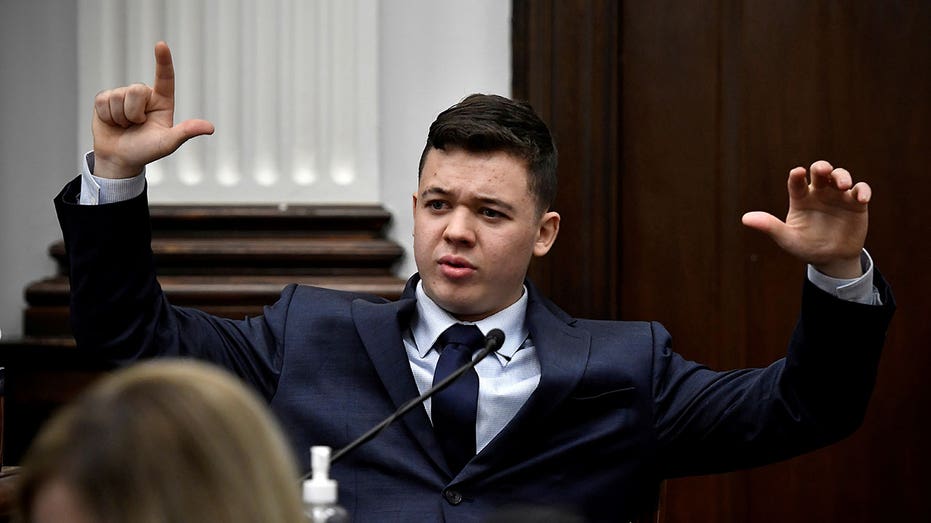
Kyle Rittenhouse talks about how Gaige Grosskreutz was holding his gun when Rittenhouse shot him Aug. 25, 2020. Rittenhouse was testifying during his trial at the Kenosha County Courthouse in Kenosha, Wis., Nov. 10, 2021. (Sean Krajacic/Pool via REUTERS TPX IMAGES OF THE DAY / Reuters Photos)
CLICK HERE TO READ MORE ON FOX BUSINESS
“It is too early to tell if GoFundMe now will be consistent or whether this is simply a reaction to the negative fallout regarding Rittenhouse,” William Jacobson, clinical professor and director of the securities law clinic at Cornell University Law School, told Fox News.
“The bigger question is why GoFundMe will not permit fundraising for legal defense of people accused but not convicted. It seems illogical to say that someone can raise money to defend themselves but only after they are acquitted, when they no longer need funds to defend themselves,” Jacobson said.
Fox News’ Michael Ruiz, Stephanie Pagones, and Breck Dumas contributed to this report