Financial Market Conditions during Monetary Tightening

Financial Market Conditions during Monetary Tightening

Simon H. Kwan and Louis Liu

The current round of federal funds rate increases is expected to reverse a historically large gap between the real funds rate and the neutral rate at the beginning of the tightening cycle. Financial markets have reacted faster and more strongly than in past monetary tightening cycles, in part because of this large gap and the Federal Reserve’s forward guidance. Historical experiences suggest financial conditions could tighten even more given the size of the gap.


Financial markets play a central role in how business cycles fluctuate and spread through the U.S. economy. As monetary policy works through various transmission channels to impact real economic activity, financial market channels are first and foremost in determining both the speed and the extent of policy transmission (Bernanke, Gertler, and Gilchrist 1999). Thus, understanding how much financial conditions have tightened provides important feedback for calibrating monetary policy.

In past monetary tightening episodes, the degree of tightening in overall financial conditions depended on how much and how long monetary tightening continued, as well as prevailing economic conditions when tightening began. Specifically, the extent of monetary tightening depends on inflationary pressures and how strong the economy is when tightening starts. In past cycles, federal funds rate increases ranged from about 1 percentage point (1965–66) to over 10 percentage points (1977–80).

This Economic Letter compares the size and the speed of financial market responses between current and past cycles of monetary tightening. We focus on analyzing long-term interest rates, stock prices, and credit spreads because they directly affect the cost of capital and thus real economic activity. Since the current tightening cycle is likely still ongoing, the financial market response could still change substantially. Nevertheless, comparing current financial market changes to those during previous tightening cycles sheds light on the speed of adjustment.

Monetary tightening cycles

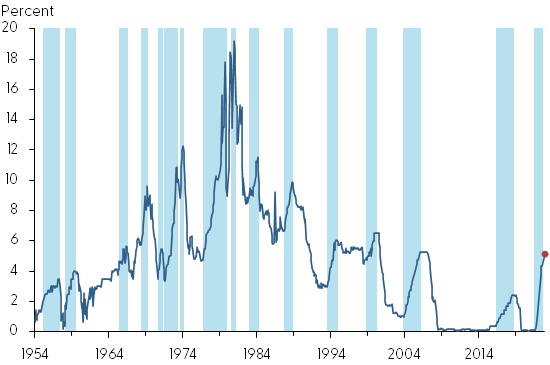
Figure 1 shows the 15 postwar monetary tightening cycles. The first 11 cycles are identified following the methodology in Adrian and Estrella (2008). This assumes that a tightening cycle starts when the federal funds rate rises by 0.25 percentage point (25 basis points) or more in two consecutive months. A tightening cycle ends when either (1) the federal funds rate is higher than at any time from 12 months before to 9 months after and is at least 0.5 percentage point higher than at the beginning of this period, or (2) the federal funds rate is higher than at any time from 6 months before to 6 months after and is 1.5 percentage points higher than the average at these end points.

Figure 1
Effective federal funds rate
Effective federal funds rate

Source: Federal Reserve Board of Governors and authors’ calculations.

Note: Blue shading indicates periods of monetary policy tightening as described in text.

Since the late 1990s, forward guidance became a prominent monetary policy tool (Bernanke 2020). We therefore identify the tightening cycles based on the Federal Open Market Committee (FOMC) communications, as financial markets are always forward looking. For example, forward-looking language first appeared in the post-meeting FOMC press release in May 1999. Although the Committee decided not to raise rates at that meeting, the post-meeting press release signaled the FOMC’s bias toward the possibility of a firming in the stance of monetary policy. We therefore assume the 1999–2000 tightening cycle started in May, even though the policy rate did not increase until June.

For the current tightening cycle, the Committee expected after its January 2022 meeting that “it will soon be appropriate to raise the target range for the federal funds rate.” In the December 2022 FOMC Summary of Economic Projections (SEP), the median projection of the federal funds rate for 2023 by FOMC participants was 5.1{21df340e03e388cc75c411746d1a214f72c176b221768b7ada42b4d751988996}, compared to 4.4{21df340e03e388cc75c411746d1a214f72c176b221768b7ada42b4d751988996} for 2022. In this Letter, we make the straightforward assumption that the federal funds rate will reach 5.1{21df340e03e388cc75c411746d1a214f72c176b221768b7ada42b4d751988996} about the middle of this year, based on the contour of the federal funds futures. Hence, the current tightening cycle is assumed to last from January 2022 to May 2023, lifting the federal funds rate from 0.08{21df340e03e388cc75c411746d1a214f72c176b221768b7ada42b4d751988996} to 5.1{21df340e03e388cc75c411746d1a214f72c176b221768b7ada42b4d751988996}.

The federal funds rate

Each tightening cycle has been unique in terms of the duration and the change in the federal funds rate. Not all tightening cycles have been followed by recessions. The median increase in the federal funds rate in past tightening cycles was 2.57 percentage points, and the median pace of tightening was 0.20 percentage point per month. For the current cycle, based on the SEP projections, the expected tightening is 5.02 percentage points at an average pace of 0.31 percentage point per month, both of which are well above the median.

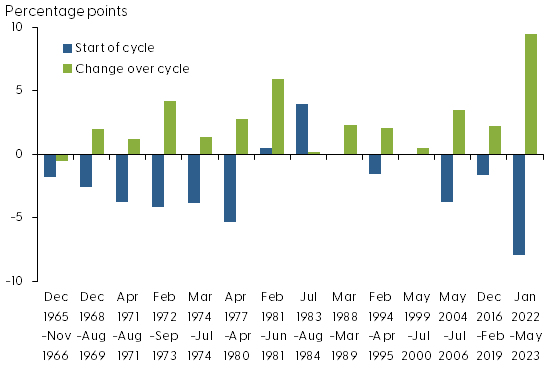
To control for monetary conditions at the onset of tightening, we compute the real funds rate gap by subtracting the inflation rate and the real neutral rate from the nominal federal funds rate. The smaller or more negative the real funds rate gap is, the more monetary accommodation is in the economy. We use the past 12-month change in the consumer price index (CPI) to measure the inflation rate. Although current CPI inflation is an imperfect proxy for expected inflation, the Survey of Professional Forecasters’ expected one-year-ahead inflation rate, which did not start until 1980, provides qualitatively similar results for the last six tightening cycles. We use the real neutral rate estimated by Laubach and Williams (2003). For the current cycle, we use a real neutral rate of 0.5{21df340e03e388cc75c411746d1a214f72c176b221768b7ada42b4d751988996}, which is the difference between the median long-run funds rate of 2.5{21df340e03e388cc75c411746d1a214f72c176b221768b7ada42b4d751988996} from the December SEP and the 2{21df340e03e388cc75c411746d1a214f72c176b221768b7ada42b4d751988996} target inflation rate.

Figure 2 shows the real funds rate gap (blue bars) at the beginning of each tightening cycle. The real funds rate gap of –7.9{21df340e03e388cc75c411746d1a214f72c176b221768b7ada42b4d751988996} at the beginning of the current cycle is the largest among all tightening cycles, in part due to high inflation. Figure 2 also shows the difference in the real funds rate gap between the end and the beginning of each tightening cycle—which reflects how much the gap was closed (green bars). Assuming the inflation rate at the end of the current tightening cycle will be 3.1{21df340e03e388cc75c411746d1a214f72c176b221768b7ada42b4d751988996} based on the December SEP, the real funds rate gap at the end of the current cycle would be 1.5{21df340e03e388cc75c411746d1a214f72c176b221768b7ada42b4d751988996}. If the Fed successfully closes the funds rate gap by 9.4{21df340e03e388cc75c411746d1a214f72c176b221768b7ada42b4d751988996} by the end of the current cycle—through both raising the interest rate and bringing down inflation—it would be the largest gap closure on record.

Figure 2
Real funds rate gap: Initial levels and changes over cycle
Real funds rate gap: Initial levels and changes over cycle

Source: Laubach and Williams (2003), Bureau of Labor Statistics, Federal Reserve Board of Governors and authors’ calculations.

Note: Last cycle includes assumptions based on December 2022 SEP projections.

Long-term rates and stock prices

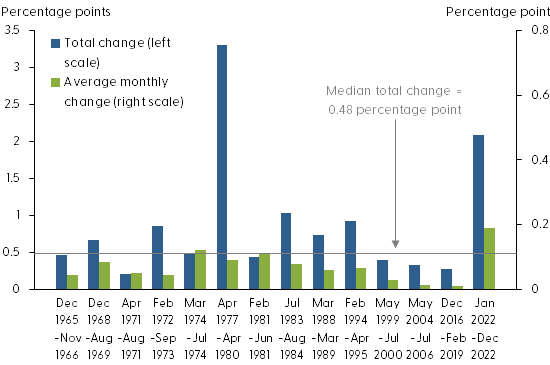
The current increase in the 10-year Treasury rate is the second largest increase of all tightening cycles, shown by the blue bars in Figure 3. Moreover, the green bars show that the speed of this increase has been unprecedented. Research shows that the response of asset prices to anticipated monetary policy changes is essentially zero, while their response to unanticipated movements is large and highly significant (Kuttner 2000). Thus, before forward guidance, each monetary policy tightening may have contained unanticipated information that had not been fully incorporated into asset prices; therefore, without advance communication, financial markets would have reacted to each tightening until the cycle ended.

Figure 3
Percentage point changes in 10-year Treasury yield
Percentage point changes in 10-year Treasury yield

Source: Federal Reserve Board of Governors and authors’ calculations.

With forward guidance, market participants can form expectations about tightening cycles, including the expected duration and amount of tightening. Because the expected tightening is fully incorporated into asset prices well before the completion of the tightening cycle, this partially explains the speed of the increase in long-term rates in the current cycle.

A widely held view by economists is that long-term interest rates tend to have relatively bigger effects on real economic activities than short-term rates. This is in part due to the large share of long-term debt contracts with a fixed interest rate in our financial system, including fixed-rate mortgages, term loans, and corporate bonds, whose rates are often tied to long-term Treasury rates. Thus, the rapid increase in long-term rates would cool the economy relatively faster than in previous cycles.

The contract interest rate above the Treasury rate, known as the spread, is another determinant of financial conditions. The spread reflects the risk premium demanded by the lender in providing debt financing to risky borrowers. In past tightening cycles, bond spreads haven’t always tightened, and the median change in the benchmark Baa bond spread was close to zero. Currently, the Baa spread has widened only about 0.06 percentage point, which is small relative to the large increase in the long-term Treasury rate.

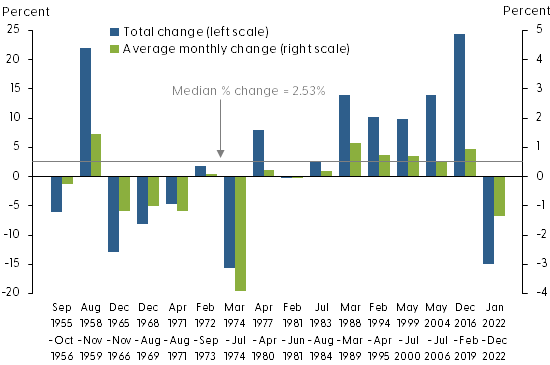
In previous tightening episodes, stock prices initially fell but sometimes rebounded to end the tightening cycle with a net gain. Figure 4 shows that stock prices declined on net in five of the past 15 tightening episodes. The median change in the Standard & Poor’s 500 in previous cycles was +2.53{21df340e03e388cc75c411746d1a214f72c176b221768b7ada42b4d751988996}. Both the current decline in stock prices and the speed of the decline, as measured by the average monthly change in stock prices, are large relative to the historical average. Stock valuations, such as the price-to-earnings ratio, exhibit similar patterns.

Figure 4
Percent changes in Standard & Poor’s 500
Percent changes in Standard & Poor’s 500

Source: Bloomberg, Federal Reserve Board of Governors and authors’ calculations.

Comparing the current changes in bond rates and stock prices to those in previous completed tightening cycles that lasted longer reflects the notion that forward guidance has front-loaded the financial market response in the current cycle. This is consistent with the stance of monetary policy being tighter than what is implied by the federal funds rate (Choi et al. 2022). Repeating the analysis to control for cycle duration yields qualitatively similar results.

Insights from the past

What can we learn from history to understand how financial conditions could play out through the end of this tightening cycle? The historical relation between monetary conditions at the onset of tightening cycles and tightening in interest rates and stock prices may provide some clues. Regressing the real funds rate gap on the change in the federal funds rate yields a significantly negative relationship: a more negative real funds rate gap tends to be followed by a bigger increase in the federal funds rate. Given the large negative real funds rate gap in the current cycle, history suggests that the total increase in the federal funds rate could be bigger than expected.

Regressing the real funds rate gap on the change in stock prices yields a significantly positive relationship, implying that the more negative the real funds rate gap, the larger the decline in stock prices during a tightening cycle. When we use this historical relationship to evaluate stock prices at the large negative funds rate gap, stock prices are projected to decline further. The historical relationship between the funds rate gap and bond spreads also calls for more tightening in the bond market. Taken together, with the historically large funds rate gap at the onset of the current cycle, past experiences indicate that more tightening of financial conditions could follow.

Conclusions

Current increases in the federal funds rate are expected to reverse a historically large negative real funds rate gap at the beginning of the cycle. Successfully closing the real funds rate gap will hinge on substantially reducing the inflation rate. Relative to history, both the size and the speed of tightening in Treasury bonds and common stocks have been large in the current cycle, in part because of the large gap and the Federal Reserve’s forward guidance. While the rapid tightening of financial conditions is expected to slow the economy relatively quickly, historical experiences raise the possibility of even more tightening in financial conditions given the large real rate gap that needs to be closed.

Simon H. Kwan

Senior Research Advisor, Economic Research Department, Federal Reserve Bank of San Francisco

Louis Liu

Research Associate, Economic Research Department, Federal Reserve Bank of San Francisco

References

Adrian, Tobias, and Arturo Estrella. 2008. “Monetary Tightening Cycles and the Predictability of Economic Activity.” Economics Letters 99(2), pp. 260–264.

Bernanke, Ben S. 2020. “The New Tools of Monetary Policy.” American Economic Review 110(4, April), pp. 943–983.

Bernanke, Ben S., Mark Gertler, and Simon Gilchrist. 1999. “The Financial Accelerator in a Quantitative Business Cycle Framework.” Chapter 21 in Handbook of Macroeconomics 1, part C, eds. J.B. Taylor and M. Woodford. Amsterdam: Elsevier, pp. 1,341–1,393.

Choi, Jason, Taeyoung Doh, Andrew Foerster, and Zinnia Martinez. 2022. “Monetary Policy Stance Is Tighter than Federal Funds Rate.” FRBSF Economic Letter 2022-30 (November 7).

Kuttner, Kenneth N. 2001. “Monetary Policy Surprises and Interest Rates: Evidence from the Fed Funds Futures Market.” Journal of Monetary Economics 47(3, June), pp. 523–544.

Laubach, Thomas, and John C. Williams. 2003. “Measuring the Natural Rate of Interest.” Review of Economics and Statistics 85(4, November), pp. 1,063–1,070.

Financial Management Think Tank Brings Power of Collective Intelligence and Expertise to South Florida Region

Financial Management Think Tank Brings Power of Collective Intelligence and Expertise to South Florida Region
Juan Ramirez, Managing Director, ProCFO Partners, South Florida

Juan Ramirez, Controlling Director, ProCFO Associates, South Florida

ProCFO Partners Logo

ProCFO Companions Launches Regional Business office in Miami, Florida and Announces Juan Ramirez as Running Director

As a economic administration and expansion specialist CFO, I glance forward to sharing the powerful collective intelligence and knowledge of the ProCFO partnership with our vibrant South Florida local community.”

— Juan Ramirez, Running Director ProCFO Partners, South Florida

MIAMI, FL, US, February 7, 2023 /EINPresswire.com/ — ProCFO Partners announces this 7 days that it will start its South Florida regional business on February 23 in Miami, Florida with a celebratory kick-off event in Ft. Lauderdale.

ProCFO Associates, founded in 2020 by Haleh Fardi and Nelson Tepfer, has immediately turn out to be an undisputed leader in the new and swiftly expanding fractional CFO sector. Now boasting more than 45 CFOs and around 150 consumers throughout the US, ProCFO is leveraging its exceptional strengths in senior economical management to launch 6 regional places of work across critical financial growth marketplaces in 2023. ProCFO Companions is poised to very best provide organizations and communities as the only economical management and development feel tank with a targeted, localized tactic to addressing business and financial growth possibilities.

Haleh Fardi, Cofounder and CVO of ProCFO Partners describes, “Over the past 3 several years, as we have grown and accrued successes, we take pleasure in the point that our fractional CFOs enter an SME, make a pivotal contribution to the economic well being and progress of the business, which in transform, advantages the regional neighborhood with higher economic opportunities including improved financial commitment, greater offer channels, far more employment, and so forth. By growing ProCFO Partners with localized footprints across strategic important marketplaces in the US, we are producing a mindful investment in economic enhancement in these markets wherever we not only provide our SME purchasers but also dwell and participate as lively community users. We see this as an quick earn-win for all our stakeholders.”

Juan Ramirez, Controlling Director of ProCFO Associates, South Florida shares, “As an energetic member of the South Florida business neighborhood for the previous 20 many years, I am thrilled to open our to start with regional ProCFO Associates business to capitalize on the remarkable development chances for our location. To me, this is a deeply fulfilling enthusiasm job that lets me to make a good affect on the neighborhood that I enjoy dearly. Around the subsequent 5 yrs, we see exponential growth options for South Florida as a US hub of global trade, tourism, authentic estate and business enterprise enhancement, and much more. As a financial management and advancement professional CFO, I look forward to sharing the strong collective intelligence and experience of the ProCFO partnership with our vivid South Florida community.”

Mr. Ramirez shares much more South Florida small business and economic insights in a discussion with host Chris Bintliff on this week’s Develop the Up coming(TM) podcast.

About ProCFO Associates

ProCFO is the only fiscal management feel tank with a strong collective intelligence and expertise of more than 45 extremely achieved CFOs. ProCFO offers exclusive fractional CFO services that harness the established leadership of the team across each sector and strategic company state of affairs. Considering that 2020, ProCFO has assisted more than 150 SMEs surpass their major monetary management and progress priorities. Find out a lot more at https://www.procfopartners.com. Stick to ProCFO Partners on LinkedIn utilizing #ProCFO to acquire the hottest expert insights and key tendencies shaping corporate finance. Subscribe to the Generate the Following(TM) podcast to investigate strategies and strategies for monetary administration and expansion to assist today’s businesses place their economical photograph in context.

Jennifer Zoga, Media Relations
ProCFO Partners
jennifer.zoga@procfopartners.com

South Florida In Small business: Position, Standpoint & ProCFO Associates with Juan Ramirez

https://www.youtube.com/observe?v=0FLfKd3lLSg

Stocks soar after Powell embraces ‘disinflation’

Stocks soar after Powell embraces ‘disinflation’

U.S. shares shut out a risky session sharply greater Tuesday following Federal Reserve Chair Jerome Powell embraced the presence of disinflation in the economic system throughout a speech in Washington, D.C.

The S&P 500 (^GSPC) soared 1.3{21df340e03e388cc75c411746d1a214f72c176b221768b7ada42b4d751988996}, although the Dow Jones Industrial Normal (^DJI) jumped 265 points, or .7{21df340e03e388cc75c411746d1a214f72c176b221768b7ada42b4d751988996}. The technologies-heavy Nasdaq Composite (^IXIC) innovative 1.9{21df340e03e388cc75c411746d1a214f72c176b221768b7ada42b4d751988996}.

In an interview with Carlyle Group co-founder David Rubenstein at the Financial Club of Washington, D.C., Tuesday afternoon, Powell said the “disinflationary method” in the U.S. overall economy has begun, though retaining that fee hikes will probable be important to bring inflation back again to its 2{21df340e03e388cc75c411746d1a214f72c176b221768b7ada42b4d751988996} focus on.

“We will probable want to do extra charge improves,” Powell said, even though introducing that restoring price tag stability “is heading to get quite a bit of time, and is not heading to be smooth.”

“The disinflationary procedure, the process of having inflation down, has started, and it is really started in the items sector,” Powell also reported, though adding “it has a extensive way to go,” and “these are the really early stages of disinflation.”

Buyers had mainly envisioned the U.S. central financial institution main to strike a hawkish tone in his remarks immediately after Friday’s blowout work opportunities report confirmed payrolls grew by 517,000 in January.

“Powell is in wait-and-see manner,” David Russell, vice president of current market intelligence at TradeStation stated in a observe. “He refrained from walking back again his disinflation remark. If just about anything, he reiterated it in a guarded way.”

“Today’s feedback do nothing to undermine the new strength in the sector,” Russell additional.

In other central lender information, the Reserve Lender of Australia lifted interest rates by 25 basis details to an more than 10-year substantial of 3.35{21df340e03e388cc75c411746d1a214f72c176b221768b7ada42b4d751988996}, adhering to go well with on the U.S. Federal Reserve’s move last week.

A trader works on the floor of the New York Stock Exchange (NYSE) as a screen shows Federal Reserve Board Chairman Jerome Powell during a news conference following a Fed rate announcement, in New York City, U.S., February 1, 2023. REUTERS/Andrew Kelly

A trader performs on the floor of the New York Inventory Exchange (NYSE) as a screen shows Federal Reserve Board Chairman Jerome Powell for the duration of a news convention adhering to a Fed price announcement, in New York City, U.S., February 1, 2023. REUTERS/Andrew Kelly

Back again in the U.S. stock market, shares of Chinese lookup motor Baidu (BIDU) jumped 12.2{21df340e03e388cc75c411746d1a214f72c176b221768b7ada42b4d751988996} Tuesday after indicating it’s on track to unveil its ChatGPT-like AI services in March.

Wild swings continued for meme stock Mattress Bath & Outside of (BBBY). Shares sank a lot more than 48.6{21df340e03e388cc75c411746d1a214f72c176b221768b7ada42b4d751988996} after the beleaguered retailer introduced strategies to raise $1 billion by an equity providing. The plunge follows a surge of as substantially as 120{21df340e03e388cc75c411746d1a214f72c176b221768b7ada42b4d751988996} on Monday.

Shares of training know-how firm Chegg (CHGG) tanked 17.1{21df340e03e388cc75c411746d1a214f72c176b221768b7ada42b4d751988996} in on the heels of disappointing direction from executives on sales anticipations.

Pinterest’s (PINS) inventory fell 5.2{21df340e03e388cc75c411746d1a214f72c176b221768b7ada42b4d751988996} following the system reported quarterly revenue late Monday that missed Wall Road estimates, renewing considerations about weak point in the ad market.

Equity marketplaces have been on a climb greater in 2023, with threat-on sentiment fueled by anticipations that waning housing and manufacturing details and a cooldown in inflation would prompt the Federal Reserve to pause and even reduce premiums sooner than predicted.

Minneapolis Federal Reserve President Neel Kashkari reported through an job interview with CNBC Tuesday morning that Friday’s shock careers details implies he and his central lender colleagues ought to keep the program on combating inflation.

“We know that boosting premiums can place a lid on inflation,” Kashkari explained in an job interview on CNBC’s “Squawk Box.” “We have to have to raise charges aggressively to set a ceiling on inflation, then let financial coverage do the job its way via the economy.”

Alexandra Semenova is a reporter for Yahoo Finance. Follow her on Twitter @alexandraandnyc

Simply click right here for the most recent trending inventory tickers of the Yahoo Finance platform

Click on listed here for the most up-to-date inventory current market news and in-depth analysis, including events that shift stocks

Study the latest financial and company news from Yahoo Finance

Obtain the Yahoo Finance application for Apple or Android

Comply with Yahoo Finance on Twitter, Facebook, Instagram, Flipboard, LinkedIn, and YouTube

Bed Bath & Beyond closes stores and raises $1 billion to stave off bankruptcy

Bed Bath & Beyond closes stores and raises $1 billion to stave off bankruptcy


New York
CNN
 — 

Mattress Bathtub & Over and above is closing 150 much more merchants — just a week following the struggling retailer announced the closure of 87 areas.

The company’s brick-and-mortar footprint has previously shrunk dramatically, a regulatory submitting confirmed late Monday, and the new closings mean it will have shuttered 400 outlets in the previous yr — just about fifty percent the 950 or so suppliers it had open in February 2022.

That consists of previous week’s announcement that it was also closing all 49 remaining Harmon Experience Benefit outlets, which marketed cosmetics moreover 5 buybuy Baby places. A checklist of the new retail outlet closures wasn’t quickly offered.

A turnaround does not glimpse imminent: The embattled home goods chain forecasts initial quarter revenue to be down by 30{21df340e03e388cc75c411746d1a214f72c176b221768b7ada42b4d751988996} to 40{21df340e03e388cc75c411746d1a214f72c176b221768b7ada42b4d751988996} with “sequential, quarterly profits enhancement thereafter” the submitting said.

The business said Tuesday it lifted some $1 billion by way of an giving of chosen inventory and warrants in a final-ditch energy to stave off individual bankruptcy. On Monday, the business mentioned it appointed Holly Etlin, a bankruptcy specialist, as interim main economical officer.

Mattress Tub & Past explained Tuesday it will eventually have 360 outlets and 120 buybuyBaby suppliers. That usually means that the business will have introduced ideas to close practically 500 of the shops it experienced just a yr in the past, and the new organization will be about half of the measurement of the old a person

The chain has stated in modern weeks that it had defaulted on a mortgage and may possibly not be in a position to remain in business, boosting issues about its long run. Mattress Bath & Past held talks in modern times with an expenditure firm to underwrite a major part of the proposed providing, according to Reuters.

Bed Bath and Outside of has been portion of the meme inventory phenomenon, with shares skyrocketing as significantly as 400{21df340e03e388cc75c411746d1a214f72c176b221768b7ada42b4d751988996} previous yr when activist trader and GameStop chairman Ryan Cohen took a stake and sought alterations.

Shares of the retailer, which closed up 92{21df340e03e388cc75c411746d1a214f72c176b221768b7ada42b4d751988996} at $5.86 in a rollercoaster session Monday, were being down 40{21df340e03e388cc75c411746d1a214f72c176b221768b7ada42b4d751988996} in in pre-industry trading Tuesday.

Founded in 1971, Bed Bath & Further than grew to become a staple for affordable property decor, kitchenware and higher education dorm area household furniture. It’s also identified for its ubiquitous 20{21df340e03e388cc75c411746d1a214f72c176b221768b7ada42b4d751988996} off blue discount codes, and cavernous outlets with goods stacked significant to the ceilings.

But the company struggled to make the transition to on the net buying and fend off more substantial chains these as Walmart and Concentrate on

(TGT)
. Quite a few buyers switched to those competitors as the novelty of Mattress Bathtub & Beyond’s coupons pale.

The business was also hit really hard throughout the pandemic, closing merchants briefly throughout 2020 whilst rivals remained open. The company shed 17{21df340e03e388cc75c411746d1a214f72c176b221768b7ada42b4d751988996} of its sales in 2020 and 14{21df340e03e388cc75c411746d1a214f72c176b221768b7ada42b4d751988996} in 2021.

– CNN’s Nathaniel Meyersohn and Reuters contributed to this report

What is your Plan B? Prepping for a money reset

What is your Plan B? Prepping for a money reset

NEW YORK, Feb 7 (Reuters) – Glance at the waves of layoffs going on throughout The usa suitable now, and you are most likely pondering something you have not experienced to imagine about for fairly a although:

Program B.

Every person has one particular, a tough plan of what they will do if Program A goes completely haywire. With layoffs accelerating – primarily in tech, with 140,000 past 12 months and 58,000 so significantly this year, in accordance to Crunchbase – your Program B could possibly not be just a idea anymore.

You may have to choose it out of the drawer, dust it off – and set it into motion.

To enable you do that, there is the well timed new book “The Fantastic Revenue Reset” from Jill Schlesinger, CBS Information business analyst and host of the “Jill On Money” radio display and podcast.

“It’s constantly intelligent to question by yourself, ‘What would take place to me if I lose my task currently? How would I navigate that, and what must I be executing appropriate now to put together?’” Schlesinger suggests. “Because lifestyle is under no circumstances a straight line. Professions zigzag – and so does lifetime.”

Most recent Updates

Look at 2 more stories

In point, it is not just a layoff that can lead to a Fantastic Dollars Reset, a minute where you have to just take inventory and re-evaluate anything in your money life. It could be a wellbeing situation, a divorce or a hundred other sticky troubles life will toss at you.

In other phrases, the concern is not irrespective of whether a Fantastic Dollars Reset is coming your way – it is when.

So as you sit down and believe as a result of the components of a monetary reboot – shelling out, saving, career path, retirement outlook, and additional – below are a several aspects to think about.

Scaled-down Actions ARE Okay

Lots of people make the cognitive mistake that a System B has to be a huge leap, entirely different from the job path they are presently on. Not always so.

It may entail extra modest steps you can choose correct now – like taking classes to acquire new techniques, or trying out a distinct position at the exact organization, or tests out a extra adaptable function program.

“A Approach B doesn’t necessarily mean you have to chuck your full job,” Schlesinger says. “Maybe it just signifies you never want as much stress, and really do not want to perform as a lot of hrs.

If you are shut to retiring, search into consulting prospects at your employer. You might shed some advantages, but remain with the firm and deliver income for a more time period of time, Schlesinger notes.

OVERHAUL YOUR Expending

The volume you are paying, or not paying out, is heading to identify the amount and quality of your Plan B options. If you are previously juggling a big home payment and a lavish way of living, you could uncover by yourself in actual problems.

On the flip side, if your regular overhead is small – downsizing your house, investing in the fancy trip – then you have the versatility to consider some thing new, possibly an entrepreneurial undertaking.

“I do not care how you opt for to spend your funds, just be mindful of how you’re spending it,” says Schlesinger. “Are there some points you would be willing to give up? As the pandemic taught us, prioritize what is definitely critical in buy to be happier.”

BE Very careful WHAT YOU Want FOR

Numerous people’s Strategy B consists of finally setting up their have corporation, in its place of doing work for any person else. Which is terrific – just be knowledgeable of what you are finding into.

“Owning a corporation will come with a good deal of threat, and it may not be for you,” states Schlesinger. “I was a business enterprise proprietor before in my profession, with a financial setting up organization. It was really difficult, and I didn’t like it. I felt so burdened and fearful for all the individuals who worked for me.”

PREP FOR Prepare C, D AND E

An all-or-very little strategy to Prepare B is normally a blunder, because daily life rarely transpires the way we expect. Imagine about many various pathways you could consider.

Schlesinger likes to map out “best-circumstance, middle-scenario, and worst-case” situations. In reality, that’s just what she did in her own vocation.

“I started out in monetary arranging, and I figured if I could not get matters began in media, I would go back to that,” she claims. “I laid a several diverse situations out, looked at the cash I experienced, and gave myself a 6-month runway to see what would take place. That is how I approached my reset.”

Reporting by Chris Taylor Enhancing by Lauren Younger and Jonathan Oatis
Follow us @ReutersMoney

Our Criteria: The Thomson Reuters Trust Rules.

Joe Duran to Leave Goldman Sachs

Joe Duran to Leave Goldman Sachs

Joe Duran, who sold his business, United Cash, to Goldman Sachs in 2019, is leaving the Wall Road firm after 3 1/2 years of integrating his advisory business into the corporation.  

“I’ve experienced a good time integrating the business into wealth, and it was just time for me to do something new,” Duran said in an job interview with WealthManagement.com.

Most not long ago, Duran was serving alongside Larry Restieri as a co-head of the Individual Money Administration Team, which has been renamed the Office and Personal Wealth business enterprise. Dave Dase, who joined Goldman’s Customer and Wealth Management division previous year as head of franchise associations, will consider around Duran’s role, according to a business memo.

David Fox, who was named head of PFM Advisors last yr, will become head of Particular Monetary Administration, the new title specified to United Funds immediately after the acquisition.

“Since signing up for the Office and Personalized Wealth small business very last year as head of PFM Advisors, David has set a renewed emphasis on the advisor knowledge,” the memo mentioned. “He will continue to deliver that aim and his passion for consumer support to driving the organization ahead for our advisors and our clientele. His nearly 25 yrs of experience in Personal Wealth Administration, including primary large PWM regions, will assist him proceed to expand the connectivity across our growing prosperity franchise.”

The Workplace and Personalized Wealth organization has about $100 billion in belongings under administration.

Duran is at the moment nevertheless a lover at the organization, though Goldman will be winding that down above time. He will also go on to perform with the company as an exterior consultant on a new coordinated exertion to convey Goldman’s abilities across divisions to the RIA neighborhood. That effort and hard work is currently being spearheaded by Padi Raphael, worldwide head of 3rd-get together distribution. She has introduced collectively a devoted staff of small business leaders across Goldman Sachs, like executives from asset management Goldman Sachs Advisor Answers, the firm’s RIA custody device GS Find, its lending offering and the private investor products team, its structured notes group.

“While I think we’re very excellent at personal enterprise strains serving our customers, our real electricity and our real magic as a organization is bringing that collectively and working as a business,” Raphael stated. “To that aim, for the past 12 months, I have been spearheading an hard work bringing alongside one another a devoted team of senior leaders across the company who have been doing work together to actually think about how we can existing Goldman Sachs as a holistic firm to the RIA local community.

“We understand that our customers are hoping to construct deeper interactions with their customers, and as an business, we can seriously deliver together all of our abilities, from products and solutions and assistance, to truly help our clients meet up with their own elaborate and historic holistic requires,” she mentioned.

Padi Rafael Goldman Sachs

Padi Rafael

“One of the major difficulties for independent RIAs right now is that it made use of to be plenty of to do just scheduling and open up architecture investment decision answer, and I’m of a incredibly business view that in get to be aggressive in the changing landscape, we’re heading to have to enable advisors to do additional for much less,” Duran said. “That signifies supplying a a person-halt monetary guidance construction for banking, for financial savings accounts, for credit history traces. The advisors are just likely to have to do a lot more to have a genuinely differentiated investment remedy since the clientele on their own can do so a lot for free of charge or quite minimal price. The advisors are heading to have to be targeted on simplifying the clients’ lives and giving ever-raising sophistication to the financial commitment environment, which are two issues that Goldman Sachs is really, incredibly very good at.”

Duran explained there was some coordination across divisions to serve the RIA channel, but not in the way the firm ought to be doing it.

“One of the matters we have to do is provide a A single GS, so that all across the divisions we have a coordinated exertion to make absolutely sure we’re in sync, that the working experience they have with us and the way we bring the agency to their consumers is coordinated with our ideal contemplating across the divisions,” he claimed.

One Goldman Sachs is an interior customer products and services initiative.

Duran said his function with Goldman will be his “primary and practically special concentration,” but he will also very likely advise with or spend in some wealthtech corporations. “I’ve been performing that as a mentor,” he explained.

He also ideas to write and add material to make improvements to the wealth management sector.