These GOP Lawmakers Invest in Companies Funding Abortion Travel

These GOP Lawmakers Invest in Companies Funding Abortion Travel

Dozens of Republican lawmakers thrilled about the Supreme Court overturning Roe v. Wade together have millions of dollars personally invested in companies committed to sponsoring abortion-related travel for their employees, an Insider investigation has found. 

And at least two national anti-abortion groups told Insider that like-minded lawmakers should consider dumping their stock in companies that will facilitate their employees’ abortions.

Among the most vocal anti-abortion lawmakers to invest in abortion supporting companies is Rep. Marjorie Taylor Greene, a Republican from Georgia whose financial exposure in the pro-abortion businesses is substantial.

Together, Greene, her husband, Perry Greene, and their children may have more than half-a-million dollars invested in businesses that fund abortion travel, according to an annual financial disclosure document Greene filed in May with the US House of Representatives.

The Greenes’ investments include up to $110,000 in Tesla, up to $65,000 in Starbucks, up to $50,000 in Microsoft, up to $65,000 in Facebook, up to $50,000 in


Netflix

, up to $67,000 in Disney, up to $95,000 in Back of America, and up to $50,000 in JP Morgan Chase. 

Since joining Congress in 2021, Greene has had no qualms about investing in companies that openly conflict with her stances on various social, political or medical matters, such as when she bought stock in three major COVID-19 vaccine manufacturers while boasting of her unvaccinated status.

Perry Greene last month bought up to $295,000 worth of stock in companies that institutionally support the Black Lives Matter movement and LGBTQ+ rights, which the Georgia Republican has vehemently opposed.

Greene, who credited Donald Trump with seeding the high court with anti-abortion judges, did not respond to repeated requests for comment about any possible divestiture plans. She previously told Insider that she has an “independent investment advisor that has full discretionary authority on my accounts. I do not direct any trades.”

roe v wade abortion

Participants hold signs during the Women’s March near the US Capitol.

Leigh Vogel/Getty Images for Women’s March Inc


Capitol Hill packed with abortion-sponsor investors

Congress’ latest financial hypocrisy flows from the conservative majority of the Supreme Court’s decision to overrule Roe v. Wade on June 24, a momentous reversal that’s sparked pushback from concerned Democrats and like-minded corporations. 

With right-leaning states already racing to criminalize abortion, abortion providers, and anyone who tries to get an abortion in localities where it remains legal, a slew of well-known businesses have pledged to help workers pay for out-of-state care. 

Among them: Microsoft, Google, and Facebook, entertainment hubs Walt Disney, Netflix, and Amazon, financial institutions Wells Fargo, Bank of America, and JP Morgan Chase, as well as household names like Tesla and Starbucks. Insider cross-referenced these and other abortion-travel-funding companies with the stock holdings members of Congress listed in their annual financial disclosures and periodic stock-trade disclosures.

Repeat STOCK Act violator and anti-abortion advocate Rep. Pete Sessions of Texas may be nearly $1 million deep in the pro-abortion camp based on his 2021 annual financial report. That filing shows that he and his wife have invested up to $100,000 in Starbucks, up to $345,000 in Microsoft, up to $250,000 in Facebook, and up to $265,000 in Amazon. (Lawmakers are only required to report the value of their assets in broad ranges.) 

Sessions did not respond to repeated requests for comment about his finances. 

Rep. Diana Harshbarger of Tennessee, who previously told Insider she’s outsourced her portfolio to a financial planner, has been given until August to file her 2021 annual report after requesting an extension. If her 2020 filings hold true, Harshbarger could have nearly $700,000 attached to abortion-friendly businesses, including up to $215,000 in Microsoft, up to $115,000 in Facebook, up to $145,000 in Google, up to $115,000 in Amazon, and up to $65,000 in Bank of America. 

Harshbarger did not respond to repeated requests for comment about her finances. 

Rep. Carol Miller of West Virginia, who hailed the gutting of Roe as “a huge victory for all Americans,” also has until August to submit her 2021 annual report. In her 2020 filings Miller disclosed that her husband owned up to $250,000 in Microsoft stock. 

Miller spokesman Tatum Wallace declined to comment on any divestiture plans, but did offer Insider a glimpse into how a GOP majority might take corporate America to task about this if they regain control of Congress this fall. 

“Paying for someone to end a pregnancy sounds like a very taxable event to me,” Wallace wrote in an email. “Congresswoman Miller is confident that next year, Republicans will look at ways to update the tax code to incentivize life and address this comprehensively.”

Dozens of congressional Democrats, including House Speaker Nancy Pelosi, whose day-trading husband Paul Pelosi routinely moves millions of dollars through the markets, also invest in companies that will sponsor abortion travel. 

But these Democrats almost universally support abortion rights, while their Republican counterparts have all but always fought to restrict or undo abortion rights.  

Across the Capitol, several Republican senators who publicly oppose abortion rights appear to have similar conflicts in their financial portfolios.

Among them is Sen. Tommy Tuberville of Alabama, who describes himself as a “champion for the God-given rights of the unborn,” yet personally invests in several such companies.

From May 19 to May 20, Tuberville purchased between $300,000 and $600,000 worth of stock in PayPal, according to federal disclosures. 

On May 19 PayPal announced — in anticipation of the Supreme Court overturning Roe v. Wade — that it would fund employees’ out-of-state travel to access abortions.

Tuberville’s office declined to say whether the senator will divest of stock in companies that bankroll employee travel for abortions. In a statement, his office said: “Senator Tuberville has long had financial advisors who actively manage his portfolio without his day-to-day involvement.”

A personal financial disclosure from Sen. Tommy Tuberville, a Republican from Alabama.

A personal financial disclosure from Sen. Tommy Tuberville, a Republican from Alabama.

US Senate


Sen. Jerry Moran of Kansas reported stock investments of $1,000 to $15,000 each in Amazon, CVS Health, Johnson & Johnson, Meta Platforms, and Bank of America stock.

“Life is precious and deserves our respect and protection,” Moran has said of his opposition to abortion. “I have used my voice and vote to further the cause of life and defend unborn children.” 

Sen. Roger Wicker of Mississippi, who touts his “long record of upholding the sanctity of life,” reported owning $50,000 to $100,000 worth of stock in Amazon.com, which said it would pay up to $4,000 in travel expenses each year for employees to obtain medical treatments, including abortions.

Sen. John Boozman of Arkansas, a self-described “consistent and staunch advocate for the cause of protecting babies in the womb,” reported modest stock investments in Johnson & Johnson, Bank of America, JPMorgan Chase, and Walt Disney Company.

Sen. Cynthia Lummis of Wyoming, who said she is “grateful for this pro-life decision” by the Supreme Court, holds between $15,000 and $50,000 in Walt Disney Co. stock and $1,000 to $15,000 worth of Microsoft stock, according to her most recent personal financial disclosure.

Representatives for Moran, Wicker, Boozman, and Lummis did not respond to requests for comment.

Anti-abortion protesters at Supreme Court

Anti-abortion protesters wear shirts that read “I am the Pro-Life Generation” as they demonstrate in front of the US Supreme Court on December 1, 2021, in Washington.

Andrew Harnik/AP


‘Eschew companies that promote abortion’

Members of Congress who oppose abortion should get rid of any stocks they own in companies that fund abortion travel and make “a public announcing of divestiture,” said Eric Scheidler, executive director of the Pro-Life Action League, a nonprofit organization dedicated to “saving unborn children through non-violent direct action.”

Lawmakers should “choose investments that fit with their values — we all have to be more intentional about this,” Scheidler said.

He recommended elected officials consider financial vehicles, such as mutual fund company Ave Maria Mutual Funds, that avoid investing in corporations that support abortion.

“We certainly think pro-life people would want to eschew companies that promote abortion,” National Right to Life Committee Executive Director David O’Steen told Insider. “Perhaps they can now look at companies that don’t make it a priority to support abortion.”

O’Steen added that anyone opposed to abortion, lawmakers or otherwise, should avoid doing business with or otherwise patronizing abortion-supporting companies.

“Avoid Disneyland,” he said.

Federal lawmakers are actively considering whether to ban themselves from trading individual stocks in part because of numerous examples of members of Congress personally investing in companies that conflict with their public duties or political positions.

Insider has recently revealed defense-related investors poised to personally profit from a recent Ukrainian aid package, environmental advocates who invest in fossil fuel-based operations, and pandemic relief supporters invested in the healthcare companies hustling to make COVID-19 manageable. 

Loading Something is loading.

Asia shares cautious as Wall St futures slide | Financial Markets

Asia shares cautious as Wall St futures slide | Financial Markets

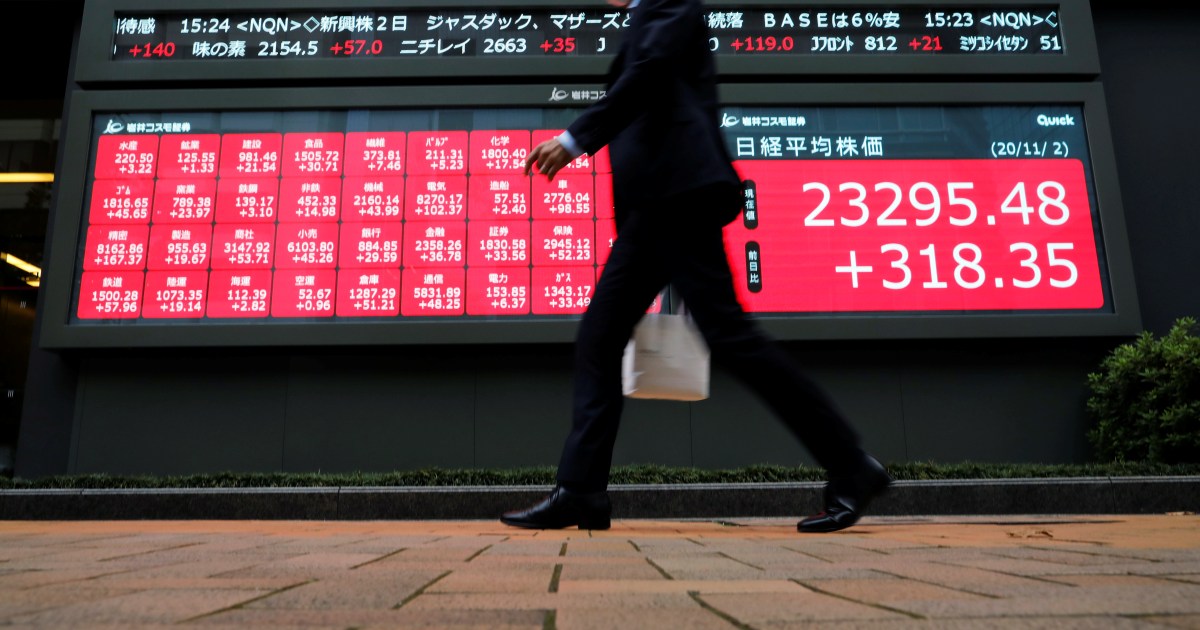
Asian share markets began cautiously on Monday as a run of tender US data proposed draw back risks for this week’s June payrolls report, although the hubbub in excess of a possible economic downturn was however driving a aid rally in government bonds.

The research for basic safety held the US greenback in close proximity to 20-12 months highs, even though early action was gentle with US marketplaces on holiday break.

Income Treasuries were shut but futures prolonged their gains, implying 10-yr yields had been holding around 2.88 percent, possessing fallen 61 basis points from their June peak.

MSCI’s broadest index of Asia-Pacific shares outdoors Japan inched up .3 percent, while Japan’s Nikkei added .9 percent.

However, both of those S&P 500 futures and Nasdaq futures eased .4 percent, right after steadying just a small on Friday.

David J Kostin, an analyst at Goldman Sachs, mentioned that each individual S&P 500 sector bar energy noticed adverse returns in the initially 50 percent of the year amid extreme volatility.

“The present-day bear market has been entirely valuation-pushed alternatively than the outcome of reduced earnings estimates,” he extra.

“However, we assume consensus revenue margin forecasts to slide which will guide to downward EPS [earnings per share] revisions regardless of whether or not the financial state falls into economic downturn.”

Earnings time starts off on July 15 and anticipations are being marked lessen offered substantial fees and softening info.

Specialized economic downturn

The Atlanta Federal Reserve’s much-viewed GDP Now forecast has slid to an annualised -2.1 percent for the second quarter, implying the state was presently in a technological economic downturn.

The payrolls report on Friday is forecast to show work opportunities development slowing to 270,000 in June, with average earnings slowing a touch to 5 percent.

Nevertheless minutes of the Fed’s June plan meeting on Wednesday are pretty much certain to sound hawkish supplied the committee selected to hike costs by a super-sized 75 basis factors.

The sector is pricing in about an 85 percent opportunity of an additional hike of 75 foundation factors this month and charges at 3.25-3.5 {21df340e03e388cc75c411746d1a214f72c176b221768b7ada42b4d751988996} by 12 months end.

“But the market place has also moved to price in an increasingly aggressive amount cut profile for the Fed into 2023 and 2024, dependable with a escalating possibility of economic downturn,” famous analysts at NAB.

“Around 60bps of Fed cuts are now priced in for 2023.”

In currencies, trader need for the most liquid secure harbour has tended to benefit the US greenback which is in the vicinity of two-10 years highs from a basket of competition at 105.04.

The euro was flat at $1.0433 and not far from its recent 5-12 months trough of $1.0349. The European Central Lender is predicted to raise fascination prices this month for the 1st time in a 10 years, and the euro could get a elevate if it decides on a far more aggressive 50 percent-stage go.

The Japanese yen also captivated some safe and sound-haven flows late last 7 days, dragging the dollar back again to 135.00 yen from a 24-calendar year leading of 137.01.

A higher dollar and soaring interest rates have not been form to non-yielding gold, which was pinned at $1,808 an ounce acquiring strike a 6-month small past week.

Fears of a world economic downturn also undermined industrial metals with copper hitting a 17-month small, possessing sunk 25 {21df340e03e388cc75c411746d1a214f72c176b221768b7ada42b4d751988996} from its March peak.

Oil has frequently fared greater as provide constraints and the conflict in Ukraine offset considerations about demand. Output limits in Libya and a prepared strike between Norwegian oil and gasoline workers have been just the hottest blows to generation.

Even now, sellers had been out early Monday and Brent slipped 34 cents to $111.29, although US crude eased 23 cents to $108.20 per barrel.

Financial planner: reaction to bear market depends on closeness to retirement

Financial planner: reaction to bear market depends on closeness to retirement

The inventory industry is officially in “bear market” territory, and could continue to be that way for some time in accordance to fiscal analysts and the latest reporting from outlets like Bloomberg. For people at or in close proximity to their transition to a mounted earnings in retirement, the response to these disorders could be quite dependent on the closeness they are to leaving a occupation powering.

This is in accordance to Nicholas Toman, a accredited economic planner with Empowered Economical Management which specializes in retirement organizing. In a new column at Kiplinger, Toman indicates that proximity to retirement could be a crucial, significant element in analyzing how to reply to volatile marketplace disorders.

“The existing point out of the inventory current market is resulting in virtually all traders to pause and consider if their present-day approaches are built to weather conditions this storm,” he writes. “Those who are at least 10-15 many years away from needing distributions from their investments and who are continuing to make prosperity as a result of systematic and normal contributions (i.e., 401K, 403B, IRA , etc.), most likely will not need to have to make any important modifications at this place. However, considering the fact that my purchasers are primarily those people who are in five to seven years of retirement or who have just lately retired, the assistance I give goes past ‘stay the study course.’”

To far better weather conditions the latest disorders, Toman endorses that his customers largely comprehend two ideas: customizing tactics and viewing money as a driver of retirement ideas.

“Your methods should be unique and tailored to you and you on your own,” he claims of the initial. “Go further than just subsequent the guide of co-staff, spouse and children and mates when analyzing what moves to make. Considering the fact that all households have their own set of distinctive situations when it will come to their prosperity (longevity, well being, tax standing, vocation enjoyment, too quite a few variables to name in this article), there actually is no one particular-dimensions-matches-all answer.”

Money as a “driver” of retirement designs is the second essential stage to comprehend, considering the fact that a predetermined retirement “budget” and being aware of just exactly where these funding will appear from is key to a profitable retirement, he points out.

“If the vast majority of your profits will be coming from predictable resources, these as Social Safety and pensions, then you must have additional overall flexibility to keep away from ‘locking in losses’ by having to sell investments in this bear industry,” he claims. “However, if you have a want for revenue now that is outside of what your Social Security and pensions will include, then you should take into account using economical tools developed to provide profits and principal defense, this sort of as CDs and different varieties of annuities, for a part of your prosperity.”

Go through other suggestions from financial planners to temperature a bear market at Kiplinger.

Argentina’s crisis deepens as finance minister quits

Argentina’s crisis deepens as finance minister quits

Argentina has been plunged into further more disaster following finance minister Martín Guzmán give up suddenly amid a break up within just the ruling Peronist coalition, unnerving investors already anxious about spiralling inflation and dire general public funds.

Guzmán, who experienced led negotiations with the IMF and non-public sector debtors, introduced his resignation on Twitter on Saturday night. He published a 7-web page letter in which he cited “political settlement within the governing coalition” as a important aspect for his successor — a reference to governing administration infighting.

An ally of President Alberto Fernández, Guzmán is the most up-to-date and most senior of 4 cupboard members to stage down in new months. His departure dealt a further blow to the president, who is experiencing dismal poll ratings, inflation forecast to exceed 70 per cent this year and sovereign bond charges in distressed territory.

The minister experienced occur under hefty pressure from the extra radical wing of the Peronist coalition, led by Cristina Fernández de Kirchner, Argentina’s powerful vice-president and former chief. The Kirchneristas have continuously criticised a deal with the IMF to restructure $44bn of financial debt, which Guzmán negotiated. They as an alternative want greater paying and much more authorities intervention to beat inflation and poverty.

Political commentators pointed out that Guzmán announced his departure as Fernández de Kirchner was talking at a rally in memory of Juan Domingo Perón, the common who founded the eponymous political motion. “Perón utilized his pen to support the men and women,” she claimed, hailing his signature welfare programmes. She also denied that the budget deficit was producing higher inflation and known as for Argentina to take into consideration a common primary money.

Guzmán had hailed the IMF deal in March this calendar year as a compromise that would roll about $44bn of personal debt and enable him to proceed to enhance paying out little by little in serious terms. But Fernández de Kirchner required him to commit far more and fall a pledge to lower strength invoice subsidies.

The open up break up inside the ruling coalition elevated thoughts about the upcoming of the IMF programme, which has been criticised as in excess of-lax by some economists for not addressing fundamental structural troubles in the Argentine financial state.

Investors are sceptical that a divided and unpopular govt struggling with elections in 2023 can retain the IMF arrangement on monitor, stoking fears of nevertheless far more restructurings and a harmful wage-value spiral.

Argentina has been still left in “great uncertainty” explained Ignacio Labaqui, senior analyst at Medley Worldwide Advisors. Whoever replaces Guzmán will “need to bridge the divide” in the ruling coalition or would encounter the identical troubles, he stated.

Nicolás Dujovne, former finance minister for the centre-appropriate opposition, stated the Argentine economy’s troubles have been deep-seated. “The governing administration has far far more challenges than the [political] divide: a significant deficit, extreme income printing and they’ve dropped sector self-assurance,” he reported.

Irrespective of complaints about paying cuts designed by the Kirchnerista bloc, Guzmán “had no fiscal willpower, he wasn’t making the vital adjustments and he’s dropped trader confidence”, Dujovne added.

Economists at Citi previous thirty day period warned Argentina’s authorities ended up not properly addressing its problems. “We imagine that a 1980s-type spiralling of inflation is a true risk for the Argentine economic system, and the chance connected to it is rising,” they concluded in a consumer be aware.

Alberto Ramos, main Latin The us economist at Goldman Sachs, wrote in a observe: “Given the low political capital of the existing administration, there is the risk that the quality of [its] policy blend could weaken even more.”

The country’s sovereign bonds have fallen to file lows, hovering above 20 cents on the dollar. Tension on the nearby forex is making irrespective of exchange controls and a high priced strength import bill is avoiding Argentina from making dollar reserves.

In the very first 5 months of the yr, electrical power import expenditures surged 205 for every cent as opposed with the very same period in 2021, totalling $4.6bn, due to the fact of rising international gas prices.

Guzmán experienced been because of to travel to France future 7 days to renegotiate a lot more than $2bn owed to the Paris Club of 22 international locations, which involves the US, Germany and Japan. The Paris Club granted Argentina additional time past calendar year to pay out off the personal debt as it negotiated a different deal with the IMF.

Add Rent to the Rising Costs Bedeviling Small Businesses | Business News

Add Rent to the Rising Costs Bedeviling Small Businesses | Business News

By MAE ANDERSON, AP Business Writer

NEW YORK (AP) — The rent has arrive owing for America’s tiny corporations and at a extremely inopportune time.

Landlords have been lenient about hire payments throughout the initially two a long time of the pandemic. Now, numerous are inquiring for back lease, and some are raising the latest lease as nicely. Meanwhile, most of the govt help courses that helped little organizations get through the pandemic have finished when inflation has sharply pushed up the value of supplies, delivery, and labor.

Martin Garcia, owner of present and décor retail store Gramercy Reward Gallery in San Antonio, Texas, survived the to start with element of the pandemic in section by paying his landlord whatever rent he could each individual month. Then in August 2021, just after the federal moratorium on evictions finished, his landlord asked for the comprehensive amount of back lease that he owed.

“I needed $10,000 in 15 days,” Garcia claimed. He took whatever loans he could obtain – usually at large fascination premiums – and hardly met the deadline.

Political Cartoons

A robust getaway period served him pay back his financial loans, but so significantly this calendar year profits have slipped, and he employed credit rating card funding to pay his June lease. Garcia thinks some of his customers are reducing again on non-essentials to pay for to pay back the increased charges for gasoline and other will have to-have items.

Thirty-3 {21df340e03e388cc75c411746d1a214f72c176b221768b7ada42b4d751988996} of all U.S. smaller corporations could not fork out their Might hire in entire and on time, up from 28{21df340e03e388cc75c411746d1a214f72c176b221768b7ada42b4d751988996} in April, according to a survey from Alignable, a small small business referral network. And 52{21df340e03e388cc75c411746d1a214f72c176b221768b7ada42b4d751988996} stated rent has amplified in excess of the earlier 6 months.

“Many small enterprises are nevertheless frankly recovering from whatsoever the very last section of COVID was,” explained Chuck Casto, head of corporate communications at Alignable. “Plus, they are working with a years’ value of growing inflation on major of that. It is produced it tricky for modest corporations to really make a go of it.”

Ris Lacoste owns a namesake cafe, Ris, in Washington, D.C., and is keeping afloat working with aid she bought from the Cafe Reduction Fund to pay out her hire. But the funds should be used by March of 2023.

“What I have to do to keep alive after that, just about every one penny that I can conserve has to go into reserve,” Lacoste explained. To slice corners she’s refinishing tables to reduce down on linen fees, not printing colour copies of menus, and operating with 22 staffers as a substitute of the 50 she after experienced.

In advance of the pandemic, the 7,000-sq.-foot cafe was often whole, but it is not “back to comprehensive occupancy at all,” Ris explained. At the similar time, inflation is compounding the price of accomplishing business.

“Payroll is up labor is up, the value of goods is up, utilities are heading up,” Lacoste stated. “I’m sporting 20 hats as an alternative of 10, and operating 6 times a week, 12 several hours a day.”

But lease is not anything she can command, and that adds to the anxiety.

“You’re working for the landlord, how extended do you want to do that, how prolonged will you survive?” she claimed. “It’s not sustainable.”

Data from the professional serious estate financing and advisory company Marcus & Millichap displays rent rose 4.6{21df340e03e388cc75c411746d1a214f72c176b221768b7ada42b4d751988996} in the initially quarter of 2022 compared with the year-ago quarter as the emptiness level dropped to 6.5{21df340e03e388cc75c411746d1a214f72c176b221768b7ada42b4d751988996}, the lowest considering that before 2015. But Daniel Taub, countrywide director of retail revenue at Marcus & Millichap, stated inflation will make it more durable for landlords to impose rent raises as the purchaser begins to sense squeezed.

“Consumers can only shell out so considerably when the greenback goes not as far, and merchants can only pay so substantially to have area and have ample inventory to shell out employees,” he claimed. “It’s a challenging retail sector and something’s heading to have to give.”

Charleen Ferguson owns the building that residences the tech business enterprise she owns with her partner, Just Connect with the I.T. Man, in Wylie, Texas. She also has 13 tenants, so she sees the predicament from the two the compact company and landlord factors of see.

In the course of the pandemic, Ferguson agreed with her tenants, which assortment from a therapeutic massage therapist to a church, to set a moratorium on hire. As soon as items began to reopen, she labored with tenants on the back lease . They all caught up within 3 months — except the church, whose money owed she forgave.

But she’s experienced to increase hire by about 5{21df340e03e388cc75c411746d1a214f72c176b221768b7ada42b4d751988996} as of Could to retain up with her personal prices of retaining the constructing. Selling prices have gone up for utilities and cleaning supplies, as very well as residence taxes. So far, she hasn’t lost any tenants.

“I did just enough to cover the improves, I did not do any far more,” she explained. “We’re not creating significantly funds, but we’re preserving people in company.”

For some smaller firms, a better hire just isn’t an alternative. The answer: Go distant.

Alec Pow, CEO at ThePricer.org, a credit rating management consultancy with 8 workforce in New York, mentioned his landlord prepared to hike rent 30{21df340e03e388cc75c411746d1a214f72c176b221768b7ada42b4d751988996} when they renewed the agreement. Pow expected a more compact raise. The landlord mentioned they had a future tenant who would decide on up the lease for the whole asked for price tag.

So, Pow determined to get rid of the office environment and enable his New York staffers operate remotely for two months whilst they look for for a more cost-effective house. The company also has just one office environment in San Francisco and two in Europe.

“We were being in the course of action of escalating the wages of our staff members to counter the increase of inflation,” he stated. “Our annual spending budget did not have space for both of these expenses, so we had to select one .”

Copyright 2022 The Linked Press. All rights reserved. This materials may well not be printed, broadcast, rewritten or redistributed.

GOP draft bill would tighten rules for finance firms using customer information

GOP draft bill would tighten rules for finance firms using customer information

Rep. Patrick McHenry, a Republican of North Carolina and rating member of the Home Economic Expert services Committee, speaks in the course of a listening to in Washington, D.C.

Andrew Harrer | Bloomberg | Getty Visuals

A new draft invoice from House Money Products and services Ranking Member Patrick McHenry, R-N.C., lays the groundwork for how the GOP will tackle economical data privacy if the celebration wins again the majority in the chamber this November.

The dialogue draft, shared exclusively with CNBC, would modernize a fiscal info safety legislation recognised as the Gramm-Leach-Bliley Act to deal with data aggregators in addition to fiscal establishments and involve far more transparency with clients. These kinds of improvements could stop up implementing to fintech companies like Plaid or Intuit’s Mint.

The text will come on the very same working day that lawmakers on the Property Power and Commerce Committee marked up the American Facts Privateness and Safety Act, a new bipartisan framework that has introduced electronic privacy back into the limelight just as Congress prepares to wrap up for its August recess. Whilst the press for a federal privateness legislation has experienced quite a few stops and starts in the earlier, the new text furnished a renewed spark guiding the exertion as it incorporated compromises on vital challenges that had formerly stalled talks.

The draft aims to update a qualified element of the regulation and broaden it so it would keep on being applicable even in the confront of even more innovation, in accordance to a senior Republican staffer for the Economic Services Committee not licensed to converse on the document.

“We failed to want to start off with a really prescriptive and restrictive product that is heading to avoid developers from building a new application or great-tuning your application, generating new solutions,” the staffer claimed. “But we wanted to make absolutely sure that shoppers experienced all of the info to make sensible selections about what they are keen to share and what they are not ready to share.”

The discussion draft would involve the money institutions to explain to buyers when their nonpublic particular information and facts is currently being collected, not just when it is really staying disclosed to 3rd get-togethers.

It also would allow for shoppers to notify economic establishments and data aggregators to cease amassing their details or delete the information they have. In addition, it would increase the definition of individually identifiable nonpublic info topic to the regulation and corporations covered by the invoice would have to give people the capability to opt out of details assortment if it isn’t required to present company.

The draft invoice allows for federal agencies to develop regulations that acquire into consideration the perhaps larger stress of compliance on smaller sized corporations. It would also preempt point out law to generate a countrywide regular, anything that some Democrats have turned down in other privateness discussions for the reason that they see the states as essential areas to grow protections on leading of federal regulation.

“This proposal will modernize the existing framework to much better align with evolving know-how and defend versus the misuse or overuse of consumers’ particular facts,” McHenry reported in a statement. “I appear forward to continuing to function with my colleagues on this discussion draft to safe Americans’ privacy without strangling innovation.”

Subscribe to CNBC on YouTube.

WACH: What you know about passwords could be all incorrect