
Mainstream Analysts Pour Scorn on El Salvador’s Financial Plans and Bitcoin Intentions

Nayib Bukele. Source: A screenshot, Instagram/nayibbukele


Mainstream analysts have criticized El Salvador’s budget plans for 2022 and its bitcoin (BTC) bond ambitions – and a media outlet has pointed out that international ratings agencies are now lining up to take aim at the nation’s President Nayib Bukele and his adoption plans.

According to El Diario de Hoy’s ElSalvador.com website, the London-based financial services company EMFI Group has echoed earlier warnings from the likes of Moody’s that the country will need USD 1.75bn in financing to meet its budgeting goals as set out in late September. However, the firm does not expect the country will reach an agreement with the International Monetary Fund (IMF).

The group claims that a strong economic recovery may well be on the cards, but El Salvador’s fiscal deficit and debt levels will remain high nonetheless. 

Similar sentiments were the order of the day more recently from the America-based, Santander-owned brokerage Amherst Pierpont, which the media outlet noted has “pointed out inconsistencies in Bukele’s economic policies and his decisions on Bitcoin bonds.”

The broker was quoted as stating:

“The formal announcement of a BTC-related USD bond issuage informally confirms a break with the IMF, along with an uncertain alternative financing/growth model.”

Amherst Pierpont added that initial market reaction has been “skeptical of increased borrowing, the lack of conditionality for a coherent economic framework and latent skepticism on the matter of whether bitcoin represents a positive alternative for growth.”

Rommel Rodríguez, a researcher from El Salvador’s National Development Foundation (Funde)’s Macroeconomics and Development unit, concurred. Rodríguez was quoted as opining that the 2022 budget plan, as outlined by the government finance chief Alejandro Zelaya, seemed somewhat “optimistic.”

Rodríguez questioned whether “projected revenues” could “coincide with the expected growth rate” – although he conceded that the “projections” had been “made with a lower growth rate” in mind.

Bukele appears to be hoping that an alternative economy will arise organically at the BTC bond-powered “Bitcoin City” settlement to be built at the foot of one of the Latin American nation’s volcanoes. He has promised potential entrepreneurial residents fast-tracked residency permits, as well as virtually no taxes – barring a single VAT charge on sales.

But there could be more trouble ahead for the BTC-keen Bukele. The same media outlet also reported that the state-run Chivo wallet’s sales volumes currently “do not even account for 1{21df340e03e388cc75c411746d1a214f72c176b221768b7ada42b4d751988996} of the trade done by SMEs [small or medium-sized enterprises].”

It quoted the Society of Merchants and Industrialists of El Salvador’s Advisor Ramón Rivera, as stating that companies “continue to make transactions in dollars, despite the fact that the government has insisted they use the Chivo mobile application, with which bitcoin can be used as legal tender.”

The same group’s President, Luis Chevez, was quoted as stating:

“In our sector, [bitcoin adoption] has not materialized. People have not been going out of their way to use bitcoin. People work with the US dollar and we do not [see] the impact that bitcoin could have on the economy.”

Last month, the IMF warned El Salvador about the need to address risks related to using bitcoin as legal tender, as well as its “new payments ecosystem” and bitcoin trading.
____
Learn more: 
– El Salvador’s Bitcoin City, BTC Bonds Plans Met With Mixed Reaction
– El Salvador Buys Bitcoin Dip Again

– Corporations & Countries Watch and Learn From El Salvador’s Bitcoin Experiment
– El Salvador Bitcoin ‘Scalpers’ Force App Turnaround as Chivo Criticism Continues
Oil prices have tanked so hard traders are assuming planes won’t fly for 3 months: Goldman Sachs

Oil prices have come down way too fast on Omicron variant concerns, says Goldman Sachs oil strategist Damien Courvalin.

In fact, the price correction is borderline comical, per Courvalin’s calculations. 

“The lack of discretionary buying activity in the face of an uncertain new COVID variant has therefore left prices in free-fall and pricing in a dire demand outlook. We estimate based on our pricing model, that the market has now priced in a mammoth c.7 mb/d [millions of barrels per day] negative demand hit over the next three months, with no offsetting OPEC+ response,” pointed out Courvalin in a new research note on Wednesday. 

Courvalin added, “To put this into context, this would represent any of these extreme outcomes: (1) not a single plane flying around the world for three months, or (2) half as intense as the 2Q20 global lockdown, or (3) a world even worst-off than before vaccinations: the combination of global jet demand falling to last winter’s level (-1 mb/d), a twice as large hit to EU demand as the Alpha variant last winter (-2 mb/d) and twice as large a hit to Chinese demand as the Delta variant this summer (-1 mb/d). The relatively parallel nature of the sell-off, with back-end prices down $7/bbl, could also be interpreted as the market pricing in a shallower but longer demand hit: a c.4 mb/d hit over 3 months with c.3mb/d of this a permanent impact offset by higher OPEC+ spare capacity.”

WTI crude oil prices have plunged 12{21df340e03e388cc75c411746d1a214f72c176b221768b7ada42b4d751988996} since Nov. 24 on worries the new variant will stunt global demand. As Yahoo Finance’s Jared Blikre notes, oil prices are now down about 23{21df340e03e388cc75c411746d1a214f72c176b221768b7ada42b4d751988996} from their recent high.

Shares of oil majors Exxon and BP have shed 7.2{21df340e03e388cc75c411746d1a214f72c176b221768b7ada42b4d751988996} and 9.8{21df340e03e388cc75c411746d1a214f72c176b221768b7ada42b4d751988996}, respectively, in the last five sessions, according to Yahoo Finance Plus data.

The sell-off in oil comes amid a violent broader market pullback this past week, which continued on Tuesday. 

The Dow Jones Industrial Average plunged 652 points in Tuesday trading, while the Nasdaq Composite and S&P 500 were also deeply in the red. All 30 Dow components were in the red for the session, except for Apple and Merck.

Courvalin believes the steep pullback in oil prices is looking overdone.

“We view the move lower in prices as excessive but understandable in the context of low year-end liquidity and risk appetite. Given the large uncertainties at this time, we await further news on the variant’s development and additional restrictions imposed before refreshing our supply and demand balances and oil price forecasts, although again reiterate our view that the market has far overshot the likely impact of the latest variant on oil demand with the structural repricing higher due to the dramatic change in the oil supply reaction function still ahead of us,” Courvalin noted.

Brian Sozzi is an editor-at-large and anchor at Yahoo Finance. Follow Sozzi on Twitter @BrianSozzi and on LinkedIn.

Read the latest financial and business news from Yahoo Finance

Follow Yahoo Finance on Twitter, Instagram, YouTube, Facebook, Flipboard, and LinkedIn

Financial watchdog cracks down on bank overdraft fees

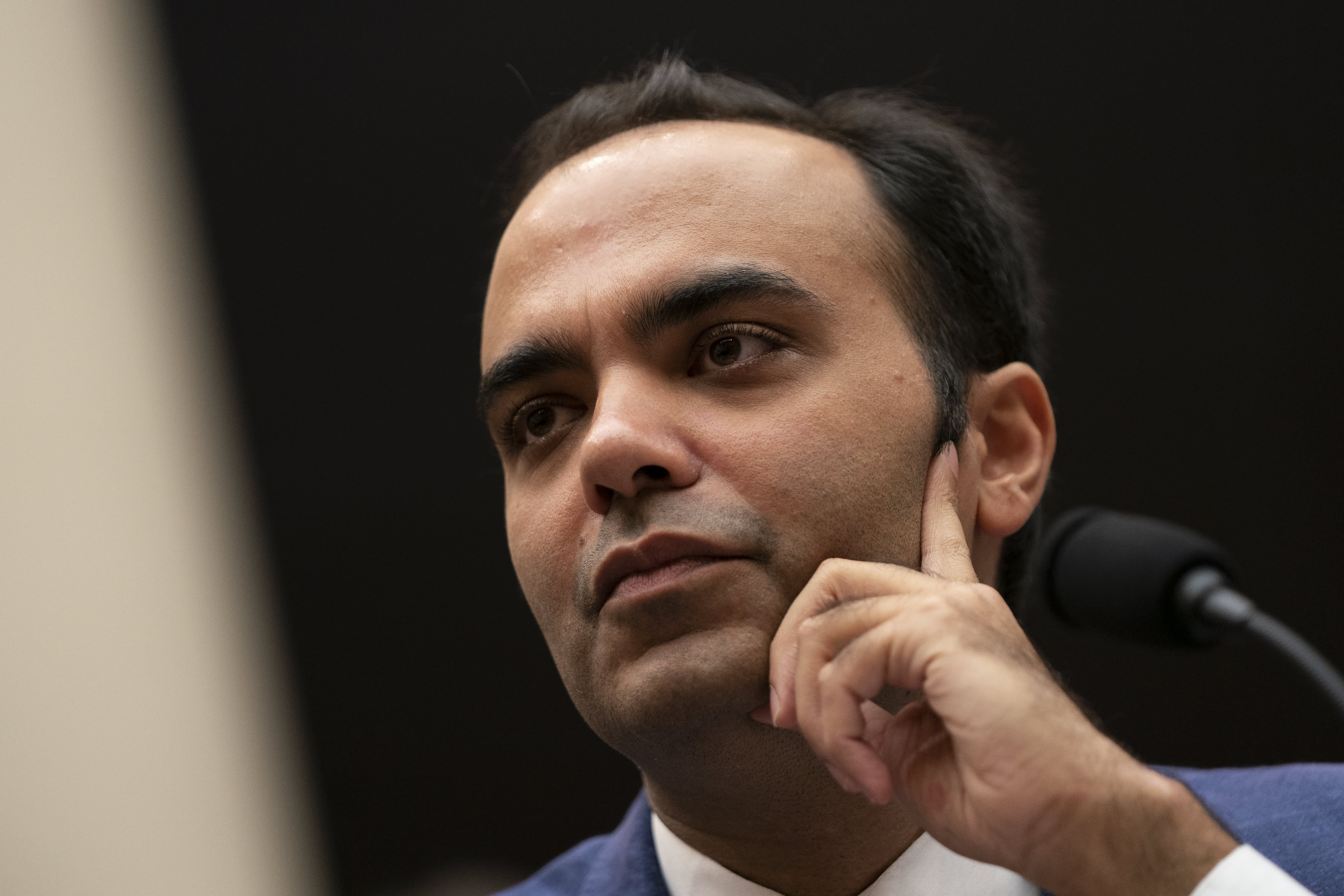
Rohit Chopra, director of the Consumer Financial Protection Bureau.

Alex Edelman/Bloomberg via Getty Images

The Consumer Financial Protection Bureau is cracking down on banks charging fees for customers who overdraw their checking accounts, the bureau announced Wednesday.

The financial watchdog is planning a “range of regulatory interventions” targeting firms that rely heavily on overdraft fees as a revenue source, Rohit Chopra, director of the CFPB, said in a press call.

Overdrafts occur when customers don’t have enough funds in their accounts to cover a transaction. Banks may allow the transaction to proceed, but charge a fee to cover the cost.

Charging for overdrafts and non-sufficient funds is a big money maker for banks, and has continued during the Covid-19 pandemic, Chopra said. Banks earned more than $15 billion from such charges in 2019, a figure that has risen steadily, according to the bureau.

More from Personal Finance:
Must-know changes for the upcoming tax season
More than half of employers to require Covid vaccines as omicron fears grow
Why Social Security retirement claims haven’t surged amid Covid-19

The fees, typically around $34 for each overdraft, largely impact families who can least afford them, Chopra said.

“Banks, especially big banks, continue to rely on overdraft and [non-sufficient funds] fees as a major source of revenue,” Chopra said. “Rather than competing on transparent upfront pricing, large financial institutions are still hooked on exploitative junk fees that can quickly drain a family’s bank account.”

The CFPB, a federal agency created by the Dodd-Frank financial reform law in the aftermath of the Great Recession, will increase its oversight of banks “heavily dependent” on overdraft fees, according to the Wednesday announcement.

Officials didn’t quantify what constitutes heavy reliance on overdraft fees. The agency will tell firms how they measure against peers, Chopra said.

The market won’t solve this on its own.

Rohit Chopra

director of the Consumer Financial Protection Bureau

The agency’s oversight will come via additional supervisory and enforcement scrutiny, according to the bureau.

The agency will take action against large banks with overdraft practices that violate the law, and officials will prioritize examinations of banks heavily reliant on overdrafts, Chopra said.

Officials declined to outline whether it will take additional steps to curb the practice.

Banks continued to charge overdraft fees during the Covid-19 pandemic, and shareholders enjoy a predictable, steady revenue stream from them, Chopra said.

Three banks — JPMorgan Chase, Wells Fargo and Bank of America — accounted for about $5 billion of total overdraft fees collected in 2019, representing 44{21df340e03e388cc75c411746d1a214f72c176b221768b7ada42b4d751988996} of the fees collected by banks with over $1 billion in assets, according to the CFPB.

Of course, not all banks charge customers for overdrafts. For example, Ally Bank, an online bank, got rid of overdraft fees earlier this year. And other firms, including PNC Bank and Bank of America, have made it tougher for customers to overdraw their accounts.

Capital One said Wednesday that it is eliminating all overdraft fees for retail banking customers starting in 2022. It’s the largest U.S. bank yet to end the industry practice. The bank expects to lose $150 million in annual revenue as a result.

Chopra said he’s not expecting other banks to follow in the near term.

“The market won’t solve this on its own,” Chopra said. “We have a clear market failure here,” he added.

A small share of households account for the bulk of overdraft revenue. About 9{21df340e03e388cc75c411746d1a214f72c176b221768b7ada42b4d751988996} of consumer accounts pay 10 or more overdrafts per year, accounting for close to 80{21df340e03e388cc75c411746d1a214f72c176b221768b7ada42b4d751988996} of all overdraft revenue, according to the CFPB.

The bureau will also “harness technology” to make it easier for customers to change banks, a difficult task due to the need to update information like automatic debits with many sources, Chopra said. He advocated for an “open banking infrastructure” in the future to make this easier, but didn’t detail how or when this might come to fruition.

(Correction: The market share of overdraft revenue for three large banks was misstated by the CFPB in an earlier version of this story. The agency has since amended the figures.)

Omicron Unravels Travel Industry’s Plans for a Comeback | Business News

By DAVID KOENIG and YURI KAGEYAMA, Associated Press

Tourism businesses that were just finding their footing after nearly two years of devastation wrought by the COVID-19 pandemic are being rattled again as countries throw up new barriers to travel in an effort to contain the omicron variant.

From shopping districts in Japan and tour guides in the Holy Land to ski resorts in the Alps and airlines the world over, a familiar dread is rising about the renewed restrictions.

Meanwhile, travelers eager to get out there have been thrown back into the old routine of reading up on new requirements and postponing trips.

Abby Moore, a librarian and associate professor at the University of North Carolina, Charlotte, was scheduled to leave for Prague on Wednesday. But the day before her flight, she started having doubts when she saw that Prague had closed its Christmas markets and imposed a city-wide curfew.

Political Cartoons on World Leaders

Political Cartoons

“I wasn’t really concerned about my trip until the Czech Republic started what looked like a mini-lockdown process,” said Moore, who decided to reschedule her travel to March.

Less than a month after significantly easing restrictions for inbound international travel, the U.S. government has banned most foreign nationals who have recently been in any of eight southern African countries. A similar boomerang was seen in Japan and Israel, both of which tightened restrictions shortly after relaxing them.

While it is not clear where the variant emerged, South African scientists identified it last week, and many places have restricted travel from the wider region, including the European Union and Canada.

For all the alarm, little is known about omicron, including whether it is more contagious, causes more serious illness or can evade vaccines.

Still, governments that were slow to react to the first wave of COVID-19 are eager to avoid past mistakes. The World Health Organization says, however, that travel bans are of limited value and will “place a heavy burden on lives and livelihoods.” Other experts say travel restrictions won’t keep variants out but might give countries more time to get people vaccinated.

London-based airline easyJet said Tuesday that renewed travel restrictions already appear to be hurting winter bookings, although CEO Johan Lundgren said the damage is not yet as severe as during previous waves. The CEO of SAS Scandinavian Airlines said winter demand was looking up, but now we “need to figure out what the new variants may mean.”

“In the past year, each new variant has brought a decline in bookings, but then an increase once the surge dissipates,” said Helane Becker, an analyst with financial services firm Cowen. “We expect the same pattern” this time.

Israel’s decision to close the country to foreign visitors is hitting the nation’s tourism industry as it geared up for the Hanukkah and Christmas holidays. The country only opened to tourists in November, after barring most foreign visitors since early last year.

Just over 30,000 tourists entered Israel in the first half of November, compared to 421,000 in November 2019, according to government figures.

Joel Haber, a Jerusalem-based guide, said during a typical Hanukkah holiday his calendar would be chock full of food tours through Jerusalem’s colorful Mahane Yehuda market. Instead, he has just one tour a day.

“Tour operators like me are the first to get hit and the last to emerge and are directly prevented from working by a government decision,” Haber said.

In the West Bank city of Bethlehem, revered by Christians as Jesus’ birthplace, local businesses expected a boost from Christmas tourism. The Bethlehem Hotel, one of the largest in the city, has operated at a fraction of capacity for the past 18 months.

“Everyone who had bookings over the next two weeks has canceled, while others are waiting to see what happens next,” said the hotel’s manager, Michael Mufdi. “I don’t know how much longer we can last, but we are doing our best.”

The pandemic already caused foreign tourism in Japan to shrink from 32 million visitors in 2019 to 4 million last year, a trend that has continued through this year.

As worries surfaced about omicron, Japan on Wednesday tightened its ban on foreign travelers, asking airlines to stop taking new reservations for all flights arriving in the country until the end of December. Prime Minister Fumio Kishida has pushed for avoiding “the worst-case scenario” and reversed a relaxation of travel restrictions that had been in effect just three weeks.

The crowds of Chinese shoppers who used to arrive in Tokyo’s glitzy Ginza district in a stream of buses to snap up luxury items have long disappeared. Restaurants and bars have been forced to restrict hours.

In Asakusa, a quaint part of town filled with souvenir shops, rickshaw drivers, and stalls selling traditional sweets, news of the omicron variant made little difference this week. Vendors say there hasn’t been any business for months except for a few local customers.

Boat charter operator Tokyo Water Taxi started on the city’s waterfront in 2015, when hopes were high for cashing in on the booming tourism trade. With the variant pushing the return of foreign visitors far into the future, the company is trying to look on the bright side.

“It’s growing popular with Tokyo residents, who have lost other ways to entertain themselves,” said company spokeswoman Yuha Inoue.

In Europe, Alpine ski resorts worry about how to keep up with requirements such as ensuring all skiers are vaccinated or recovered from infection and have tested negative for the virus.

Matthias Stauch, head of the German ski lift operators association VDS, said many are small family businesses that lack the staff to perform such checks. Meanwhile, the association is warning about “massive” economic damage to the tourism sector if there is another lockdown.

Travel executives argue that government decisions about restrictions should wait until more is known about omicron, but they admit it’s a difficult call.

“If you wait, by the time you have all the data it’s probably too late to stop community spread because (the virus) is already here,” said Robert Jordan, the incoming CEO at Southwest Airlines. “If you jump ahead, you run the risk of the measures being more impactful than the actual cases.”

About a month ago, Javier Barragan and his husband booked a visit to Paris for later this month. When news of omicron hit, they were concerned but decided to go ahead with the trip.

“The way that it was in the news, there’s a sense of ‘Oh, is this worse? Is this different?’” said Barragan, who lives in New York. France’s health protocols — the couple will have to submit vaccine cards to enter the country — made them feel more comfortable. Also, both got booster shots.

They did, however, buy travel insurance that will cover cancellation for most any reason.

Koenig reported from Dallas and Kageyama from Tokyo. Associated Press writers Mae Anderson and Tali Arbel in New York; Dee-Ann Durbin in Detroit; Tia Goldenberg in Tel Aviv, Israel; Jack Jeffery in Bethlehem, West Bank; Frank Jordans in Berlin; Pan Pylas in London; and Mogomotsi Magome in Johannesburg contributed.

Follow AP’s coverage of the coronavirus pandemic at https://apnews.com/hub/coronavirus-pandemic

Copyright 2021 The Associated Press. All rights reserved. This material may not be published, broadcast, rewritten or redistributed.

Prominent Financial Advisor Henry Bragg Celebrates Launch Of Independent Wealth Management Firm In Houston, Tx | Texas News

HOUSTON, Nov. 29, 2021 /PRNewswire/ — Experienced wealth advisor Henry Bragg, CPA, CFP®, is pleased to announce the first anniversary of Henry Bragg & Co., an independent Registered Investment Advisor (RIA). Serving as the Principal, Bragg celebrates the successful launch of his firm, which offers a full complement of comprehensive portfolio and wealth management services. Foremost among the firm’s responsibilities as an investment advisor is the obligation to act in the best interests of its clients. 

Building on more than 20 years of experience, including five years at professional services firm Ernst & Young, and as partner with two different investment management firms, Bragg leverages his broad experience in investments, tax, and estate planning. Henry Bragg & Co. is centered around personalized services with a hands-on, individual approach for clients. Bragg understands and communicates the “big picture” while relating it to the client’s personal needs, goals, and family values. Bragg utilizes specialized wealth mapping techniques to visually illustrate a client’s overall financial picture. Bragg believes finding perspective in the complexities of each client’s individual circumstances is key.

“While I established my career at larger firms,” Bragg said, “I saw the opportunity for a more individualized approach. The ability to serve our clients based on their specific needs and financial subtleties makes all the difference in their overall success. As a result, tailored plans are core to our work.”

In keeping with the firm’s vision and to serve clients’ needs, Henry Bragg & Co. offers a variety of services including portfolio management, retirement planning, managing trusts and estates, tax and insurance planning, charitable giving, next-generation investment education, wealth transfer design, and succession planning.

“A good wealth advisor can help clients see the forest, the trees, and where the roads need to be built.” said Bragg. “People may not think of engaging a wealth advisor until something new or significant is happening in their lives. However, having an advisor help you plan for the future is important no matter what stage of life you’re in. We all need help at some point. Life doesn’t slow down; it only moves on. Not being prepared can lead to unexpected challenges and missed opportunities.”

With a passion for helping people and building relationships, Bragg strives to be more than a financial advisor. Clients see him as a trusted partner dedicated to helping them bring their finances in good order.

Henry Bragg & Co. is a member of the Wealth Advisor Alliance and is closely supported by Forum Financial Management, recently named a Top 300 financial advisor by the Financial Times. For more information on Henry Bragg & Co. and its wealth management services, please visit www.henrybraggco.com

About Henry Bragg & Co.

Headquartered in Houston, TX, Henry Bragg & Co. is a wealth management firm that specializes in designing tailored investment and planning strategies for its clients. Led by Principal Henry Bragg, CPA, CFP®, the firm prides itself on its detail-oriented approach to the “big picture,” believing perspective is found in the complexities of each client’s unique circumstances. The firm follows an integrated method to portfolio management, financial planning, and risk management, working closely with clients to help them streamline their situation and capitalize on the opportunities of substantial wealth. Passionate about helping people, Henry Bragg strives to be more than a financial advisor. Clients see him as a trusted partner dedicated to helping them bring their finances in good order.

Cision View original content to download multimedia:https://www.prnewswire.com/news-releases/prominent-financial-advisor-henry-bragg-celebrates-launch-of-independent-wealth-management-firm-in-houston-tx-301433429.html

SOURCE Henry Bragg & Co.

Analysts Anticipate Dime Community Bancshares, Inc. (NASDAQ:DCOM) Will Post Quarterly Sales of $101.93 Million

Wall Street brokerages forecast that Dime Community Bancshares, Inc. (NASDAQ:DCOM) will report $101.93 million in sales for the current fiscal quarter, Zacks Investment Research reports. Two analysts have provided estimates for Dime Community Bancshares’ earnings. The highest sales estimate is $103.60 million and the lowest is $100.27 million. Dime Community Bancshares reported sales of $48.44 million in the same quarter last year, which would suggest a positive year over year growth rate of 110.4{21df340e03e388cc75c411746d1a214f72c176b221768b7ada42b4d751988996}. The firm is scheduled to issue its next earnings report on Thursday, January 27th.

On average, analysts expect that Dime Community Bancshares will report full year sales of $399.74 million for the current fiscal year, with estimates ranging from $398.08 million to $401.40 million. For the next financial year, analysts anticipate that the firm will post sales of $415.88 million, with estimates ranging from $405.35 million to $426.40 million. Zacks Investment Research’s sales calculations are a mean average based on a survey of research firms that that provide coverage for Dime Community Bancshares.

Dime Community Bancshares (NASDAQ:DCOM) last released its earnings results on Thursday, October 28th. The savings and loans company reported $0.89 earnings per share for the quarter, topping the Zacks’ consensus estimate of $0.81 by $0.08. Dime Community Bancshares had a net margin of 20.83{21df340e03e388cc75c411746d1a214f72c176b221768b7ada42b4d751988996} and a return on equity of 14.25{21df340e03e388cc75c411746d1a214f72c176b221768b7ada42b4d751988996}. The firm had revenue of $104.56 million during the quarter, compared to analyst estimates of $100.18 million. During the same quarter in the previous year, the business earned $0.77 EPS.

Separately, Zacks Investment Research upgraded shares of Dime Community Bancshares from a “hold” rating to a “buy” rating and set a $42.00 price objective on the stock in a report on Wednesday, November 3rd. Three research analysts have rated the stock with a buy rating and one has given a strong buy rating to the company. Based on data from MarketBeat, the stock currently has a consensus rating of “Buy” and a consensus price target of $41.17.

(Ad)

The U.S. and China are fighting for new sources of lithium – the linchpin of clean energy. Lithium mining operations have been declared a national emergency. Biden has ordered America’s lithium supply chain to be strengthened and investors in lithium exploration companies are rejoicing. We may be entering a decades-long lithium bull run. You don’t want to miss it.

NASDAQ:DCOM opened at $34.30 on Wednesday. The firm’s 50-day moving average is $35.24 and its 200-day moving average is $33.91. Dime Community Bancshares has a 52-week low of $22.23 and a 52-week high of $38.35. The company has a debt-to-equity ratio of 0.18, a quick ratio of 0.92 and a current ratio of 0.92. The company has a market cap of $1.39 billion, a price-to-earnings ratio of 18.34 and a beta of 1.15.

The firm also recently announced a quarterly dividend, which was paid on Monday, October 25th. Investors of record on Monday, October 18th were paid a $0.24 dividend. The ex-dividend date of this dividend was Friday, October 15th. This represents a $0.96 dividend on an annualized basis and a yield of 2.80{21df340e03e388cc75c411746d1a214f72c176b221768b7ada42b4d751988996}. Dime Community Bancshares’s payout ratio is currently 51.34{21df340e03e388cc75c411746d1a214f72c176b221768b7ada42b4d751988996}.

In other Dime Community Bancshares news, Director Basswood Capital Management, L bought 21,648 shares of the stock in a transaction that occurred on Thursday, September 2nd. The shares were acquired at an average price of $33.07 per share, with a total value of $715,899.36. The acquisition was disclosed in a legal filing with the Securities & Exchange Commission, which can be accessed through the SEC website. Insiders own 16.40{21df340e03e388cc75c411746d1a214f72c176b221768b7ada42b4d751988996} of the company’s stock.

A number of institutional investors have recently modified their holdings of DCOM. Advisor Group Holdings Inc. grew its stake in Dime Community Bancshares by 252.2{21df340e03e388cc75c411746d1a214f72c176b221768b7ada42b4d751988996} during the second quarter. Advisor Group Holdings Inc. now owns 877 shares of the savings and loans company’s stock worth $29,000 after buying an additional 628 shares during the last quarter. Eaton Vance Management bought a new stake in Dime Community Bancshares during the first quarter worth about $37,000. Point72 Hong Kong Ltd bought a new stake in Dime Community Bancshares during the third quarter worth about $41,000. Captrust Financial Advisors grew its stake in Dime Community Bancshares by 303.0{21df340e03e388cc75c411746d1a214f72c176b221768b7ada42b4d751988996} during the third quarter. Captrust Financial Advisors now owns 3,619 shares of the savings and loans company’s stock worth $118,000 after buying an additional 2,721 shares during the last quarter. Finally, Carolina Wealth Advisors LLC grew its stake in Dime Community Bancshares by 28.4{21df340e03e388cc75c411746d1a214f72c176b221768b7ada42b4d751988996} during the second quarter. Carolina Wealth Advisors LLC now owns 4,691 shares of the savings and loans company’s stock worth $158,000 after buying an additional 1,037 shares during the last quarter. 72.21{21df340e03e388cc75c411746d1a214f72c176b221768b7ada42b4d751988996} of the stock is currently owned by hedge funds and other institutional investors.

About Dime Community Bancshares

The largest community bank headquartered in Brooklyn, New York, chartered on April 19, 1864. The bank specializes in Commercial Mortgage finance in the NY Metro area and services depositors in 24 full service branches throughout Brooklyn, Queens, Nassau, and the Bronx.

Recommended Story: The mechanics of the bid-ask spread in trading

Get a free copy of the Zacks research report on Dime Community Bancshares (DCOM)

For more information about research offerings from Zacks Investment Research, visit Zacks.com

Earnings History and Estimates for Dime Community Bancshares (NASDAQ:DCOM)

This instant news alert was generated by narrative science technology and financial data from MarketBeat in order to provide readers with the fastest and most accurate reporting. This story was reviewed by MarketBeat’s editorial team prior to publication. Please send any questions or comments about this story to [email protected]

Should you invest $1,000 in Dime Community Bancshares right now?

Before you consider Dime Community Bancshares, you’ll want to hear this.

MarketBeat keeps track of Wall Street’s top-rated and best performing research analysts and the stocks they recommend to their clients on a daily basis. MarketBeat has identified the five stocks that top analysts are quietly whispering to their clients to buy now before the broader market catches on… and Dime Community Bancshares wasn’t on the list.

While Dime Community Bancshares currently has a “Buy” rating among analysts, top-rated analysts believe these five stocks are better buys.

View The 5 Stocks Here